Showing posts with label youth group. Show all posts

3.15.2024

The Disconnect and Ties that Bind Part Two

My maternal grandfather was genealogist. He started while he was still a teacher but his hobby became his passion after retirement. Not only did he track his own heritage as far back as he could go, he also studied the family trees of his kids’ spouses. He was fascinated by the family lineages of everyone he met. Thanks to his efforts, and the stories told by my paternal grandmother, I know as much about my family as possible.

I know my roots. I feel it in the lyrics of My Culture when Maxi Jazz raps, “Like a lifeline, I light lines ‘cause my compassion is deep for the people who fashioned me, my soul to keep and this is who I happen to be. If I don't see that I'm strong, then I won't be. This is what my Daddy told me, I wished he would hold me a little more than he did. But he taught me my culture and how to live positive. I never want to shame the blood in my veins and bring pain to my sweet grandfather's face in his resting place. I made haste to learn and not waste everything my forefathers earned in tears for my culture.”

From a passenger on the Mayflower, to Norwegian immigrants joining early settlers in Minnesota. The German, Irish, and Scottish ancestors. My distant Samoan cousins. Forefathers (and foremothers) who were farmers and pastors, advocates and survivors. Their stories twist my DNA and flow through my blood.

I know who I am. And yet, I don’t.

Comprehension of names, birthdays, occupations don’t tell a complete story. There is a limited amount to be learned from marriage licenses, immigration papers, and death certificates. I strive to leave a legacy worthy of my family but they are not my tribe. When my parents got married in the early 70s, they began a westward migration. I grew up completely disconnected from my heritage. Between my dad being a workaholic and our family living below the poverty line I barely knew my aunts, uncles, and cousins. I rarely saw my grandparents. My familial tribe had communities in Cheyenne and Oklahoma while I was the left coast stranger in the Emerald City suburbs.
image courtesy of the City of Marysville

My being is more defined by coming of age as a Seattleite during the grunge era than by my heritage. There’s a playlist in Spotify serving as the soundtrack to my life which will tell you more about who I am than you could learn from anyone sharing my surname or my mom’s maiden name. Separated from those clans, I had to find my own tribes.

I’ve been pretty open about the state of my childhood. It was not an enjoyable experience. I am still struggling with the trauma of being a bullied kid, of poverty, of undiagnosed mental illness, of religious fundamentalism. Finding my tribe was not an easy task.

On a five hour road trip with my dad last summer, he admitted his greatest fear while I was a kid was that he’d lose me. Which brings me back to the 1 Giant Leap song. In the second verse, Robbie Williams sang, “Hello Dad, remember me? I'm the man you thought I'd never be.” Then continued, “I'm the one who you told look don't touch. I'm the kid who wouldn't amount too much.” My parents didn’t think I’d ever be much of anything because they didn’t know if I’d survive long enough.

My father is a smart man. He could see my symptoms of depression before I recognized them myself. He knew the degree of which I was bullied and abused by my peers and didn’t know how to help. He watched as I slowly faded into the background and was terrified I’d become a suicide statistic.

I was raised in the boys will be boys era. When the kids who got their asses kicked were given the same punishment as the kid who dealt the ass kicking. When autism and neurodivergence were woefully misunderstood and under-diagnosed. When kids with learning disabilities were treated like bad students. When kids were better seen and not heard. When terms like nerd and geek were still vindictive insults. And I suffered all of it. If you ask my wife, I bear the scars and some of the wounds have yet to heal.

The saddest aspect of my lonely story is how the one place that should have been safe for me, the place that should have been most welcoming was just like everywhere else. My church should have loved me the way I was, the way God created me, but they could be just as hostile and ostracizing as the kids at school. Nowhere was safe.

So I found my tribe with the freaks and geeks, the outcasts and underdogs, the athletically un-gifted, the last ones picked, the tortured geniuses, artists and music makers, agents of chaos, the misunderstood wanderers, and anyone who never fit in or felt like they belonged.

A funny thing about life stories: they don’t always follow the hero’s journey. Life isn’t a three act play hitting all of the beats of plot and structure. There are unexpected turns warping our expectations. As the adage says: truth is stranger than fiction.

The church youth group of my youth wasn’t the happy home it should have been, but it was still home. No matter how desperately I tried, it was clear I was never going to be a part of the in crowd. However I was still in the crowd. Years, distance, and education have provided me a new perspective on this weird little tribe of teens inside our religious subculture. I am much more forgiving these days and a lot less desperate to fit in.

Because humans are tribal by nature, we always look to the best and strongest and bravest to lead and protect. In our strange tribe, that bigger stronger leader was never going to be me. It was a sociological impossibility. I was short, uncoordinated, poor, not conventionally attractive, and socially awkward. I was a weird little dork. Through time and space I’ve also come to realize the teasing they foisted on me wasn’t all mean spirited. Obviously some of it was, but some of it was good natured too.

I no longer blame them for their cruelty. It’s hard being a teenager. While I wasn’t like them, according to science we were identical. We were undergoing physical and neurological changes, our brain chemistry and hormone levels were constantly in flux, the rules transitioned from how we were treated as children to the way we would be treated as adults, culture around us was shifting throughout the 90s. We were all trying to find our place while figuring out who we were and how we related to each other all at the same time. It would be unrealistic to expect any of us to navigate such a confusing era with grace and perfect kindness.

Looking at that time of my life in the rear view mirror, once again I feel disconnected. Because I left. I got out. I moved away. All of those kids who were once my church family are practically strangers. They’re now pastors, teachers, missionaries, community leaders, realtors, mechanics, engineers, and doing their own things with their own families.

I don’t miss being the weird kid. I don’t miss the way my peers treated me like I was a second class citizen. I don’t miss being overlooked and maltreated. But I miss them. I miss the community we had. Despite the pain they caused me, I love these people dearly. In the midst of what was a tumultuous time of my life, my happiest memories all involve my youth group tribe. I will forever be bound to them through the shared experiences of our formative years.

Every now and then, I wonder if it would be feasible to get the old gang back together again. For us to collect in one place one last time. Jimmy and Sue. Kari and Dan. Shane. The twins. Megan. Nikolai. Pike. Nettles. Jennifer. Travis. Erin. Marcus. The younger siblings (Chris, Nathan, Adam, and Chad). Perhaps we could gather together a Dennys, order coffee and fries, chat for hours, then leave our tip among the avant-garde displays made from salt, pepper, ketchup, and coffee creamer. Like we used to do.
Sure, such a reunion is logistically impossible. But it could be fun. I am curious what it would be like to see them all again. If for no other reason, I’d want to do it for my culture.

5.16.2023

Be Weird

Do you remember the first time you realized you were weird? I do.

It happened during the 1983/84 school year and I was four years old. My best friend in preschool was a kid named Marcus. While I thought I was friends with all of the kids in our class, Marcus was the only one who really treated me like I was his friend.

Show and tell was always a highlight - being able to see all the cool stuff other students brought. Their swag was always so much cooler than anything I had to share. Marcus proved it one week when he brought in the Millennium Falcon play-set. It was the big one that opened up and had space to stand action figures inside. It was so large he had to carry it with two hands.
photo courtesy Kenner


My mom and aunts took me to the theater for a Return of the Jedi showing the previous summer and I thought it was the best movie ever. I was obsessed with Wookiees, Ewoks, Sarlaccs, and Kowakian monkey-lizards (Salacious B. Crumb was my favorite character).

The most exciting Star Wars toy I owned was a speeder bike that exploded into four pieces when you pushed a button behind the seat. Then my best friend walked into our classroom with the most epic toy my young brain could have imagined. I was legitimately jealous. When it was his turn for show and tell that day, I spoke the word that Keanu popularized a decade and a half later. “Whoa.”

Was it really that awesome though? I thought so. And Marcus was proud of it. Unfortunatly, we were the only two students who had positive feelings about the Millennium Falcon. The other kids in our class were unimpressed. When our teachers asked if anyone had questions for Marcus, I was the only student to raise a hand. No one else cared. I watched Marcus deflate, his pride slowly evaporated.

These days, the same toy now sells for anywhere between $300 and $400. In hindsight, Marcus and I knew something about the magic of a galaxy from a long time ago and far far away. We were ahead of our time. Or rather, we were geeks out of place. Return of the Jedi might have been the most popular movie of 1983, but in our conservative evangelical ran preschool in our corner of suburbia, being a Star Wars fan made you a weirdo.

Marcus’ anticlimactic moment in the show and tell spotlight was the first time I realized I was weird. All our peers disapproved of his special interest except me. If he was weird for what he liked, then I was weird too.

Countless interactions with my church peers throughout my childhood and adolescence reconfirmed my oddities. I was the short kid, uncoordinated, and the last one picked in all of our competitive games. I was the theater geek, the quirky and socially awkward kid, the only one in church who read comic books. I was the lone fan of science fiction, fantasy, and horror. I was never elected into the leadership team even though I was one of the few kids who showed up to every event, entered every talent show, played every puding-through-the-nose game, attended every camp and retreat, and participated in every work and witness trip. By the time I graduated high school my role of the outcast was clear, I would never be a part of that inner circle.

Marcus was still around, as weird as always. But he was at peace with his weirdness. He found a way to lean into it and embrace it. He knew the cool kids in our youth group would never accept him, and he didn’t care. He and I walked away with his preschool show and tell defeat with different lessons. He was determined to never let the opinions of our church peers bother him again, while I desperately and fruitlessly sought their approval. It would take me another two decades to find the happiness in weirdness Marcus developed as a teenager.

Grandpa Budd’s funeral was last week. I watched online as Grandpa’s friends and my family entered with a pizazz rarely observed at such somber events. Many wore red clown noses, track suits were abundant, a few people walked into the sanctuary on stilts, and nearly everyone wore bright colors. After the funeral, they held a party with calisthenics and dancing. In the atmosphere of grief and loss, the room was filled with joy and energy. That’s the way Grandpa desired it. He wanted his family to be as loud and as fun as he was.

This is the side of my family who treated me to my first movie theater experience to see Return of the Jedi. This is the side of the family who taught me to enjoy Batman, Star Wars, Lord of the Rings, and The Matrix - but also "normal" things like travel and volleyball. Grandpa was an athlete and educator with an irrepressible thirst for knowledge and a goofy sense of humor. He gave me my passion for continuous learning and my insatiable wanderlust. He also gifted our whole family the freedom to be weird. Or as my cousin Wendy said, “Thanks Grandpa for being a total weirdo and ensuring that your family followed suit.”
photo courtesy my cousin Wendy


My life has been so much better since I learned the skills my friend Marcus and my Grandpa Budd had already mastered. Weirdness is an asset. My family has always been weird and it took me far too long to appreciate it. I’ve always been weird and I wish I gave myself permission to enjoy it sooner.

Be weird. It’s a beautiful thing to embrace your weirdness. If I have one mission in life, it’s to live out my God-given weirdo personality to help others find joy and peace in their own weirdish ways. To help you live weird.


More to read:

Marcus and Black Hole Sun
Marcus and cold weather
Remebering Grandma Budd

3.30.2023

Good Will Through Older Eyes

In the fall of 1997, 18 year old me had this massive crush on a girl I met through church. She wasn’t one of the popular kids from our youth group, a trait we shared. She could have been if she wanted to but I think she didn’t want to be a part of that inner circle. An outsider by choice. We hung out a lot and she was flirtatious. She was one of the few girls at my church that didn’t treat me like I was a weirdo. Did I need a sign to know if she was into me? Maybe. The sign was lit up in neon lights with all arrows pointed at her. If I had asked her out on a date, she would have said yes.

If.

The question of our romance remains hypothetical. A really big if. Why? Because I never asked her out.

The reasons are many. I was young and stupid. Naive. I might have had the ego and invincible arrogance of any normal newly minted adult, but I also struggled with soul crushing insecurity - a malady that would grow into diagnosed depression and anxiety as I got older. While I was 99% sure she liked me and would be willing to date me, that 1% chance was holding me back.
What if I was wrong? What if she wasn’t flirting? What if that’s just her personality? What if there was no meaning to her giggles and hair twirls while she stared at me? What if there was no emotion to the times she touched my arm or placed her hand on my back? Like a criminal trial, there was reasonable doubt. I couldn’t find her guilty of infatuation so I couldn’t sentence her to my adoration.

Like I said, I was young. And dumb.

My best friend, Jeff and I worked at a record store at the time. When the girl mentioned needing a job, I suggested she come work with us. She applied and with a good recommendation from me, she was hired. I was twitter-pated. Now I could see those eyes gazing into my deepest being six days a week instead on once a week. I could have longer conversations and feel her lingering touch more often than I had ever expected. We worked well together, occasionally took lunch breaks in tandem. I’d drop by when I wasn’t scheduled to see if she was still there; anything for a little extra time in her presence. Yet I still never asked her out. This awkward reciprocal flirting and unrequited romantic tension went on for months.

After work on Friday, December 5th, 1997, Jeff and I opened the store. He and I were the only two people employees for the first few hours of our shift. There weren’t many customers visiting that morning, so we had a lot of time to chat and goof off. When he and I talked our conversations were deeply philosophical, even if immature. Our topics usually fell into one of three topics: God, girls, and geekery. After all, we were straight dudes trying to figure out our places in this world. As for the nerd talk, Jeff was the dude who got me into comic books back in junior high. We bonded in high school drama club. We were both fans of horror and science fiction. After graduation, he and I were practically brothers, going to concerts, movies, and poker night together nearly every weekend.

That Friday, the girls topic narrowed down to one girl. The girl. The one I had been enamored with for most of the previous six months. He wanted to know why I still hadn’t asked her out. Even he could see she wanted me to ask her on a date.

I told him I couldn’t. He said I was an amateur. I told him she was beautiful, smart, fun, and different than any girl I’d ever known. He said he’d ask her out for me if I didn’t do it. I balked. I explained she was too perfect and I didn’t want to ruin what I had. He smacked the back of my head and said “Maybe you’re perfect right now” and suggested it was me I didn’t want to ruin.

How do I remember the exact day and date that conversation transpired? Because it’s the day the movie Good Will Hunting was released. After Jeff and I clocked out from work, we drove to the theater in Lynnwood and watched it. That was common for us, catching the movies we were most excited to see on opening night. We did it with everything from The Matrix to The Big Lebowski to The Mask of Zorro.

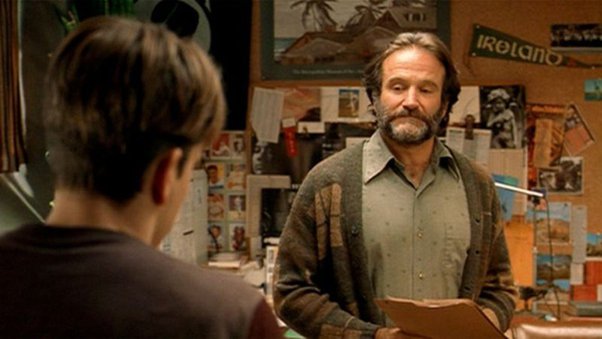
In the movie, Will (Matt Damon) told his therapist Sean (Robin Williams) about a recent date with a girl he liked. Sean asked if they were going on another date and Will said he didn’t know because he hadn’t called her back. Sean called Will an amateur.

Then Will said “Don’t worry about me. I know what I’m doin’. Yeah, but this girl was, like, you know, beautiful. She’s smart. She’s fun. She’s different from most of the girls I’ve been with.” Sean urged him to call the girl. Will continued, “Why? So I can realize she’s not that smart? That she’s fuckin’ boring? You know, I mean, you don’t. This girl’s, like, fuckin’ perfect right now. I don’t wanna ruin that.”

Sean replied, “Maybe you’re perfect right now. Maybe you don’t wanna ruin that. But I think that’s a super philosophy, Will. That way, you can go through your entire life without ever having to really know anybody.”
In the darkeness of the theater, Jeff and I turned our heads to look at each other. His expression matched mine. Jaw slack and wide eyed. Our earlier interaction matched the movie nearly word for word, just with less swearing. It’s as if Matt Damon and Ben Affleck were time travelers and they eavesdropped on our future discussion when writing this scene. We walked out of that theater questioning ourselves. “Did that really happen? Did we recreate the movie before even seeing in it? Was our life imitating art? And how could we recreate art with no prior knowledge of the art we copied?

The movie also made me cry. Seeing Matt Damon break down into tears as he and Robin Williams’ embrace at the end of the film is enough to melt the coldest heart. Good Will Hunting impacted me in other ways. Lines like “How do you like them apples” and “Go with the wrench” and “It’s not your fault” have become permanent parts of my vocabulary. As an autistic person I’ve always used song lyrics, movie dialog, and literary quotes as substitutes for original communication as a way of masking my social awkwardness. It’s called scripting.

It shouldn’t need said, but Good Will Hunting remains one of my favorite movies of all time. I’ve lost count of how many times I’ve watched it.

My oldest son has been struggling lately as he is trying to figure out how to adult. After he got some discouraging news recently, I figured he and I needed a movie night. Something to help him feel better. A reminder that it’s not his fault. Naturally, I chose Good Will Hunting. He’s roughly the same age now as when I first saw the film: halfway between 18th and 19th birthdays. He is, like I was, going through transitions, trying to discover who he is and what he wants from life. Confident yet insecure. Opinionated yet confused.

Thankfully, he really liked the movie. I don’t think my ego would have survived if he said it was dumb. Then we talked for a bit. Thomas already knew about the girl and the saga of me never asking her out. I’ve told him the whole story before because it includes one of the few times I believe I audibly heard God speaking to me. When the movie was over, he asked me if I regretted not asking the girl out, much the same way Will asked Sean if he regretted meeting his wife. I told my son no. I have a lot of regrets, but not asking that girl on a date isn’t one of them. We talked about a couple other things and Thomas let me know he felt better after watching the movie. Mission accomplished.

Aside from getting my son’s impression on one of my cinematic favorites, I also had an unexpected observation about myself.

The first time I watched this movie, I identified so much with Will. Unlike him, I wasn’t abused or shuffled around different foster homes. I had parents who loved me. I was not as violent. I didn’t smoke, didn’t drink alcohol. But I was insecure and angry like Will Hunting. Both Will the character and Nic the kid were well above average intelligence failing to live up to our potentials. I saw him as a more delinquent version of me. Repeat viewings never changed the connection I felt to Matt Damon’s creation. But something different happened last night. For the first time, I related more to Robin Williams character. I felt more like the therapist Sean than the patient Will.
It’s not 1997 anymore. I still need to improve myself. But I’m not the lost, insecure, and directionless kid I once was.

During the same counseling session where Will and Sean talked about Will’s date and the possibility of more, Sean said “You're not perfect. And let me save you the suspense, this girl you met isn't either. The question is, whether or not you're perfect for each other.” I feel this in my soul these days. Annie and I both know we’re not perfect people, but we are perfect for each other.

When Will challenges Sean, the therapist replied, “I teach this shit, I didn't say I knew how to do it.” If there was a line from Good Will Hunting that resembles who I am today, that would be it.

7.21.2022

The Hateful Faith

Growing up as a church kid in the 80s & 90s, I’m aware there are aspects of my youth most would consider abnormal. I’m OK with that. I have come to terms with the weirdness of my evangelical roots. Even though I’ve flown away from the nest, it’s still the beast who raised me.

While rote memorization of scripture is common in many religious communities, mine focused on recalling a select few verses stripped of context and prioritized word for word accuracy over a thorough understanding and the complete text. One of those verses came from the gospel of Matthew: “You will be hated by everyone because of me but the one who stands firm until the end will be saved.”

Unfortunately, like many other things, the focus on this verse was dumbed down and twisted. Many of my youth group peers interpreted it to mean “People hate us because we’re Christians. If people don’t like us, it’s because we’re right!” Rather than using this as a command to relax when mistreated, it became a self fulfilling prophecy. We can see it happening today: Christians who are hostile and rude to nonbelievers then celebrate victory when their vitriol is returned with anger.

“Hah!” They say. “I told you so. See, they hate us because we’re Christians.”

It’s as if those church kids I grew up with wanted their struggle to be against flesh and blood because it’s more tangible than the spiritual forces of evil in heavenly realms described in scripture. I used to hang out with guys who wanted a little more physical combat in their metaphysical spiritual warfare.

By the time I was in high school, I was prepared with years of reminders - they’re going to hate you. I was fully prepared for my non-Christian classmates to treat me like shit because I believed in Jesus.

Then something unexpected happened. The people who supported my faith the most were people that didn’t share my faith. Instead of hating me because I was a Christian, they were accepting of me, as I was, Christianity included.

Against all logic, those who hurt me most were people who supposedly shared my faith. I was never truly welcomed or accepted in my youth group. There, I was a weirdo, the outcast, the last one picked, the often picked on. The churches who taught me we were strangers and aliens in this world made me feel like an alien among them. Those who claimed the banner of Christ acting so unlike Christ.

Being a teenager is confusing for most everyone - my church home made those years even more perplexing for me. I was loved and respected by people who were supposed to hate me, but mistreated by the spiritual family who should have been my safe place.

I still believe following Christ is following an idea that miracles happen. My continuing faith in God is a true miracle as life has given me every reason to run the opposite direction. It’s for this reason I understand how and why anyone else makes that choice.

This has been the heart and soul of my deconstruction. How do I continue to love a God served by the same folks who have wounded me so deeply? How to I practice my faith when those who taught it to me act contrary to the doctrines they gave me? How do I heal from the wounds inflicted by people who should have loved me unconditionally? None of it makes sense yet I’m convinced answers are out there.

Some things never change. 25 years after graduating high school, the harshest and most hateful treatment I receive still comes from Christians. These people tell me to follow Jesus, and when I say I am, they reply “No, not like that.” These people trained me to love my neighbor but constantly remind me which neighbors they don’t love. They instructed me to act humbly while they pursued power. If I say “I love God,” they reply “No you don’t.” I tell them I’m leaving toxic communities and they respond with toxic behavior.

I get it. Deconstruction is the evangelical boogie man du jour. Celebrity pastors (a thing that should not be) rant about it being “sexy” or demonic. Even Christian musicians rant against deconstruction between songs. Speaking of which, when did John Cooper (of Skillet) stop preaching the gospel and become an asshole for Jesus?

These people cause so much pain, division, strife. Yet, if I take my faith seriously, I’m supposed to love them too. I’m obligated to love the friends, coworkers, acquaintances, and former mentors who curse, ridicule, and condemn me. I don’t know of any way to do that except love them from a distance.

My original plan for this blog post was to wrap it up with an observation about the anger and madness demonstrated by Christians in the public square of media and politics. The odium they display doesn’t surprise me because I’ve experienced their ire my entire life. If Jesus told his followers to prove their discipleship through their love for one another, the hateful behavior of mainline evangelicals is anti-Christ. That’s how I thought this post would end. Then something funny happened.

These days, it takes me a couple weeks to compose a blog entry. Writing the first draft, revisions and re-writes, grammatical editing, beta reads and feedback, a final round of corrections and adaptation, finally the selection and formatting of imagery - all before I click the publish button. Somewhere in the middle of this process, I managed to ruffle some feathers on social media because I shared a quote from a Lutheran minister. Predictably, it was my church friends who were most offended. Here’s the quote:

One of the hateful faithful is a former coworker and ex-Mormon. She felt it was her religious duty to rebuke me, condemn me, and eventually unfriend me. The weirdest part of the exchange is how her arguments against me were all built on false assumptions. She kept leveling accusations against me with no basis in anything I said or posted. Those claims she made include the following:
• That I’m violating scripture because I’ve given up meeting with other Christians.
• That I’m ignoring what God is telling me to do.
• That scripture is absolutely worthless to me.
• That I think the church is all bad.
• That scripture has nothing to do with my decisions or ideology.
• That I’m creating God in my own image.
• That I’m looking for the world’s approval.
• That I’m playing the victim.
• That I’m being led by feelings and bad theology.
• That I claim to have access to a higher spiritual plane no one else can reach.
• That my god is myself and my opinions.
• That I’m a part of a cult.


Her crusade against me is as meaningless as it is invalid. But that’s OK, she’s free to believe whatever she wants about me. The timing of her attacks were peculiar though considering I was in the middle of writing a blog about her kind of Christianity. Without realizing the irony of her own behavior, she was proving why I posted what I posted. The Bible told me I would be reviled because I follow Christ and so far, it hasn’t been wrong - even if the hatred is coming from other Christians like my former friend.

What’s the point of all of this? Well, if you tell me you feel like Christians hate you, it’s OK - they hate me too. If you don’t want anything to do with the institutions who claim to be followers of Jesus while acting nothing like Jesus, I get it. Me too. You’re not alone and I believe in a God who loves you even if their followers don’t. And no matter what people think of me or my theology, I will chose to love when everyone else chooses the opposite.

10.10.2021

Deconstructing Love

True love waits. At least, that’s what I was taught when I was growing up. My adolescence began with the birth of grunge and graduated with the publication of I Kissed Dating Goodbye. In the years between 1991 and 1997, purity culture took root in evangelical churches, leaving its well intentioned mark (ahem, scars) on my generation. Looking back, I am fairly confident this is the source my emotional baggage and the reason I am a psychological mess.

My experience isn’t unique. Instagram, Tik Tok, YouTube, and Twitter are littered with the wreckage of grownups like me, who lived through the 90s, and flailed our way through the last 20 years wondering what the hell happened to us. One testimonial after another, first hand accounts, teary-eyed disclosures, secrets people kept buried for decades. Even the author of I Kissed Dating Goodby disavowed his book as garbage, apologized for the harm he caused, and delivered a TED Talk admitting he was wrong.

But why? What was so misguided about the pursuit of purity? How did messages about abstinence and love lead to an abundance of former youth group kids trying to navigate adulthood through sexual dysfunction, broken marriages, depression, anxiety, body dysmorphia, and abysmal self-loathing? I have some thoughts.
Photo courtesy of Gratisography

1. It used confusing terminology. Dating was discouraged as if it was sinful. They taught us dating and breaking up only to date and break up with someone new created an unfaithful pattern we would take into marriage, ultimately leading to an inevitable divorce. Instead, boys were told to court girls. The emphasis in courtship was to prepare you for marriage. Unfortunately, neither term (dating or courting) are in the Bible and such teaching completely ignored biblical wedding traditions. Sexual lessons resembled American Puritan values more than those of the first century church. Besides, there really isn’t any actual difference between the two. You can still break up courtship just like a dating relationship. Dating can prepare you for marriage just like courting. Courting is nothing more than a fancy term for dating. Condemning one in favor of the other is like kicking your own ass.

2. It misunderstood human biology and brain chemistry. As a result, boys were provided excuses and girls got assigned blame. The church took scientific ideas about hormones and attraction, made dozens of assumptions, then spit out restrictive rules with neither scientific or biblical basis. Boys like me were instructed to avoid all temptations, but we were also told we were helpless to resist our urges. Girls were never cautioned against their temptations, rather they were warned to not be a temptation for boys. When boundaries were pushed and broken, the same people who claimed boys will be boys also asked the girls what they were wearing.

3. It demonized everything. The music we listened to, the nooks and magazines we read, the movies and television shows we watched, all of it was painted with a broad brush of being inherently evil. Any mention of sex was taboo, depictions of romance in pop culture, and secular descripdeclarations of love were deemed the devil’s attempt to lead us astray. We were encouraged to boycott everything from Disney to Levi’s for their unholy embrace of love outside of God’s design. This fostered an unhealthy “us vs them” mindset which festered into the isolationist beliefs currently staining our world.

4. It turned modesty and purity into idols. The Bible frequently talks about having a pure heart. The lone biblical reference to dressing modestly was about about wealth - modesty over extravegance. I don’t want to claim that either are bad things. However, these admirable goals become problematic when they become the most important thing. Christians should strive to be Christlike above all other things. What good is remaining sexually pure if you’re dishonest? Does dressing modestly matter if you’re cruel to those who don’t? The book of 1 Peter says “be holy because I am holy.” Not “be pure.” When you preach “don’t have sex” more frequently than “pursue God” purity is an idol. When boys can wear tank tops but girls can’t, modesty is an idol.

5. It failed to teach the true meaning of love. The 13th chapter of Corinthians listed off qualities of love - the things it is and the things it’s not. You know what word isn’t there? Pure. Neither is the word modest. Yet somehow, the pastors and leaders running youth groups when I was a teen seemed to to preach and teach modesty and purity as if they were the essence of love. And waiting? The phrase “true love waits” was inescapable. While the first definition provided in Paul’s letter to the church in Corinth says “love is patient,” true love is more than just waiting. I love French fries but if I wait to long to eat them, they’ll get cold and gross. There is so much variety in both the meaning and application of love glossed over or deemed unimportant. Perhaps it’s the laziness of the conservative evangelical movement or the unfortunate inadequacies of the English language, but the depths and power of love were never discussed with my generation. We never pondered the mystery of how the word we use to explain how we feel about a romantic partner is the same word describing our appetite for pizza. True love doesn’t just wait. It’s committed. It’s a bond of friendship and intimacy. It’s familial and erotic. And it is a long suffering which ensures hardships and continues to love when everything else has given up. These truths were never a part of the Wednesday night youth group discussions at Marysville Nazarene through the 90s. Judging from conversations I have had with friends across the US; from stories told and retold through books, blogs, seminars, and videos by exvangelicals, I know my experience isn’t an anomaly.

Why does any of this matter? How did these teachings of purity culture warp how my generation viewed ourselves and approached relationships? What led these good intentions to cause so much damage? We can follow purity teaching to its furthest logical conclusion and we see this in the behaviors and outlook of my peers who, like me, grew up in 90s era churches.

Using confusing terminology creates confusing boundaries. At many Christian colleges, there was an impression that any boy asking a girl out for a date – even something as innocent as getting a cup of coffee – meant the boy was interested in marrying the girl. It left people clueless about the intentions of anyone thinking they’re cute or even saying “hi.” It made maintaining friendships with members of a different gender difficult, if not impossible. It led to numerous unhappy couples who rushed into marriage without learning the kinds of things you learn while dating.

Giving boys excuses for their behaviors while blaming girls for the same actions creates an environment where rape and sexual assault thrive. It fosters men’s worst proclivities, allowing them to be abusers with a free pass. This is why #yesallwomen, #metoo, and #churchtoo have all been trending topics over the past few years.

Demonizing every product of pop culture teaches kids to be ashamed for liking the things they like. They feel bad for listening to their favorite songs or watching a popular TV show. They hide their interests and nothing good happens in hidden shame. They grow up developing guilty pleasures and destructive addictions. Make the topic of sex taboo and you get people embarrassed to discuss it – even in the confines of an intimate relationship.

The focus on purity and modesty distract from other essential qualities: kindness, humility, fidelity, affability, honesty, and perseverance. Kids were instructed to be sexually pure but they weren’t taught how to be good people. They’re awkward and malicious but at least they’re virgins.

When the only message kids get about sex and love is “true love waits until marriage,” you get young adults in a hurry to get married just to have sex – like it’s the only reason to get married. They’re ignorant of the nuances, commitment, and passion it takes to have a healthy and happy marriage. They’ve been told to wait but not what to do when the waiting is over.

My generation took the tenets of purity culture and thought we had the secret to lasting wedded bliss and yet so many of us still found our marriages ending in divorce. Many of us abandoned the ideas of purity culture, evangelicalism, and even Christianity due to the harm caused by the faulty teachings of our youth. However, what hurt me the most and twisted my psyche in ways I’m still trying to untangle were the incompatible and contradictory elements of what I was taught.

One of the most fundamental beliefs of the Christian faith is God IS love. From the youngest ages, we were taught this through song: “Jesus loves me this I know, for the Bible tells me so.” Over and over, teachers and pastors and church elders reminded us: God loves you unconditionally. According to scripture, there’s nothing we could do that could separate us from God’s love for us. Then as we got older, we began hearing different messages from the church. Leaders started telling us we were unlovable. We were taught that we did not deserve love – especially if we didn't adhere to purity rules. God loves you but you’re worthless. God loves you but you’re undeserving.
Photo courtesy of Gratisography

This is one of the many reasons why I deconstructed. Despite a crippling deprecating image of self, I did everything right. I believed God loved me and I didn’t deserve it. I waited for marriage. I married a Christian woman. I remained faithful. I was active in church. I followed the doctrine of purity culture. And I still got divorced. Doing all of the “correct” things doesn’t guarantee success. Purity doesn’t inoculate you from the pain and suffering of broken relationships. Even the author of I Kissed Dating Goodbye ended his marriage. Purity teachings doesn’t work. Looking at the tattered lives of my generation, it’s safe to say it did more harm than good.

Now I’ve deconstructed what I thought love was. I meditated on 1 Corinthians 13. I studied every mention of love in scripture. I read all of the Bible stories of sex and marriage from Genesis to The Song of Solomon to Revelation. I concluded the evangelical church led me astray.

The Bible teaches all people – men and women were created in the image of God. If (as I was taught) we are unworthy of love, then God would also be unworthy of love as we reflect God’s image. This idea of being unconditionally loved by a worthless lover is illogical; I refuse to believe it. It is also completely unbiblical. The book of 1 John tells us “God is love.” If we bear his image, then humanity was created to love and be loved. We need love and deserve love.

It’s time to reclaim the definition of real love. The type of love that is selfless and kind. The love that is devoted in the midst of hard times.The love that celebrates the successes of others. The love that lifts and elevates their communities. The love that flourishes in equality and justice. Love that always protects, always trusts, always hopes, always perseveres. Love that loves the way God loves us. A love that loves when it waits and loves when it doesn’t wait. A love that deserves love.

The kind of love that craves Chinese food on a stormy night. That too.


ps: I love you

4.22.2021

Through the lense of a former 90s youth group kid.

If you're a long time reader you probably know I grew up in a conservative evangelical church. I was also a teenager in the Seattle suburbs during the grunge era. Those years were the Wild West of youth ministry. Youth pastors today want to be relatable and relevant. Youth leaders back then wanted to know how much crazy shit they could get teens to do before the kids revolted. If youth pastors were mad scientists, we were the guinea pigs.

One of the most predominant highlights of any church youth event during the 90s is what I’ve lovingly (and regrettably) described as pudding through the nose games. They didn’t actually consist of slurping pudding through your nose, but the nasal consumption of a Snack Pack was always a possibility. These games were designed to induce a gag factor, inspire PG-13 levels of comedic violence, or encourage what modern youth leaders call “purple.” No idea what I’m talking about? Allow me to provide some examples.

The Toothpick Lifesaver relay. Teams lined up boy/girl/boy/girl with toothpicks in our mouths. Without using our hands, a package of Lifesavers had to be passed toothpick to toothpick from one end of the line to the other. And we had to start over if the candied fruit flavored ring was dropped. First team to pass along all 14 candies through every member wins.
image courtesy of Sterling College

Or The Chip Race. In this game, a boy and girl held a potato chip between their lips while trying to reach the finish line before the other couples. If the chip broke or was dropped, the pair had to start over.

Or Wink’em Blink’em. Everyone of one gender stood in a circle while kids of the other gender sat in front of them with one empty seat. The person behind the empty chair winked at someone who tried to escape the grasp of the person standing behind them to sit in the empty seat. Originally, the rules stated the fleeing player would be stopped with a tap on the shoulder but my generation never liked rules. When we played this game (it was a favorite at Marysville Naz) we played it like a full contact sport. The standing player could use any means necessary to stop the runner. Nights with Wink’em Blink’em on the itinerary usually ended with pulled hair, scratches down the back, torn t-shirts, and rug burns on the knees and elbows. Ironically, the popular kids were more likely to be tackled or dragged than the uncool kids like me.

Or the Caterpillar Relay. Teams laid face down and shoulder to shoulder on the beach to form a human caterpillar. (Note: I said caterpillar, not centipede. That's something wildly different.) The person at the end of the end of their team's line rolled over all of their teammates to the front of the line where they resumed the face down position as other players rolled over the top of them. New competitors began rolling as soon as they were the last in line. First team to get their whole caterpillar across the finish line won.

Or Eat That Food. This was played like Name That Tune but with food. Teen versus adult volunteer took turns claiming they could eat a food item in a certain number of bites, each challenge lower than the previous. If that number reached a point where one player couldn't eat the food in fewer bites than the other, they dared the other player to "Eat it." If a player scarfed the item within the promised number of bites, they won. They would lose by failing to complete the challenge or throwing up. I saw people eat a whole can of spam in one chipmunk-cheeked bite, pour an entire tin of Altoids into their open maw, chomp a foot long raw carrot with a diameter of their in three bites, cram a king size Snickers in their mouth while drinking a can of Pepsi, and chug a large jar of applesauce in a single gulp. There was always a garbage bin on stage for vomit.

And Shaving Cream Wars. A section of the football field was cordoned off to separate spectators and warriors. Teenaged campers and adult leaders purchased hundreds of cans of shaving cream to battle each other in a one vs all battle royale. Combatants ran around with aerosol cans of shaving cream, filling their hands with foam, and smearing it into the faces and onto the bodies of other willing participants. Extreme players Duct taped their shaving cream cans into their hands with fingers hovering above the spray triggers.
image courtesy of Baltimore Sun

Between the inappropriate entertainment, the purity culture teachings, and attempts to dictate what kinds of movies we could watch or music we could listen to, my generation was subjected to an ongoing clash of contradictions and double standards. It is no surprise why so many of my peers have left the church in the decades since then.

Youth group was weird enough bit summer camps is where it got really awkward. Teen camp had a different theme every year and games were tailored to match the theme. One year our theme was “The Doctor is In.” Bed pans (if you couldn’t already tell where this was going) were used in a majority of the games that year. One of those bedpan games was a root beer relay. Teams lined up 20 yards away from a bedpan filled with root beer. Everyone was given a straw to hold with their mouth. First person in their team’s line ran to the bedpan, laid face down with hands behind their back, and drank through their straw. As soon as they sucked up as much root beer as they could, they ran back to their team and the next person sprinted to lie down and chug through their straw, then repeat until their team drank all of the root beer. First team to finish a half dozen 2 liters won.

If you’re thinking it would have been funnier for the camp organizers to use Mountain Dew, I agree. However, despite the shades of violence and confusing sexual boundaries, there were still lines that Nazarenes were not brave enough to cross.

I thought this game would be easy. I could guzzle a can of Dr Pepper in one shot - proved it a couple times before. Drinking soda should be easier with a straw, right? Wrong, so very wrong.

When my turn came, I ran the 20 yards as fast as my scrawny teenaged legs would carry me. I laid down in the prone position, hands clasped behind my back, dunked my straw into the warm brown liquid, and began to sip. Then I discovered something: I couldn’t drink. I could barely breathe. Gravity pulled my body weight down onto my lungs and I lacked any alternative to support that weight because my hands were clasped behind my back. The position of my hands also stretched out my chest cavity and tightened my pectoral muscles making it difficult to expand my rib cage. My ability to draw a breath was smothered.

Instinctively, my brain knew breathing was more important than drinking soda. My desire to live outweighed my hopes to win a pudding through the nose game. I couldn't drink even if I wanted to. I got up, ran back to my line, and hoped everyone else on my team had better luck than me.

To be clear, while I was scrawny weakling, I was also healthy. I kept fit by spending summers hiking all over the Northern Cascades and walking/biking everywhere during the school year. I didn’t have asthma, didn’t smoke, didn’t suffer any underlying health issues. I was a normal (even if socially awkward) teenager, spry and energetic. Yet despite everything in my respiratory favor, I still struggled to breath when laying prone with my hands behind my back. I can’t imagine doing the same thing with a police officer kneeling on my neck.

I have frequently pondered this story from my youth while watching the Derek Chauvin trial over the last couple weeks. It’s been heavy on my mind. Watching the videos, listening to testimony and cross examination, I keep imagining myself in George Floyd’s place.
image courtesy of Dazed & Confused Magazine

Laying prone with your hands behind your back isn’t like getting a back massage as Chauvin’s lawyer claimed during closing arguments. If it was difficult for me to breathe in that position as a healthy teenager with no weight on my neck, logic leads me to believe it would impossible for George Floyd to do the same under the weight of Derek Chauvin.

That is a conclusion any reasonable person should be able to understand. Thankfully, the jury agreed.

4.10.2018

The Kids Are Alright

On a Tuesday night a few weeks ago, I was sitting in McDonald's with my laptop and my standard order of a McChicken, medium fries, and a cup of water. When I am writing, I am more productive in public spaces than I am at home. Even with the distractions of people coming and going, I get more work done at a fast food joint or coffee shop than in the comfort of my living room. I prefer Jack-in-the-Box or Wendy's, but anywhere with free wi-fi is fair game for me except Starbucks - it's a bit too cliché.

This writing session was flowing as it usually does. I was typing out a film review in between bites of food, rewatching the movie trailer on YouTube, staring into space trying to determine exactly how to phrase a certain conglomeration of words in a way it would be coherent and reasoned. Then some teens began to enter the lobby. Then some more. And then even more. Three waves of youthful energy packed the place, roughly two dozen when all had walked through the doors. They all appeared to know each other, they bounced from one conversation to the next while waiting to place or receive their orders, a nebulous mass of human forms and boisterous voices.

Normally, customer traffic doesn't bother me. I can continue plucking away at my keyboard as if they're just ghosts in the room, present yet unseen. With this group of kids though, it was different. I stopped typing, looked away from my screen, and observed for the duration of their visit. Sure, they splintered off into small huddles like any other group of teenagers would do. However, they never remained in one conversation for long. They bounced around from one cluster to another. All smiling, happy, eager, and connecting with each other. I watched in wonder.

(like this but less creepy)

I remember being their age. between the ages of 17 and 19, the kids I hung out with would invade various food establishments after church on Sunday nights. We'd roll in, dine cheap, stay for an hour, then leave behind a mess. We were obnoxious, sloppy, and enjoying our time together. Twenty years ago, we were the wayward youth grownups blamed for the downfall of America. The kids I recently observed in McDonalds reminded me of my old group of friends. Descending upon a source of inexpensive edible junk, chatting and laughing the whole time, loving every minute, then leaving.

Yet they were different than the crew from my good old days. I was impressed by how they presented themselves. None wore anything flashy or revealing. None dressed grungy or slobby. Not over the top formal wear like they were on their way to a school dance, just smart and semi-professional in appearance. Each spoke with polite language. They were goofy and boisterous, yet they didn’t use any profanity, insults, or dirty jokes. They were all respectful toward each other and the other customers in the dining area. When they left, it was like they were never there. These teens were just like the kids I grew up with, only better. Their visit filled me with a sense of hope.

This transpired in the weeks after the shooting at MSDHS, before the nation-wide school walkouts and March For Our Lives protests. The kids from Parkland were constant faces on news channels, headlines both praised and criticized them. At the time, I wanted to write something about how great it was to see youth engaged in the political process. Whether you agreed with them, whether they’re right or wrong, whether they succeed or fail is irrelevant. We need passionate and energetic fresh faces involved with political discourse because the decisions our government makes today will affect them and their peers more than it will impact me and my generation.

After the shooting, I avoided writing about the topic. I've talked about gun control before and I probably will again but that wasn't the blog post I wanted to write. Instead I wanted to compose something encouraging those students challenging the adult world, political process, and the way we think about American rights. I was dismayed at the alleged grownups in the room who acted with a maturity level more fitting for grade school playgrounds. Yet I couldn't do it. I tried. There are four different drafts I deleted after I couldn't figure out how to say what I wanted to say in the way I wanted to say it.

I know what it was like to be young and ambitious and inspired and facing nothing but a wall of condescending elders. I felt like I had words for these kids that needed to be said. I wanted to let them know that they would be mocked and ridiculed for their actions. I wanted them to know how people will go to absurd lengths to defend their sacred cows, and when it comes to Murica, there's no greater sacred cow than the Second Amendment. I wanted to tell them the same thing I tell my son about bullies, their words and actions speak more about them than you.

Much of what I wanted to write about was obvious, the smear campaigns and ad hominem attacks were prominent in conservative media. I saw the fake news stories and photoshopped memes on Facebook. Everywhere I looked, I saw a grumpy old man complaining these kids were too young to have an opinion. Every news channel had a pundit claiming these kids were paid actors. I didn't need to warn them what was already happening was going to happen.

There's more I wanted to say. I wanted to let them know a day is coming when they'd look back and wish they had done things differently and it's OK to have those kinds of regrets. I wanted them to know they would make mistakes and they shouldn't let those errors derail them. I wanted to warn them of the danger of overnight celebrity. Historically speaking, youth and fame are not a good combination. The rush of everyone paying attention to you can be addictive. The lure of the spotlight is powerful and can be taken away as fast as it was obtained. However, I've never been famous; I don't have any legitimate advice from experience.

I hope they have strong emotional support. I hope they don't take these days for granted. I hope they remain engaged and do great things with their lives, yet I also hope they do the things kids their age typically do: attend sporting events and concerts, compete in talent shows, go to prom, graduate, take summer road trips, go camping, register to vote, enlist in the military, apply for scholarships and enroll in a university or trade school, get a degree, fall in love, fall out of love, start a career.

At the end of my high school days, the private Christian college I wanted to attend required all prospective students to memorize a Bible verse from 1st Timothy: "Don't let anyone look down on you because you are young, but set an example for the believers in speech, in conduct, in love, in faith, and in purity." I wanted to pass on the wisdom in this scripture to these kids leading the Never Again movement. It doesn't matter if they follow Jesus or not, if they're religious, spiritual, or none of the above. There is power in embracing your youth. Any time a young person finds themselves in a leadership role, older generations will attempt to discredit or discourage them. I wanted to tell these kids to not allow their elders to destroy them, to stand strong, to set an example for their elders so loud and noble and pure that it can't be ignored.

That is what I wanted to write, and I just couldn't do it. Then I witnessed local kids in action. I've spent a lot of time with teenagers as a youth leader, yet those interactions were all in controlled and supervised environments of church youth groups and summer camps. My oldest is now a teenager, yet I don’t see him when he's not around adults like me or teachers or youth pastors. My time at McDonald's was like watching kids in the wild, observing them in their natural habitat. No chaperone. No responsible adult monitoring. No grownups telling them what they can or can't do. Only a herd of teenagers free to do whatever they want and act upon their own desires. I couldn't look away and I was in awe. These were not the Tide Pod eating, Logan Paul wannabe, participation trophy receiving idiot youth my conservative friends warned me about.

Whitney Houston once sang, " I believe the children are our future." On a Tuesday night in late February, I was given a glimpse into days yet to come; someday soon they will be our elected leaders and corporate CEOs. Bring it on. Give them a platform and a microphone. Let them lead. Let them protest. Agree with them, disagree with them. Debate them. Educate them and learn from them. If these kids are our future, then the future is very bright.

12.14.2017

To the Evangelicals Who Raised Me

To the various pastors, Sunday School teachers, youth leaders, family friends, and other well meaning adults who helped my parents raise me. Thank you for your efforts. My folks are amazing people and I know they could not have handled me all on their own. Allow me to congratulate you on mission accomplished. You successfully ushered me into adulthood where I became a law-abiding, tax-paying, contributing member of society. I know it was not easy.

image courtesy of Huffington Post

I was a quirky and precocious child. I knew all the Bible stories you would never teach to children. Like how Lot's daughters got him drunk so they could have sex with him. Or how the prophet Elisha summoned bears to maul a group of obnoxious teenagers. Or the time a youth fell from a second story window after dozing off during one of Paul's all-nighter sermons. I was the kid in church asking you why I wasn't allowed to dance when King David once danced naked, and why we weren't allowed to drink alcohol when Jesus and his disciples frequently consumed wine.

Those questions I asked were the first starts at pulling threads to see what would unravel. Those were my attempts to peek behind the curtain and see how the wizard worked.

The older I got, the more I queried. In the environment you maintained, asking questions was a dangerous activity. My inquisitiveness was often discouraged, mocked, or ignored. Yet I kept poking and prodding and trying to figure it out for myself.

What I discovered is that a lot of what you taught me did not make sense. In fact, much of it was unbiblical.

You taught me smoking, drinking alcohol, dancing, using profanity, and watching movies in a movie theater were all sinful activities. You made me think that my soul could be condemned to hell for dropping a single f-bomb, stepping foot inside the local cinema, or holding a single Marlboro between my lips. Your biggest message was how doubt was the gravest of sins, and possibly one which was unforgivable.

You prohibited one non-sinful thing under the assumption it would lead to something biblically sinful. Forget the verses about freedom in Christ or liberty for believers or personal convictions. You created strict (and sometimes absurd) rules not grounded in scripture to prevent what the Bible does describe as wrong. For example, you prohibited any imbibing because the Bible tells us to avoid drunkenness. What we have here is legalism.

When I reached the age where several of my peers were abandoning the Christian faith, I rebelled against legalistic dogma. I still believed. I still attended church. I also questioned everything. In the end, I realized a lot of what you taught me was crap.

Now, as a grown adult with kids of my own, my tenets of faith are much different than what you tried to pass on. My theology is probably a bit more liberal than you would prefer.

I still don’t smoke, for health reasons - not because of religious objections. I rarely drink, although I do love a good mojito. I dance like a fool, but only when no one is watching. It no longer bothers me when I hear other people cussing because I do not believe in a God that is scared by our vulgar language. I go to the theater as often as my budget allows. And I still have a bevy of doubts. There might be a few of you who think I'm hell-bound based on this paragraph alone.

I picked apart the Christian faith to determine how much of what you said when I was a kid held up under the weight of scripture. In the end, I got rid of a lot of baggage. Hopefully what remained were the parts that matter.

That God designed us to have an intimate relationship with the divine.
How God's love for us is the most powerful force imaginable.
That Jesus came as God in the form of a man to disrupt the corrupt patterns of human folly.
How Jesus set an example for how we should live.
That people have no greater way to love than to sacrifice their own lives for others.
That God's plan is to restore this world and fix the broken bits of our lives.

I still believe in sin. I believe that child abuse and sexual assault are sins. I believe intentionally deceiving others is a sin. I believe anything that brings harm to the weak, the poor, the powerless, minorities, children, the elderly, and the disabled is a sin. I believe it is a sin when our words and actions do not demonstrate love for God or love for our neighbors. I believe that racism, misogyny, and other forms of bigotry are sins. I believe these sins separate us from God. I also believe that God is eager to forgive and God’s grace is bigger than any of us can imagine.

Smoking and swearing and movie theaters and slow dancing and wearing jeans to church on Sunday mornings have nothing to do with creation, incarnation, crucifixion, resurrection, or salvation. Following petty rules about what should or should not be done will not change how much God loves us. Arguments over daily sanctification or eternal security are meaningless when we should be caring for orphans, widows, and refugees.

The person I am today is alien to the kid you taught and guided and mentored all those years ago. That kid might even think of me as a heathen. Regardless, I must thank you. You raised me to be a (hopefully) decent human being. I would not be who I am without your influence. For the good and bad and ugly, you were the catalyst for my wandering, rebellion, and renewal.

But there's more.

6.12.2017

Changing Perspectives: Fighting Back

The 80s and 90s were strange times to be raised in the church. Our parents faithfully honored the opulence of PTL with Jim and Tammy Faye but we lived meager lives. We received mixed messages about the virtues of pride and humility. Our youth pastors tried to simultaneously embrace the silliness of the 80s and the angst of the 90s. We weren't allowed to see movies at the theater or attend school dances because those activities could lead to hand-holding, hand-holding led to kissing, kissing would inevitably tumble into sex, and sex before marriage was the ultimate sin. Yet our moms spent their days watching soap operas - shows where everybody was having extra-marital sexual affairs with everyone else.

As a kid, no other conflicting lessons confused me more than the formal and informal teachings on violence. Pastors would preach a sermon on the verse declaring "blessed are the peacemakers" while choirs would sing "Onward Christian Soldiers." We were taught to be pacifists in Sunday school, then went home and watched The A-Team. Our parent's generation celebrated both Martin Luther King Jr's non-violent protests and Braveheart's battle cry "They can take our lives, but they will never take our freedom!" We were given the advice to play nice, and then told to toughen up. War and violence were often praised with equal measure as peace and passivity. After all, Jesus taught us to love our enemies but he also flipped tables. It was difficult to understand Christ as both a lion and a lamb when our cultural icon for a lion was Bruce Willis in Die Hard and our symbol for a lamb was Michael Clarke Duncan in The Green Mile.

Even the games we played as teens frequently took a brutal turn. My youth group's favorite activity was called "Wink-em Blink-em." This game's instructions are more complicated than could be fully explained in a simple blog post. However, it involved players winking at other players of the opposite gender prompting the person winked at to attempt an escape from the person standing behind them. It sounds innocent but my peers took it to extremes. Our rounds of Wink-em Blink-em often ended with bruised limbs, pulled hair, torn shirts, bloody scratches, and broken fingernails. Afterwards, an adult volunteer would lead a devotional reading Bible verses urging us to "make every effort to do what leads to peace and mutual edification."

It was enough to make a kid like me question if it was even possible to be a peacemaker. After all, my generation came of age when one of the biggest songs played on the radio was about a bullied kid named Jeremy who spoke in class with lyrics like "the dead lay in pools of maroon below" and "he hit me with a surprise left, my jaw left hurting dropped wide open." In that pre-Columbine era, bullying was practically accepted. Or at best, it was ignored. This was all before the existence of programs like Dude Be Nice or the It Gets Better campaign. If you were (like I was) beat up or picked on, the recommendations we were given was either “stick up for yourself” or “just stand there and take it.”

The latter instruction was usually the one provided by well-intentioned youth pastors. They relied on the sermon on the mount, guided us with the words of Jesus. Blessed are the meek, the poor in spirit, and the persecuted. Rejoice and be glad when people insult and hurt you or lie about you. Don't get angry because anger is sinful. Befriend your enemies and pray for them. Don't resist an evil person. Turn the other cheek. Give up your clothes. Walk an extra mile. Give the bullies your lunch money.

I was a nerd growing up in an age where the geeks and nerds routinely got our asses kicked for being freaks. After getting teased and physically accosted at school, someone would tell me what the bible says. If someone hits you, let them hit you again. If they take part of your outfit, let them take it all. If someone forces you to do something, do it twice.

Derived from the fifth chapter of Matthew, verses 38-42 were the highlights of this passive advice. Even the NCV translation of the Bible titles this section "Don't Fight Back." I shouldn't need to say this but the "biblical" instruction I was given did more harm than good. I was led to believe that our purpose was to suffer. Whether intentional or not, the lesson I learned was that we were to be punching bags for the abusers, bullies, assholes, and jerks of this world.

Too often, we read scripture from a Western viewpoint. We filter the Word of God with modern bias. Yet, in doing so, we miss a very important detail about the Gospels: Jesus was a Jew. More than that, He was a Jew, living in ancient Palestine under Roman occupation. His people were an oppressed population ruled by foreign tyrants.

When we study passages like these verses from Matthew, we need to understand the meaning is far deeper, more audacious, and of greater power than we could ever perceive through the context of 21st Century Americana. When we begin to understand the culture and traditions of Jewish life combined with laws and expectations of the Roman Empire, we get a better perspective on what Jesus really intended. We can hear his words with the outlook of his original audience. His talk discouraging taking an eye for an eye was about human dignity as much as it was about de-escalating conflict. When interpreted with American ideals of vocabulary and syntax, what sounds like quiet resignation is actually a call of rebellion; it is a peaceful way of fighting back against the powers that be.

Over the past couple years, I have been learning more and more about what life was like when Jesus walked the earth. I'm unlearning unhealthy lessons from my youth and my perspectives are changing. What I am discovering in this process is that the Bible truly is living and active. I am finding out how the words of Jesus are bigger, better, and perhaps more wild and dangerous than I have ever known before.

1.04.2017

Glass Cutters

Marcus was my first artistic friend. Granted, it is hard to brag on the artwork of four year olds but I remember his skill exceeding the rest of those in our age group. We were in the same preschool class which was inevitable since his parents and my parents attended the same church.

He was always doodling pictures of monsters and he had imaginative stories to accompany each piece. His parents would frequently invite me over to their house for lunch after church and the earliest memories I have with him were in his yard re-enacting epic sagas of his invention.

He was also a big Star Wars fan. One day, for show-and-tell, he brought in a Millennium Falcon playset. It was one of those huge plastic beasts large enough to fit action figures inside of it, with removable panels to see the cockpit and other sections of the interior. Back in 1983, it was the holy grail of Star Wars toys and cost more than my parents would have ever spent on a gift for me. I had a Han Solo action figure. And Chewbacca. But Marcus had their ship, their home, the place where they belonged.

From that moment on, I thought Marcus was the coolest kid my age. In 1987, he was the first in my circle of friends to see The Monster Squad and Spaceballs. Afterwards, he told me about all of the most salacious parts of each movie and the phrase "Wolfman's got nards" quickly became an inside joke.

Unfortunately, geography drew us apart. He and I were districted for different elementary schools, so once preschool was over we would only see each other at church. We both developed friendships with classmates that we interacted with more frequently. A few years later, we attended the same middle school, but by then we rarely interacted.

Over the years of our childhood, his personality changed. Once the most comical and outgoing of my peers, Marcus grew to be more introverted and soft-spoken. By the time we were teenagers, he didn't speak much. At a rewards ceremony for our wrestling team when we were in ninth grade, Coach Iverson praised his skill on the mat and gave the most accurate description of Marcus's personality that I've ever heard. Coach said, "When Marcus joined the team, I didn't know much about him. But after working with him every day for the past few months, I still don't know much about him."

Even in youth group, Marcus maintained his brevity. He and I didn't hang out much but he was always someone I respected because of our shared status as youth group misfits. Like me, he wasn't one of the popular kids. Due to his quiet and unassuming persona, he was often overlooked or ignored. He did not go to any of the youth camps or retreats but he would show up for other events like attending Mariners games or parties held at the church.

At one of our white elephant Christmas exchanges, he brought a big heavy box that everyone assumed would be the best gift. Instead, it contained a large rock (miniature boulder) that he dug up out of his yard. Even in silence, he was a practical joker.

Once a year our youth group held an all-nighter. My favorite memory with Marcus happened at one of these all night parties.

On a Friday night, all of the teens gathered around dinner time at the church where we played group games that only 90's era church kids would understand and snacked on the type of foods potheads buy when they get the munchies. One of the leaders led a quick devotional then we piled into church vans to travel to our first destination: the Family Fun Center in Edmonds. We spent the evening with mini-golf, batting cages, and arcade games until closing time. We returned to the vans and headed off to the next location.

Around midnight, we arrived at a gym facility rented out from a local campground. Inside was a basketball court, volleyball court, a couple ping-pong tables, an air hockey table, a foosball table, a collection of Nerf footballs, and several of those rubber balls once used for dodgeball. We were trapped there until 5am and no one was allowed outside.

I don't know which of our youth leaders thought it would be a good idea to herd a bunch of sleep deprived teens into a gym in the middle of the night and expect them to be sporty for five hours, and I don't know if they would do the same thing today. What I do know is when we left the gym, most of us were exhausted and would have preferred bed instead of breakfast.

Sleep would have to wait because our leaders took us all out for breakfast. During the 20 minute ride in the church vans while we drove from the middle of nowhere to the Denny's in Everett, half of us dozed off and the rest were were silently staring out the windows like zombies.

We typically held these all-nighters in late January or early February. That meant the mornings were cold and frosty as we climbed out of the van and stumbled into Denny's. The coldest of our all night excursions happened during my junior year of high school and it was on this trip where Marcus uttered one of the funniest statements I have ever heard.

The van he and I rode got to Denny's first; our leader made us get out of the vehicle and wait in the parking lot for the other van to arrive. We stood there, shivering, complaining of the low temperatures, and observing our breath form clouds as it escaped our lips.

Then Marcus spoke: "My nipples could cut glass."

All conversation ceased. Everyone turned and stared at Marcus. For some of the kids in our youth group, they had never heard Marcus say more than one or two words at a time, let alone a complete sentence. Furthermore, our church was extremely conservative. Mention of certain body parts was taboo and the nipple was one of those parts of which we shouldn't speak. To describe nipples as being as hard as a diamond or tungsten steel was definitely verboten. His comment broke the ice - literally and figuratively. Suddenly, no one cared about the cold. We were laughing by the absurdity and audacity of what Marcus had to say.

When we were four, Marcus gained my admiration for his Star Wars fandom. When we were sixteen, he cemented my admiration for saying things no one else was brave enough to say.

Why do I share this story now? Because it is that time of year. The nights are long and the air is frigid. For those of us in North Idaho, this is the season where single digit and negative temperatures are normal. Through the years, that one out-of-nowhere comment has stuck with me. And last night, in my apartment, it was the only way I could think to describe how cold I felt. My nipples could cut glass.


It is not a phrase of my design. I am neither funny or creative enough to create such a remark on my own. I can only thank my childhood friend Marcus for his inventive eloquence.

12.03.2013

Youth group alum? No, try survivor.

Yesterday, Rachel Held Evans launched a barrage of the funniest tweets I've read in a long time. She asked her followers to remember potentially dangerous youth group games we played when we were actually in a youth group. Then she proceeded to retweet every reply so that we could all see the hilarious atrocities endured in years long gone. I can't imagine how much fun she had reading through all of those responses.

Looking back, it's amazing that I survived youth group. And I'm not talking about safely navigating the popularity games because we all know I lost there. Nor am I talking about the trip Shane and I took to Nampa during our sophomore year where we (bored and unsupervised) snorted some Altoids and engaged in a two man game of tag. In the dark. Long story.

The grace that allowed me to fondly contribute to Rachel's invitation to reminisce is the miracle that I survived the officially sponsored activities horrors.

I am convinced that the 90s were a special time in youth groups. A time where the risk of life and limb were permissible as long as alcohol and foul language was not involved. A time when youth leaders were convinced that making kids fear for their actual safety was some sort of spiritual lesson we all needed to learn. A time when relay races were scientifically designed to risk either injury or humiliation. Those with no shame and no timidity prospered. I am also convinced that no youth group existing today would be able to do half of the stuff we did without a lawsuit.

There was the camp crowd favorite: Eat That Food. This was a game similar to Name That Tune, but instead of identifying songs, contestants had to eat a food. In as few bites as possible. Through my tenure as a teenager, I witnessed the following feats of Eat That Food: a grown man shoving an entire can of Spam into his mouth, a girl chug a 48 ounce jar of applesauce, and a camp counselor dump a full tin of Altoids in his mouth. Witnessing this game played many times over the course of six years, I saw things I never wish to see again.

There was the Caterpillar Relay. This was a race where teams laid face down and shoulder to shoulder along the beach. The last person in line rolled on top of his or her team mates to the front of the line. This created a new person at the end of the line who also had to roll over and over their teammates to reach the line's beginning. Thus creating a "human caterpillar." The first team to get their caterpillar across the finish line won.

When we went snow tubing, some were too lazy to walk all the way back up the hill so they would try to jump onto other tubes sledding down the hill. It was at one winter retreat that I got buried under four other riders; our overloaded and top heavy inner tube hit a jump and went flying without the tube. When we came down it felt like everyone landed on my head and the side of my face was ground into the ice and slush. I had to go back to the cabins with an eye-patch and a concussion.

Games of tag. Blindfolded. In the woods.

Games of hide and seek that had us kids traipsing through poison oak, poison ivy, and occasional bee hives.

Games of Sardines (like hide and seek, but only one person hides and everyone that finds that person hides with them). At night. No lights allowed.

Blind-man's volleyball. The volleyball net was covered with a tarp so that you were unable to see what the other team was doing. Then the ball was usually replaced with something hard and heavy. Or a water balloon.

Four-way tug of war.

Slip'n'slides that were carved into the slope of a steep hill.

Touch football matches that often turned into tackle football.

Full contact Ultimate Frisbee.

Camps were always the Super Bowl of dangerous and/or embarrassing entertainment. Every year had a different theme and those in charge of group recreation worked hard to have games that fit the theme. That meant many of the games during the year of "The Doctor Is In" involved bedpans. Two memorable relay races sent participants from one end of the field to a bed pan waiting at the opposite end. In one race the bedpans were filled with warm rootbeer and we were expected to drink as much as we could through a straw while laying on our stomachs, without using our hands. In the other race the bedpans were filled with baking flour and a package of M&Ms hidden in the powdery white mess; first team to find 20 M&Ms (again, without the use of hands and laying on our stomachs) were the winners.

Every year, the pinnacle of camp fun was the annual shaving cream fight. During the week, campers and counselors could purchase cans of shaving cream to save for the final night of camp. On that last night, a section of grass about the size of a tennis court (singles not doubles) was roped off with water filled garbage cans at each corner. All those who wished to participate would climb inside the cordoned area and wait for the whistle to blow. After the shrill cry of the referee's whistle, that small patch of grass turned into a battlefield. The ensuing pandemonium resembled what would happen if the food fight scene from Hook was set in Mad Max's Thunderdome. The war raged until the last man standing or until everyone ran out of shaving cream. The grass and surrounding field was stained a foamy white. Muscles and egos were bruised. And participants still smelled like shaving cream the next morning.

But at my church, when it was just us - the kids in our youth group - our favorite game was Wink 'em Blink 'em. This was an incredibly violent and flirtatious mash up of the Hunger Games and Blind Date. The girls would sit in a circle with one empty seat and a guy would be standing behind each chair including the empty chair (or the guys would sit with the girls behind them). The guys (or gals) would be staring at the top of the head of the person seated in front of them... all except the guy with the empty chair. He would be looking at all the girls and eventually, he'd wink at one of them.* The girl he winked at would try to escape her location, move across the circle, and sit in the empty chair. The guy standing behind her would attempt to catch her before she got away. Or roles reversed with a girl winking at a guy and that guy trying to flee the girl behind him. During my first years in the youth group, a simple tap on the shoulder was enough to keep the sitter in the seat. But as I got older, we got progressively more aggressive. Soon, the person that was winked at was permitted to continue away the single handed tap of the peer behind them. Both hands had to touch the shoulders. But then a two handed tap (one hand on each shoulder) was not enough; the person trying to prevent the escape had to hold the runner in place. Then we allowed those that were winked at to do all they could to elude the grasp of the person behind them.

By the time I was a high school senior, our rounds of Wink 'em Blink 'em produced more rug burns and bruises than I can possibly count. I can recall a few torn shirts. Jimmy got a set of fingernails scratched down his back that tore through both cloth and skin. Hair was pulled. Eyes were blackened. And there was at least one bloody nose.

I can't believe our youth leaders remained trouble free with our parents for such games. I hope my kids never have such insanity inflicted upon them. However, I wouldn't trade those days for anything.

We were young. We were wild. We were free. And we were unashamed. Sometimes, it would be nice to feel like that again.


* Now that it's in print - Wink 'em Blink 'em sounds way creepier than I remember.