Showing posts with label cartoons. Show all posts

3.08.2024

Fantastic Four: A Timeline

November 1961: The Fantastic Four debuted with issue #1 for Marvel Comics. This is the first team of heroes created by the collaboration between Jack Kirby and Stan Lee. Due to their popularity among readers and their status of being an actual family in fictional continuity, the Four quickly became known as the first family of Marvel.
Image courtesy Marvel Comics

While superhero teams were not a new concept in the world of comic books, Fantastic Four were unique because they were a family. The first issues introduced Reed Richards (Mr Fantastic) as a man with an elastic body and his girlfriend Sue Storm (Invisible Woman) who could become invisible and project an invisible force field around her. The two would later get married. Also on the team was Johnny Storm (Human Torch), Sue’s brother who could fly and light himself on fire. The last member was Ben Grimm (Thing) who was Reed’s college room mate and possessed a body made or rock. Like all families, this one bickered a lot adding their family drama into the tension of fighting supervillains and anti-heroes like Namor, Dr Doom, Annihilation, and the Silver Surfer.

July 1963: with issue #16, Marvel dropped the The. The Fantastic Four officially became Fantastic Four.

1975: Fantastic Four is released as a radio show starring Bill Murray as Human Torch. It doesn’t last long.

1977: Bill Murray joined the cast of Saturday Night Live, completely redeeming his role as Human Torch.

September 1967: Hannah-Barbera produces a cartoon Fantastic Four series. It lasts for a rear. The cartoon is revived in 1978 with a different producer. The revival does not include Human Torch, instead they have a robot servant named H.E.R.B.I.E who is incorporated into the comics.
Image courtesy Hannah-Barbera

1979: another cartoon broadcasts titled Fred and Barney Meet the Thing. Thing is the only F4 character featured in the series and gave us the catch phrase “Thing-rings, do your thing!” We’ll pretend this doesn’t exist.
Image courtesy Hannah-Barbera

1985: Questprobe 3 was released as an 8 bit game on the Atari. It only featured Human Torch and Thing.
Image courtesy of Adventure International

1986: Constantin Film purchases film rights to Fantastic Four. Those rights were set to expire 12/31/92 if a movie isn’t produced.

1992: Constantin Film teams up with Roger Corman (known for creating countless B-movies) to produce the first Fantastic Four movie on a $1 million budget. Constantin Film had to make this movie to prevent film rights from being reverted back to Marvel. It was set to be in theaters Labor Day weekend of 1993 but that never happened because it was so terrible. It was never officially released but can be pirated online.
Image courtesy of New Concorde

October 1997: Fantastic Four was released as a beat ‘em up style video game on the original PlayStation.
Image courtesy Acclaim Entertainment

2004: 20th Century Fox acquired the film rights to Fantastic Four.

July 2005: 20th Century Fox releases Fantastic Four starring Ioan Gruffudd as Mr Fantastic, Jessica Alba as Invisible Woman, Chris Evans as Human Torch, and Michael Chiklis as Thing. It got mixed reviews. I thought it was just OK. Not bad but not good either.
Image courtesy 20th Century Fox

September 2006: debut of the cartoon series Fantastic Four: World's Greatest Heroes.
Image courtesy Taffy Entertainment

October 2006: The Fantastic Four we’re playable characters in the game Ultimate Alliance. A month later it was released on the PlayStation2, then on the Wii another month later. They appeared in the sequel but not playable, and they were playable again as DLC in the third game of the series.
Image courtesy Activision

June 2007: Fox premiers the movie sequel. Fantastic Four: Rise of the Silver Surfer debuts to more mixed reviews. While I don’t think it was a great movie, I enjoyed it more than its predecessor. There were plans for a third movie that never materialized.
Image courtesy 20th Century Fox

September 2009: Debut of the cartoon Super Hero Squad. This show features a wide variety of marvel characters and frequently includes members of Fantastic Four. My older three kids were obsessed with this show when it came out.
Image courtesy Marvel Animation

2011: Chris Evans is cast as Captain America in the MCU, completely redeeming his role as Human Torch.

August 20015: Fox released the Josh Trank Fant4stic starring stars Miles Teller as Mr Fantastic, Kate Mara as Invisible Woman, Michael B. Jordan as Human Torch, Jamie Bell as Thing. This movie was created for the same reason as the unreleased Fantastic Four movie - to prevent the film rights from expiring and reverting back to Marvel. And just like the 90s F4 movie, it sucked. It was trashed by critics, ignored by fans, and won two golden raspberry awards (worst director and worst picture).
Image courtesy 20th Century Fox

2018: Michael B. Jordan was cast as Killmanger in Black Panther, completely redeeming his role as Human Torch.

March 2019: Disney bought 21st Century Fox, returning Fantastic Film rights to Marvel Studios.

July 2019: Kevin Feige appeared at San Diego Comic-Con to announce the slate of upcoming MCU projects in production, which included Fantastic Four.
Image courtesy Marvel Studios

May 2022: Mr Fantastic has a brief appearance in Doctor Strange in the Multiverse of Madness as a member of The Illuminati. He’s portrayed by fan casting favorite John Krasinski.
Image courtesy Marvel Studios

September 2022: At the D23 Expo, Kevin Feige announced a director (Matt Shakman) and a release date (11/8/24). The release has since been pushed back to 7/25/25.

November 2023: It is heavily rumored then confirmed Pedro Pascal was cast to play Mr Fantastic in the MCU. This is a disappointment to many (including me) who wanted to see John Krasinski continue this character. Since Pascal perfected his geek chops as a loner escorting a special child to safety in The Mandalorian and as a loner escorting a special child to safety in The Last Of Us, jokes started circulating social media asking which special child he would escort to safety in Fantastic Four.

February 2024: For Valentine’s Day, Marvel Studios released a teaser image for Fantastic Four confirming the cast. Pedro Pascal as Mr Fantastic, Vanessa Kirby as Invisible Woman, Joseph Quinn as Human Torch, and Ebon Moss-Bachrach as Thing. Easter eggs in the announcement confirm rumors that the movie would be set in the sixties.
Image courtesy Marvel Studios

4.10.2021

Coffee & Road Trips

Dad’s stories used to be one of my kids favorite things but they make the request less frequently these days. Listening to me reminisce about my wonder years isn’t as interesting to teenagers. I’ve also reached the age or reruns. “I’ve heard this one before, Dad.” Still, when they request me to entertain them with tales of my youth, I oblige. I won’t be able to do this for much longer.

Last weekend, they wanted crazy driving stories. Most of tales I have to tell about diving wild involve my brother, Aaron. I told them about the time he picked me up from school and we scared a student driver by head banging to some metal music turned up to full volume while heading down the long driveway from the MPHS campus. Story time ended with an anecdote from a road trip we took to Cheyenne in the summer of 96.

It was an ill fated trip. The original plan was a non-stop drive straight through from Seattle to Cheyenne, but it was nearly midnight when we reached Billings and Aaron was too tired to continue. He got us a hotel room and we slept hard. In the morning, we discovered I had accidentally locked his keys in the car and we had to wait for a police officer to pick the lock for us. On the way back home, we spent the night with one of our dad’s college friends in Meridian. After they woke us up for breakfast, news broke about the bombing at the Atlanta Olympics. Then Aaron’s car broke down on the freeway after we passed Caldwell. He took the next exit and his Ford Lemon sputtered to a stop on front of a gas pump in Sand Hollow. There was a mechanic there who took a look at the car. He didn’t have the parts to fix it and it would take a week to get it if he placed an order. Instead, he duct taped some hoses together so it would hold long enough to get to a fancier mechanic in Ontario. After the car was fully repaired, we got lost trying to get out of Ontario. Attempting to make up time, Aaron got caught speeding by a flying radar trap somewhere north of Umatilla. The ticket was for driving 15 mph over the limit.

I didn’t tell the kids about any of that though. Instead I focused on our arrival in Cheyenne.

Aaron and I agreed it would be funny if we were blasting west coast rap while driving through the city of cowboys. I selected our entrance music as we rolled into town: Gospel Gangstaz. Windows down, volume up. The bass bumped and thumped the whole way to Grandma and Grandpa’s house.

There was one necessity visibly absent during our hip-hop ride: coffee shops. Growing up in the Seattle suburbs, America’s coffee Mecca, we were accustomed to seeing drive-thru coffee stands in parking lots at every major intersection. It felt weird driving through Wyoming’s biggest city and not seeing a coffee shop. Or any big city without seeing a single latte stand.

Granted, this was 1996. The concept of espressos were still an American novelty abundant on the urban coasts but foreign in the heartlands. Small town USA had yet to discover the joys of breves and americanos. In mid-90s Cheyenne, if you wanted coffee, you brewed it at home with the ground Folgers you purchased at the grocery store, or you bought a cup with unlimited refills at 24 hour diners like Sheri’s.

Still, Aaron was a coffee addict and I was coffee curious. We wanted to get some real good caffeinated brew, The first question we asked when we arrived at The Budd house: where can we find a coffee stand? Of the many aunts and uncles gathered, only one knew where we could seek our treasure. There was only one drive-thru shop and it was located on the other side of town. Aaron got the directions and we jumped back into his car for the cross town drive in hopes to find the glorious java.

It was there. As promised. No other vehicles were in line when we arrived so we drove up to the window without a wait. My order was simple, a single shot mint latte. Aaron placed an order for his usual: a quad shot mocha mint. Unfortunately, what was a normal drink in the Seattle suburbs was unusual in Cheyenne. How unusual? Well, they had never heard of it.

“What’s that?” The barista asked.

Aaron asked if she knew how to make a mocha. She did. Then if she knew what a double shot was. She did. By this time, he had the attention of both baristas.

“Well,” he said, “if it takes two shots to make a double shot, then it would take four shots to make a quad shot.”

“Four shots?” said one barista. “Can you do that?” asked the other.

Aaron nodded and instructed the ladies at Cheyenne’s only drive through coffee shop how to assemble his quad shot mocha mint.

Today, there are at least seven Starbucks in Cheyenne (more if you include those located inside of grocery stores) and a couple dozen other cafes, drive-thru stands, and boutique shops offering a variety of fancy espressos. If you’re ever in Chy-Town, I’d recommend stopping by Rail Yard Coffee Haus.

It’s a new age where coffee is holy water and every caffeine craving American has their favorite spot to get their fix. 25 years ago was a different time, we were not quite so obsessed. The plentiful options available now were once nonexistent.

I’ve told this story dozens of times. My Seattle friends don’t believe it ever happened because coffee shops have been a fixture of our culture since the grunge era. Younger kids don’t believe me because they can’t remember anything before the ubiquitous latte stand. As I relayed this tale one more time with my kids, I had a revelation.

The first quad shot mocha ever made in the city of Cheyenne was made for my brother. This as an indisputable fact.

The baristas working at the coffee stand we visited had never made a quad shot before. They didn’t even know it was possible which means such a strong coffee had never been brewed in their shop. Since that lone latte stand was the only coffee shop in Cheyenne, there was nowhere anyone else could have previously ordered such a monstrosity. Therefore, it is only logical to deduct my brother’s order was the first time a quad shot had been made in the entire city of Cheyenne.

In previous iterations of this story, I never considered the monumental implications of what my brother accomplished the sunny July day in the summer of 96. To be the first patron to order a quad shot mocha in the entire city makes him a legend.

There should be an award for such feats.

Four years after our trip, Aaron and his wife became residents of Cheyenne. They’ve made the city their home. And it’s become easier for Aaron to find espressos with more than two shots.

12.11.2014

S is for Stories and Superheroes

I love a good story. Actually, I crave them. A well told story is a narcotic; it makes me feel powerful and vital – like I could conquer the world. But deeper than that, I believe that humanity’s existence is dependent on our ability to tell our stories and pass on the stories of those who came before us.

A few years ago, I stumbled upon a quote on the Kennedy Center website that has stuck with me. It delighted me so much that I have it posted on the wall of my office: “Telling stories is an essential part of being human. People everywhere, throughout history, have told and still tell stories. Whether it's to remember history, to communicate feelings, or honor an individual, telling stories helps us understand the world in which we live.

Boom.

Drops mic. Walks away.

In those three sentences is a truth that you will find repeated in resources for teaching literacy to young learners and encouraging youth to appreciate literature. You will see it in academic papers and writers' workshops. Over and over again – storytelling is an essential part of being human. In our modern era, we have a multitude of mediums available to seek out the stories of others and to tell our own. We have oral traditions and books like past generations, but we also have newer outlets like television, movies, comic books, video games, blogs, podcasts, and social media.

Stories are everywhere in our world. The challenge is finding a good one.

Confession time:

Lately, I've been binging on superhero stories. In the past couple of months, I've caught up on all of the super powered movies that I've missed over the past couple of years: Captain America Winter Soldier, The Amazing Spider-Man (and its sequel), X-Men Days of Future Past, and Wolverine; sometime this weekend I will be watching Guardians of the Galaxy. I’m working through the second season of Arrow on Netflix instant. I've kept up with Agents of S.H.I.E.L.D., Gotham, and Constantine. My oldest and I finished watching the last few episodes of Avengers Assemble. I've read a Guardians of the Galaxy graphic novel and am midway through an Avengers graphic novel.

For most of my life (not to mention the first few decades of their existence before I entered planet earth) comic books were seen as a subculture reserved for nerds and social misfits. There was an idea that reading comic books made you some sort of miscreant. The crossover appeal to wider markets were either complete failures (Howard the Duck) or contrived as campy comedies (60s era Batman TV show). It hasn't been until recent years the major studios began to take comic books seriously and recognized their mainstream appeal. Better scripts, bigger budgets, more recognizable names cast as lead actors.

Suddenly, it's cool to be a geek.

My kids are lucky. They can talk about superheroes at school without all of the other kids labeling them as dorks. They have nearly 80 years worth of comics available to read. Their favorite characters are being portrayed as worthy role models. The actors that play these characters are being recognized for their charitable work, their kindness, and their generosity. Books featuring comic heroes are printed at every reading level from pre-k through high school. Comic books are more accessible and acceptable now than ever before.

More so, comic books are beginning to be viewed as more than entertainment. Educators are seeing value in them as powerful methods to help kids become better students. Studies are finding that kids who read comic books tend to be more creative and have better vocabularies than kids that don't read comic books. These stories are tools for academic achievement and weapons to fight against illiteracy – nonprofit foundations are finding success in helping low-income and developmentally disabled kids learn to read by using comics. One study even suggested that the vocabulary in comic books is written at a higher grade level than newspapers due to having less space to convey big ideas; this makes comics more complex yet laid out in a visual format that makes sense to kids – even if they don't understand a word, those visual cues help them understand the context and meaning far more than in picture free texts. Despite the differences between comic book stories and traditional literature, comic books are equally valid. They follow the same literary devices as other forms of fiction: character development, plot arcs of conflict to climax and resolution, setting and world building, themes and symbolism.

With that in mind, last weekend provided a moment of pride when I caught my daughter reading her older brother's Guardians of the Galaxy comic book. She identifies with Gamora (the dangerous girl), Rocket (the sarcastic raccoon) and Groot (the friendly yet fiercely protective sentient tree). It was not an easy read for her. She struggled pronouncing some words and frequently asked me to help her sound out a word or tell her the definition of other words. But she made the effort and smiled the whole time.

I am happy to see my kids reading and enjoying comic books. Not just for the reasons I listed above. Yes, it sparks their creativity, expands their vocabulary, and encourages them to enjoy reading. But comic books are still more than that. Comic books carry on the tradition of storytelling that is essential to human existence. This year is Batman’s 75th anniversary, but superheroes are much older. If you take a serious look at human history, you will find that superheroes have been a central aspect of the stories we've told since our ancestors began telling stories.

The ancient Jews had Moses and Abraham, figures that play predominant roles in three different religions. The New Testament book of Hebrews listed the heroes of the faith – people who “conquered kingdoms, performed acts of righteousness, obtained promises, shut the mouths of lions, quenched the power of fire, escaped the edge of the sword, from weakness were made strong, became mighty in war, put foreign armies to flight.” The Egyptians had Isis, Osiris, and Ra. The Greeks had their gods and demigods. The far east had stories of Genghis Khan, Emperor Qin, the samurai, the shoguns, and ronins. The middle ages produced exaggerated stories of the Templars and Europe gave us tales of fairy godmothers, King Arthur, and Robin Hood. Even America’s Wild West had their tall tales of Paul Bunyan, Johnny Appleseed, and Pecos Bill. All superheroes in one form or another.

Throughout time, people from different cultures all over the world have used these stories to remember their histories. They expressed their emotions through these stories. They told and retold these stories to honor individuals. These stories helped them to understand their world.

More than any others, these stories of superheroes communicate what it means to be human – even when the characters featured are more than human. We can't be superhuman ourselves, but we see in them qualities that we desire. Honor. Courage. Strength. Passion. Loyalty. Self sacrifice. Dedication. The ability to fly. Whether it is Jason and the Argonauts quest for the golden fleece or Peter Parker's struggles balancing power and responsibility, superheroes reveal our humanity. They inspire us to be better people. Telling these stories is an essential part of being human.

My older son, inspired by his favorite superhero, Captain America.

4.03.2014

C is for Chuck/Charlie/Charles

One of the members of my D&B group posts a #fivethings challenge almost every day asking us to list of five answers to various questions. Five favorite candies. Five most influential people. Five favorite quotes. That kind of thing.

A couple of weeks ago, the challenge was to name your five favorite fictional characters. I listed mine without much thought to a pattern. It was there though, and I didn't notice it until someone else pointed it out. Three of my five were named Charles - or some derivative of that name. Digging deeper, I recognize more Charles, Chucks, and Charlies that land in the list of my favorite fictional characters. They are as follows.

Charlie Bucket from Charlie and the Chocolate Factory. I've adored this story as long as I can remember. There's so much hope: the impoverished kid winning the chance of a lifetime through a stroke of luck? We all dream of opportunities like that. But more than being lucky, Charlie deserved this break. He was a good kid, and perhaps the most noble of all of the characters - including Mr. Wonka.

Chuck Bartowski (AKA Charles Carmichael) from Chuck. There are so many things that this show got right. The culture of big-box electronics retailers. The customers. The staff. The geekery. As a former Best Buy employee, that show constantly reminded me of days past. Except when they were fighting spies and blowing stuff up. That never happened at my store.

Charles Xavier (AKA Professor X): The leader of the X-Men was my fictional sensei. A mind reading Mr. Miyagi that looked like Mr. Clean. Through the comic books and the cartoon series, there was no doubt that Professor X was the smartest guy in the room. Yet he never lorded that superior knowledge over anyone. He was compassionate and endlessly forgiving. Qualities I always wanted, even without superpowers.

Charlie Brown from Peanuts. He was me. Insecure, melancholic, and awkward around girls. But also a champion for those that kept trying in the face of ongoing failure.

Charlie Pace from LOST. Charlie's story is one of the most heartbreaking in LOST. I might have cried when he died. But his story is that of redemption. A rock star by choice, a one-hit wonder by the nature of the recording industry. He was a heroin addict when the plane crashes. There he sobered up, rekindled his music dreams, became a surrogate father to a baby born on the island, and finally sacrificed himself to save his friends. One of my favorite scenes in all of TV history is him sitting on the beach with Rose. He was distraught and depressed. Rose sought to comfort him and told him, "It's a fine line between denial and faith. It's much better on my side." He asked Rose for help, but she prayed with him instead, knowing that there wasn't anything she could do. They struck the balance between loss and hope so perfectly.

Charlie Gordon from Flowers for Algernon. There is a bittersweet tone to Flowers. The sadness of Charlie's low IQ at the beginning of the story, his gained and lost love for Miss Kinnian, the realization that his friends were only interested in mocking him, the mouse's death, Charlie's realization that his intelligence will not last, the reversion back to being dimwitted yet knowing that he was once smart. There isn't a happy ending, but rather a challenging conclusion. This book was one of the more important stories I read while growing up.

Did I miss any? What's a good Charles that I've overlooked?

3.19.2014

They are coming. Soon.

Peanuts. The movie. Digital animation from the same studio that made Ice Age, Rio, and Epic. This brings me so much joy.


Hearing Vince Guaraldi's jazzy Peanuts Theme warms my heart. It reminds me of all that is good. It evokes feelings of optimism and innocence. It brings me back to that youthful belief that anything is possible, that maybe this time Lucy won't pull away the football when I go to kick it.

I loved the Peanuts gang when I was little. It was the first comic strip at the top of the Sunday paper's comics section. While my dad read through local news and my big brother dove into the sports section, I would sneak off with the funny pages. Of course, when I was too young to read, Aaron was a good brother and read them to me, but that's irrelevant. Every Sunday morning, the first thing I would consume was the newest mishaps of Charlie Brown and his circle of friends.

There were the cartoons. I've seen every single one of them. Multiple times. It's the Great Pumpkin Charlie Brown and Snoopy Come Home were my favorites.

The pastor at my childhood church was also a fan of Peanuts. He would regularly slip references and stories from the comic into his sermon illustrations.

Then there was my first nickname. When I was really young, my parents referred to me as Woodstock because the blond hair on top of my head stood strait up like that lovable yellow bird.

The Peanuts characters are woven into the fabric of my identity. Rewatching the cartoons as an adult stirs up so many wonderful memories. I feel at peace and remember the simplicity of being a kid.

Eventually, I outgrew the Woodstock nickname. As I got older, I began to identify more with Charlie Brown. Clumsy. Horrible at sports. Over-eager to fit in. Awkward around girls. He failed almost everything he did. On the surface it looks like he had a lot of friends, but I get the impression that those friends tolerated him more than they accepted him.

When I watched the movies and TV specials - when I read the comic strips, I couldn't help but recognize myself in Charlie Brown. Still do today. I see his foolishness, his insecurity, his sadness, his hopes, his efforts, his failures. I see all of that and think, "Yes, that's me."

Charlie Brown wasn't equipped to navigate the relationships in his life. He was ill prepared to handle the teasing. He really did not belong with that group of kids. However, Charles Schultz did something brilliant with this character. Charlie Brown was never portrayed as a victim. Even when he was being tormented by Lucy, Charlie Brown took ownership of his actions. Even when he failed miserably, he kept going. Charlie Brown never let his mistakes or mistreatment hinder his ability to get up and try again.

Those are lessons I'm still learning.

10.03.2006

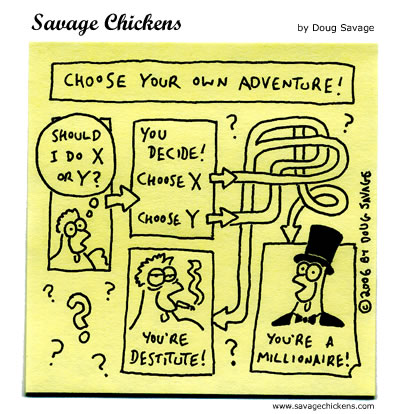
More fun from Savage Chickens

This is how I've been feeling lately.

For more chicken fun, go to