Showing posts with label music. Show all posts

1.02.2026

2025 in Rearview (Pages and Stages)

There were three goals I had rolling into 2025. Watch more movies, read more books, attend more live shows. It was my hope to keep myself distracted so the news of the real world didn’t drain my already weary soul. I succeeded. I watched more movies last year than I have in a long time. Books and performances on the other hand … Technically I did it. While I didn’t read as many books or go to as many concerts as I would like, I did more in both categories than in the year (years?) prior.

As with the movies, I ranked them in two separate lists for you to enjoy. Solely objective, completely opinionated, and set in wet concrete. With a solid enough argument, I could change my mind. Should you want details of any of my choices below, all you need to do is ask.
Watching Evil Dead: Unlocking the Radiant Artist Within (2025) 10/10
A People's History of the United States by Howard Zinn (1980, revised in 2003) 9/10
Hip-Hop Is History by Questlove (2024) 8.5/10
UnClobber by Colby Martin (2016) 8.5/10
Blood at the Root by LaDarrion Williams (2004) 8/10
The Devils by Joe Abercrombie (2025) 8/10
Eruption by Michael Crichton and James Patterson (2024) 6.5/10
We Ate the Dark by Mallory Pearson (2024) 0.5/10
Georgia Warder / Andrew Rivers / Steve Hofstetter (Comedy) 10/10
Puddles Pity Party / Weird Al (Music) 10/10
Gabrielle Grace / Joseph (Music) 10/10
Adam Conover (Comedy) 10/10
Heather Shaw (Comedy) 9/10
Amos Gill (Comedy) 8.5/10
Nonpoint / POD / Seether (Music) 7/10

While this quantity is an improvement over the year prior, I do hope to exceed 2025’s productivity in this new year. My wife and I are reading Dungeon Crawler Carl together and I’m reading Baby Teeth when I’m home alone. Maybe next year I’ll have more to look back upon.

6.13.2025

Tidbits - rewind and revisit

Eight years ago, I had an idea for a blog post - dismayed by the abysmal cabinet Diaper-Don assembled for his first term. The business of life and parenthood overshadowed the thoughts I had about the potential post so it was a plan with no execution. A lot has happened in the two presidential terms since then. Other ideas percolated and faded into the fuzziness of incomplete and half baked notions, haunting my cranium for frequent contemplation. Back then, I thought the tangerine tyrant’s cabinet was the worst possible collection of unqualified and incompetent individuals to ever disgrace the White House. The events of the last six months have proven me wrong. The sentient Cheeto’s current cabinet makes his original group of advisors look like sober genius patriotic saints in comparison. This newness of lower lows in politics has rekindled inspiration from the murky depths of previous designs.

Needless to say my typing fingers have been busy. The project I had originally thought to be a single blog post or two has grown. Burgeoned. Ballooned. Expanded. Exponentialized. It has bred with other unmaterialized concepts and decided it was gonna go big or hibernate. I’m in the middle of composing the eighth part and have no clue how far it’ll go. But it is going somewhere.

This is not the only big thing I’m working on either. I’m editing and revising the first 1500 words of “Only for a Day” (my superhero/pandemic science fiction novel) to enter it into a contest. This work in progress is more commercially viable than my first book so I have high hopes. Even if I don’t succeed in the contest, I’m looking forward to querying the final product as soon I get to that phase.

In the meantime, I wanted to throw out a quick update since it will be a while before I post any new content. It’s also June, practically halfway through the year and a good time to revisit my new year’s resolution: take more hikes, read more books, and watch more movies.

Well, I’ve only gone on one hike. Technically that’s more than I completed last year but there’s still room for improvement. The other two parts are more successful. So far I’ve watched 25 new (or new to me) movies and read five books. I know the latter number isn’t that impressive but compared to last year it’s a win. Not included in my January declaration is a goal to attend more live shows (comedy/theater/music) of which I’ve seen four so far with a fifth happening tonight.

A full list will be provided at the end of the year. Until then, here’s a brief preview.
Least favorite movie so far: Blink Twice.
Favorite movie so far: The Unbearable Weight of Massive Talent.
Least favorite book so far: We Ate the Dark by Mallory Pearson.
Favorite book so far: Hip-Hop Is History by Questlove.
Lease favorite performance: Seether.
Favorite performance: Steve Hofstetter.
With that said, I’m headed back into the writer’s lab. Things to do, words to type, and ideas to solidify. Happy escapism my friends.

6.18.2024

Wedding Professionals

This is me and my friend Syafiq. Both of us are DJs. He’s a dance instructor and choreographer who’s just started officially working as a day-of coordinator. I’m a licensed minister. Naturally, our skill sets place us in the same universe. If you ask my teenage daughter, she’ll tell you Syafiq and I have the same vibe.
selfie courtesy Syafiq Fuller

We live in the world of weddings. If you’re getting married and need an officiant? We got you covered. Need a DJ for the reception? That’s us. Need someone to teach you to dance so you look like you know what you’re doing during your first dance? Syafiq is your man. Want help writing custom wedding vows? I can do that. Need someone to keep everything moving and organized? We’re available for hire. Taking it a step further - we both take pictures during our gigs which we give our clients for free as an added little bonus.

There’s something about the public display of love and commitment that fuels us and the music we play heals us. We love celebrating love. And that’s what we do at Fuller Entertainment. (Shameless plug: you should follow us on Facebook and Instagram.) If you or someone dependent on you is getting married, we’d love to hear from you.

It’s more than a wedding thing though. We are also available to play music for school dances, corporate events, private parties, religious celebrations, family reunions, bars, and coffee shops. As for the ministry side of things, if you want someone to officiate a comic book or ren faire themed wedding I’d be happy to help. Because I’m a geek and us nerds deserve love too.

And it’s still more than that. The real reason I’m writing this is because Syafiq is a great dude. He’s was the best man at my wedding and is one of the best men I’ve ever known. If it wasn’t for him, I wouldn’t be a DJ. Working with him over the years, I’ve learned a lot about his heart and what makes him tick. The compassion he possesses bleeds into everything he does. His goal as a DJ has also become my goal - to lift up and encourage others. We look for clients who ooze positivity. When we recommend photographers, stylists, and caterers, we suggest people who also believe in hope and promote humanity’s better nature. We aim to work with clients, venues, and other vendors with a spirit of collaboration. When a gig is over, we want to be able to tell everyone involved we look forward to working with them again - and be sincere in that statement.

This world is ugly and bitter enough as it is. Neither of us wants to contribute to the proliferation of selfishness and greed rampant in our culture. It might be the harder path to take but we would rather be a light in the darkness. This ideal has been hardwired into Syafiq’s fiber ever since the day I met him. He’s an amazing friend and I’m honored to share his business adventures.

For real though, we’d love to be the DJ and/or minister at your next event.

5.28.2024

Everything Counts

Depeche Mode has been around for nearly as long as I have. I say nearly because their debut album was released in 1981, so I have a couple years on them.

Despite them being huge in the 80s, I didn’t get into them until I was in high school. I became a fan somewhere between “Songs of Faith and Devotion” in ‘93 and my senior year when “Ultra” was released. I became obsessed. I collected their entire back catalog and sought out all of the remixes I could find. I started collecting cover versions of their music - everything from Johnny Cash’s “Personal Jesus” to The Cure’s “World in My Eyes” to Anberlin’s “Enjoy the Silence.” Veruca Salt has version of “Somebody” both devastating and hauntingly beautiful.

I’m still a fan of Depeche Mode, just not quite as obsessive as I used to be. They released Memento Mori last year and it’s a brilliant album but I still only listened to it once and haven’t gone back. They’ll always be a band I respect and admire but they’ll never appeal to me like they did through the mid to late 90s. That said, one of my favorite songs of theirs remains a single recorded over 40 years ago: “Everything Counts.”
This song popped in my head this morning. It’s been years since I last listened to it - or even thought about it. Then while waiting on a colleague to show up this morning, the words popped into my head. “Everything counts in large amounts,” the refrain repeating in my internal jukebox.

“The grabbing hands grab all they can
All for themselves after all
It’s a competitive world
Everything counts in large amounts
Everything counts in large amounts”

Where did this song on my mind come from? The last music I listened to was Matt Osowski’s background beats on the Hood Politics podcast. And the last actual songs I intentionally listened to was a Jelly Roll tune my wife sent me last night and Chance the Rapper’s new track I stumbled into while falling into a YouTube hole. Beyond that, I’ve been playing a lot of Jay-Z, a far cry from DM’s synthy new wave dance pop. So why are the voices in my head suddenly vibing to Everything Counts?

If you assume I spent way too much time pondering the answer to this question, you’re correct. I’m the type of person who believes everything happens for a reason. Even if that reason is bad. Even if that reason is my own stupidity. I am a big believer in cause and effect. The rules of physics enforce it. Newton’s third law demands for every action there is an equal and opposite reaction. But there was no corporeal inciting incident. I haven’t played Depeche Mode at a DJ gig or while chilling at home. There’s been no recent radio airplay or Spotify listens. I cannot conceive a literal physical cause where “Everything Counts” is the tangible reaction.
That leaves the metaphysical. Whatever it is you want to call it - God, the universe, gut level instincts … I’m compelled to believe that divine source plumbed the darkest recesses of my musical obsessions to make me pay attention. There are a lot of grabbing hands in my life grabbing all they can. That’s just a natural side effect of parenting teenagers - they will always take more than you allow. But it’s more than just my kids being kids.

The second verse is aptly relevant to the complex and sprawling narrative of this current phase in my life. In it, Dave Gahan sings “Picture it now, see just how, the lies and deceit gained a little more power.”

If that ain’t the damn truth. I’ve been watching (and suffering the effects) of a person who has been steadily gaining power through a web of lies and deceit. It’s been soul crushing to observe, especially when every attempt I’ve made to challenge or expose it has only solidified their amassing power. For years I’ve felt powerless against this dishonest and abusive force.

But everything counts, right?

I don’t really believe in karma but if there was ever a time to hope for it, it’s now. And in large amounts. When I was a kid, I was frequently taught the verse from the Bible that says it’s God’s role to avenge and the Lord will repay. These days, a different piece of scripture is my heart’s cry, “let justice flow like a river, and let goodness flow like a never-ending stream.” Because justice counts in large amounts. As Francis Bacon once said “to delay justice is injustice.” Martin Luther King Jr paraphrased the same concept, “justice too long delayed is justice denied.” Over the last couple years, I’ve held an unfortunate front row seat to recurring perversion of justice. But tides are slowly turning.

Perhaps this is the reason I got Depeche Mode stuck on intracranial replay. Because grabbing hands grab what they can. Everything counts in large amounts. Karma counts in large amounts. Justice counts in large amounts.

Or maybe I just need to listen to more Depeche Mode.

5.11.2024

Once a Poet …

My brother graduated high school in 1992 which was the end of my seventh grade classes. It’s also the year grunge broke big. Pearl Jam’s Ten was released right before school started, Nivana’s Nevermind followed a month later, and by October Soundgarden unleashed Badmotorfinger. I was immune to grunge though. Aaron was a heavy metal fan which strongly influenced my musical preferences. A year earlier, most of the kids my age listened to George Michael and MC Hammer. Thanks to my conservative religious upbringing, I was led to believe grunge was inherently evil.

That all changed when I entered eighth grade. Two big albums were dropped in the fall of 92: Core from Stone Temple Pilots and Dirt by Alice In Chains. When my math teacher offered the class permission to select background music, my friend Matt nominated Dirt. “It’s brand new, just came out.” Class lasted 40 minutes so we didn’t have time to play the whole record yet those first few tracks blew me away. Them Bones, Dam That River, Rain When I Die, Down in a Hole. Whatever worksheets we were supposed to be doing is lost to my memory. Mathematic exercises were instantly irrelevant. I spent the remainder of class staring absently at the numbers on the paper in front of me, devoting all of my attention to the driving drum beats, low bass growl, and distorted guitars. My ears clung to every lyric as the vocals alternated between Layne’s manic howl and Jerry’s moody harmonies.

Within the next year, nearly all of my school friends were starting their own bands, including Matt who brought his brand new Alice In Chains tape with him to math class. I was not a good singer and I couldn’t play any instruments but I still loved the world of creating music. Matt suggested I start writing songs. If they were good, his band might use them. I had never written a song before so I asked him for tips. His advice was to pick a random word then write about how that word made me feel. A couple nights later, while bored and sitting in the back row pew of a Sunday night church service, I used the blank space of an offering envelope to write my first song: Reach.

This was the birth of my writing journey. Those first few songs I wrote were nothing more than poetry with a repeating refrain. We lived in the Seattle suburbs, Kurt Cobain was still alive (at least for a few months longer), and I was all in with grunge. The songs I wrote never got used but I kept writing. The song structure became looser until I was writing straight poetry and (according to friends of mine) I was prolific. I continued this habit into my early twenties.

Fear, anger, and pain fueled my prose. A lot of my poetry also contained themes of unrequited love. Loss. Regret. It was the essence of all the stereotypical teenage angst you’d expect from the mid-90s.

Then I fell in love at 23 and discovered I couldn’t write a romantic poem even if my life depended on it. I’d never compose a decent love song. My poetic output decreased, eventually dwindling into nothing. By the time I was 24, I was no longer a poet.

My creative outlets shifted to essays. For twenty years I’ve maintained the storytelling tradition through both fiction and non-fiction. You can’t kill an inner poet though. In the wake of divorce, I penned a couple new poems - an act of pure catharsis. Grief and turmoil were always my greatest muses. Over the years after, I’d unearth my poetic mindset and compose something new. Then put it away and move on.

When the question of women choosing between a bear and a man recently started trending, my wife told me I should write a poem about it. I balked at the idea. I couldn’t do it - it’s been years since I’ve been a poet. I don’t have it in me anymore. Even in the middle of denying my wife’s suggestion, I already had a couple lines swimming in my cranium. Within 24 hours, I wrote a new poem: Choose the Bear.

In the days that followed, my inner poet re-emerged. Two more poems were scribed in quick succession. Annie recorded me reading Choose the Bear and you can find it on TikTok. The next poem, A Weird Combination I Know, will be shared soon but the other, Early Onset Alcoholism will remain hidden for another year. Annie is also pushing me to try out some open mic nights to share my poetry with a larger audience.

Through this process, I’m rediscovering something I knew to be true when I was a teenager: poetry has the power to divulge those feelings you can’t describe in simple conversation. Since my autistic brain has difficulty expressing my emotions, poetry is giving me a chance to process trauma and release all this grief I’ve never been able to grieve.

My wife and I have been dragged through hell the last couple years. Outside forces have been doing all they can to tear us apart but their efforts have only bound us closer together. Somehow it feels the poems I write have more power because I’m speaking for both of us.

This new creative muse is providing more than just catharsis, it’s also healing. Because there’s shit from my childhood I’ve still not processed. There’s shit from my first marriage that I’ve never talked about. And there’s shit flung at my wife and I that I’ve kept quiet.

Until now.

Annie and I have full custody of our younger two children. We only had to split custody with my older three kids. The first is 19 and lives independently. My next daughter is 17 and in the going-to-do-whatever-she-wants-to-do phase and there’s nothing I can do to stop it. My son is in jail and will be until he’s almost 18. This era of co-parenting is coming to an end.

For the last 11 years, I’ve tried as hard as I can to keep my mouth shut and take the high road. My ex-wife continues to violate our custody order and makes every attempt to stir up chaos in my life. Her reasons are unknown to me but my happiness seems to offend her. With these factors at play, my gloves are off. I have nothing to lose. We need peace and I’m finding it in poetry.

Ps: I’ve kept everything I wrote in the decade between the ages of 14 and 24. It’s all squirreled away in a box somewhere in the garage. Perhaps I’ll need to revive them and re-write them, transform them into something a little less angsty and juvenile.

3.15.2024

The Disconnect and Ties that Bind Part Two

My maternal grandfather was genealogist. He started while he was still a teacher but his hobby became his passion after retirement. Not only did he track his own heritage as far back as he could go, he also studied the family trees of his kids’ spouses. He was fascinated by the family lineages of everyone he met. Thanks to his efforts, and the stories told by my paternal grandmother, I know as much about my family as possible.

I know my roots. I feel it in the lyrics of My Culture when Maxi Jazz raps, “Like a lifeline, I light lines ‘cause my compassion is deep for the people who fashioned me, my soul to keep and this is who I happen to be. If I don't see that I'm strong, then I won't be. This is what my Daddy told me, I wished he would hold me a little more than he did. But he taught me my culture and how to live positive. I never want to shame the blood in my veins and bring pain to my sweet grandfather's face in his resting place. I made haste to learn and not waste everything my forefathers earned in tears for my culture.”

From a passenger on the Mayflower, to Norwegian immigrants joining early settlers in Minnesota. The German, Irish, and Scottish ancestors. My distant Samoan cousins. Forefathers (and foremothers) who were farmers and pastors, advocates and survivors. Their stories twist my DNA and flow through my blood.

I know who I am. And yet, I don’t.

Comprehension of names, birthdays, occupations don’t tell a complete story. There is a limited amount to be learned from marriage licenses, immigration papers, and death certificates. I strive to leave a legacy worthy of my family but they are not my tribe. When my parents got married in the early 70s, they began a westward migration. I grew up completely disconnected from my heritage. Between my dad being a workaholic and our family living below the poverty line I barely knew my aunts, uncles, and cousins. I rarely saw my grandparents. My familial tribe had communities in Cheyenne and Oklahoma while I was the left coast stranger in the Emerald City suburbs.
image courtesy of the City of Marysville

My being is more defined by coming of age as a Seattleite during the grunge era than by my heritage. There’s a playlist in Spotify serving as the soundtrack to my life which will tell you more about who I am than you could learn from anyone sharing my surname or my mom’s maiden name. Separated from those clans, I had to find my own tribes.

I’ve been pretty open about the state of my childhood. It was not an enjoyable experience. I am still struggling with the trauma of being a bullied kid, of poverty, of undiagnosed mental illness, of religious fundamentalism. Finding my tribe was not an easy task.

On a five hour road trip with my dad last summer, he admitted his greatest fear while I was a kid was that he’d lose me. Which brings me back to the 1 Giant Leap song. In the second verse, Robbie Williams sang, “Hello Dad, remember me? I'm the man you thought I'd never be.” Then continued, “I'm the one who you told look don't touch. I'm the kid who wouldn't amount too much.” My parents didn’t think I’d ever be much of anything because they didn’t know if I’d survive long enough.

My father is a smart man. He could see my symptoms of depression before I recognized them myself. He knew the degree of which I was bullied and abused by my peers and didn’t know how to help. He watched as I slowly faded into the background and was terrified I’d become a suicide statistic.

I was raised in the boys will be boys era. When the kids who got their asses kicked were given the same punishment as the kid who dealt the ass kicking. When autism and neurodivergence were woefully misunderstood and under-diagnosed. When kids with learning disabilities were treated like bad students. When kids were better seen and not heard. When terms like nerd and geek were still vindictive insults. And I suffered all of it. If you ask my wife, I bear the scars and some of the wounds have yet to heal.

The saddest aspect of my lonely story is how the one place that should have been safe for me, the place that should have been most welcoming was just like everywhere else. My church should have loved me the way I was, the way God created me, but they could be just as hostile and ostracizing as the kids at school. Nowhere was safe.

So I found my tribe with the freaks and geeks, the outcasts and underdogs, the athletically un-gifted, the last ones picked, the tortured geniuses, artists and music makers, agents of chaos, the misunderstood wanderers, and anyone who never fit in or felt like they belonged.

A funny thing about life stories: they don’t always follow the hero’s journey. Life isn’t a three act play hitting all of the beats of plot and structure. There are unexpected turns warping our expectations. As the adage says: truth is stranger than fiction.

The church youth group of my youth wasn’t the happy home it should have been, but it was still home. No matter how desperately I tried, it was clear I was never going to be a part of the in crowd. However I was still in the crowd. Years, distance, and education have provided me a new perspective on this weird little tribe of teens inside our religious subculture. I am much more forgiving these days and a lot less desperate to fit in.

Because humans are tribal by nature, we always look to the best and strongest and bravest to lead and protect. In our strange tribe, that bigger stronger leader was never going to be me. It was a sociological impossibility. I was short, uncoordinated, poor, not conventionally attractive, and socially awkward. I was a weird little dork. Through time and space I’ve also come to realize the teasing they foisted on me wasn’t all mean spirited. Obviously some of it was, but some of it was good natured too.

I no longer blame them for their cruelty. It’s hard being a teenager. While I wasn’t like them, according to science we were identical. We were undergoing physical and neurological changes, our brain chemistry and hormone levels were constantly in flux, the rules transitioned from how we were treated as children to the way we would be treated as adults, culture around us was shifting throughout the 90s. We were all trying to find our place while figuring out who we were and how we related to each other all at the same time. It would be unrealistic to expect any of us to navigate such a confusing era with grace and perfect kindness.

Looking at that time of my life in the rear view mirror, once again I feel disconnected. Because I left. I got out. I moved away. All of those kids who were once my church family are practically strangers. They’re now pastors, teachers, missionaries, community leaders, realtors, mechanics, engineers, and doing their own things with their own families.

I don’t miss being the weird kid. I don’t miss the way my peers treated me like I was a second class citizen. I don’t miss being overlooked and maltreated. But I miss them. I miss the community we had. Despite the pain they caused me, I love these people dearly. In the midst of what was a tumultuous time of my life, my happiest memories all involve my youth group tribe. I will forever be bound to them through the shared experiences of our formative years.

Every now and then, I wonder if it would be feasible to get the old gang back together again. For us to collect in one place one last time. Jimmy and Sue. Kari and Dan. Shane. The twins. Megan. Nikolai. Pike. Nettles. Jennifer. Travis. Erin. Marcus. The younger siblings (Chris, Nathan, Adam, and Chad). Perhaps we could gather together a Dennys, order coffee and fries, chat for hours, then leave our tip among the avant-garde displays made from salt, pepper, ketchup, and coffee creamer. Like we used to do.
Sure, such a reunion is logistically impossible. But it could be fun. I am curious what it would be like to see them all again. If for no other reason, I’d want to do it for my culture.

3.14.2024

The Disconnect and Ties that Bind Part One

In the earliest records of human history, people formed in tribalistic cultures. Families, tribes, sects, and clans. Every ancient society on every continent has documented their beginnings in small groups warring over limited resources of food, water, clothing, and shelter. Whether nomadic or settled, humans coalesced into factions based on shared values and lineage.

For thousands of years, humanity flourished in tribalism. This gave us the epic tales of folklore. In them we find the gods and legends of Egypt and Greece; tales of heroes and dragons; adventures, explorers, Vikings, and warriors. The earth experienced plagues and cataclysms, but its inhabitants endured because their tribes were united with common purpose.
Neighboring populations didn’t always get along so the survival of our clans depended on the biggest, the bravest, and the strongest among us to lead, guide, and protect us from those who wish to do us harm. We looked to the smartest and most beautiful to continue our bloodlines. We created popularity contests out of necessity because their success meant we could live and hopefully thrive.

From the indigenous populations of Australia and America, to the biblical Israelites, to the Chinese dynasties, to the feudalism of Western Europe, we found our identities, our health, and safety in the numbers and proximity of our people. Over time, these sects grew. They became villages and hamlets, then cities and nations. Divisions and culture formed around heritage, religion, geography, language, mythology, tragedies, kings, and lords.

Then something funny happened. The Industrial Revolution made life easier. Citizens of industrialized countries migrated from agrarian lifestyles to urban developments. As culture modernized, we lost the need for strength and courage to survive. We no longer needed the muscles and calluses of manual labor to tend to our own crops. The talent and focus needed to stitch fabrics together became a hobby instead of a mandatory skill. We could get the food and clothing we needed from markets and mercantiles.

Who needs to build their own hoses when specialized laborers could do it for you? Who needs giants to protect us when the government has armies? Who needs a bodyguard when you can buy your own weapons? Why protect your outskirts with roving bands armed with spears and swords when walls and secure border crossings will work more efficiently?

The neighboring towns were no longer rival clans, they were fellow countrymen. Our enemies were further away. The ever-present dangers and perils of pre-industrialization was a thing of the past. We were new people with modern needs and worries.

However, our tribalism was still hardwired into the human brain. Our communities might not need to bond they way we once did to survive, yet the human spirit still craves the bonds of community. Without the impetus for a tribe that lives together and fights together, we created new tribes with different purposes. The popularity contests continued in different domains.

Middle school cliques, political parties, college alumni, fraternal organizations, religious denominations, athletic franchises, MMORGPs, artist co-ops, book clubs, chosen families, and countless other ways we can find a way to say “these are my people, this is my tribe.” Our clans are bigger than they used to be. We can find kinship with strangers thousands of miles away. We can bond with individuals we may never meet in ways completed foreign to our ancestors.
Image courtesy of Lukas Zischke

Even though we no longer need the smartest and strongest to lead us, we still seek them out - even if we don’t know them personally. We find our leaders in hero worship, celebrity gossip, reality TV, social media influencers, and ballot boxes.

Modern civilization is completely disconnected from how we functioned for millennia. At the same time, we are bound to the ways historical cultures shaped our brains. Try as hard as we might to escape our past, the past is never truly dead.

Because my brain thinks through a filter of movie quotes and song lyrics, it is music which helped me comprehend our anthropology. My Culture by 1 Giant Leap featuring Maxi Jazz and Robbie Williams specifically speaks of this connection between our heritage, our biology, and the functions of modernity.

“I am the sum total of my ancestors, I carry their DNA. We are representatives of a long line of people and we cart them around everywhere: this long line of people that goes back to the beginning of time. And when we meet - they meet other lines of people. And we say: bring together the lines of me.”


I will remember.

2.03.2024

Scenes from a Movie We’ll Never See

We all know this castle right?
Image courtesy Disney

We have observed Tinker Bell flying over this structure for the better part of the last century. Soon, there’s a movie coming from the house of mouse the younger version of me thought would never happen.
Image courtesy movieweb.com


Humor me for a moment.

You’re sitting in a darkened theater and the Marvel fanfare begins. You’ve watched enough MCU movies to know what’s coming. Flashing comic book pages followed by reddened clips of Earth’s Mightiest Heroes framing the inside edges of letters comprising the words Marvel Studios. However, instead of Chris Pratt, Chris Hemsworth, and Chris Evans populating the studio title card, it’s all images of Deadpool doing inappropriate things from his first two movies.

Next up is the Disney branding. This is where the Magic Kingdom comes in. However, instead of the home fit for Cinderella, the castle we all know and love is constructed with katanas, pistols, grenades, rocket launchers, sais, and knives. The sky is red, the river black. Replacing the old ship, there’s a food truck selling chimichangas. Instead of the orchestral version of “When You Wish Upon a Star” as the fanfare, you have Flava Flav singing the lyrics in the same passionate and slightly off key voice like when he sang the National Anthem. With the last line “come to you” you hear the snikt sound of Wolverine’s claws, then a second snikt, followed by a slash.

When the Disney fanfare is done, the camera zooms into and through the castle doors as if it was attached to a drone flown by Wade Wilson. Once inside the castle, the camera turns 180° to replay a clip from 2018’s Deadpool 2 where Wolverine is about to fight the weird Deadpool from 2009’s X-Men Origins. Through Logan’s claws, you watch the crappy Deadpool get shot in the head by the cool Deadpool. Deadpool steps out and says “Hey, it’s me, don’t scratch.”
Image courtesy Fox Marvel/Disney

This is all straight from the post credits scene of Deadpool 2. As soon as Wade says “Don’t scratch,” you hear a record scratch and the frame freezes. Over the motionless action from the previous movie, the new Deadpool’s narration begins.

“Remember when this happened? Ever since then, shit got weird. How weird? Glad you asked.”

Suddenly, new footage starts in a room full of Deadpools from different universes. One is wearing a Santa hat, one is dressed like Gwenpool (voiced by Blake Lively), one is a cartoon, there’s a dinosaur, and a kid. With the exception of Gwenpool and the kid, all of them are played by Ryan Reynolds. This collection of Deadpool variants are arguing about which Deadpool is the real Deadpool. One of them cracks, screaming “there can be only one” and kills all of them except Gwenpool. He tells Gwenpool, “Bye hon, I’ll see you when I’m done with filming.”

Breaking the fourth wall, Deadpool looks at the camera and says “I told them I was the real Deadpool.” He pauses and cocks his head to the side then continues. “Wait, what if I’m not the real Deadpool.” Wade looks around and kicks a couple corpses to see if any other Deadpools are still alive then faces the camera again. “Oh well, too late now. The last Deadpool puts on a pair of Mickey Mouse ears and leaves the room while whistling the dwarfs’ tune from Snow White: “Whistle While You Work.”

Title card. DEADPOOL 3 fills the screen. The opening credits sequence features a gratuitous amount of Deadpool twerking with the soundtrack playing Ying Yang Twins’ song “Whistle While You Twurk.” Deadpool twerks with Chewbacca, She-Hulk, Zachary Levi dressed like Flynn Rider, the emotions from Inside Out, Quorra from Tron, Will Smith’s Genie, Woody and Buzz, Domino and Cable, Ernesto de la Cruz, Loki, Olaf, Gaston, Quasimodo, Sir Patrick Stewart, Salacious B. Crumb, and Ke Huy Quan reprising his role of Short Round but he’s wearing Indiana Jones’ hat.

I know the real movie won’t start like this but dang I’d love it if it did. There are a lot of scenes I want to see in Deadpool 3 which I know will never happen. Because I’m not a writer with Marvel Studios; I’m just a fan. But if I was one of Disney/Marvel’s screenwriters, here are a few other bits I’d include.

Peter Dinklage comes back as Bolivar Trask - the villain he played in 2014’s Days of Future Past. He’s lamenting how his sentinel project failed and wants to hire a mercenary to kill all the mutants. Deadpools shows up to take the job. After introductions, Deadpool tells Trask “You look like my friend Eitri. But you can’t be him, he was a giant.”

In another scene, Deadpool and Wolverine explore the X Mansion where they run into Bobby Drake, AKA Iceman played by Shawn Ashmore from Days of Future Past. When Iceman demonstrates his powers, Deadpool asks “Do you want to build a snowman?” Wolverine the grump answers “No.” Deadpool replies with singing “OK bye …”

Wolverine goes feral and destroys a building. Deadpool tells him “You’re stealing Wreck-It-Ralph’s job.”

Deadpool asks if Harrison Ford is going to show up throughout the movie. At one point, he asks “Which Ford are we going to see next? Han Solo, Doctor Jones, or the red hulk.” After knocking on a door, Calista Flockhart answers. Deadpool asks her if Harrison can come out and play. Flockhart says “He’s busy filming Air Force Two.”

If any of these scenes appear in the final version of Deadpool 3, I will be the giddiest fanboy in the theater. Reality is I’m not Professor X, Jean Grey, Emma Frost, Stryfe, or any other physic powered mutant so I can’t predict what jokes or songs or cameos will be in the real movie. I won’t riot if my wishes are unfulfilled. What I do want is bountiful Disney jokes. I want to hear jokes about the MCU’s inconsistent timeline and how the Netflix series were retconned to be cannon. I want to hear Deadpool criticize Marvel’s toxic fandom telling them to shut up when it comes to shows and movies featuring female superheroes. I want a rickroll. Even if I don’t get any of that, I just want the movie to be fun.

My version is not coming to theaters ever. But Disney’s version is set to be released in July and (if the rumors are true) the trailer will debut during the Super Bowl. Until then, we can only speculate what shenanigans the merc with a mouth will get into.
Image courtesy Marvel/Disney

8.21.2023

Our Region In Flames

I thought about fire burning in your eyes. I thought about fire. - Blindside
Image Courtesy Thoma Casey


How can we dance when the world is turning? How do we sleep while our beds are burning? - Midnight Oil
Image courtesy Myk Crawford


We didn't start the fire. It was always burning, since the world's been turning. We didn't start the fire. No, we didn't light it but we tried to fight it. - Billy Joel
Image courtesy WADOT


Now I see fire inside the mountain, I see fire burning the trees, and I see fire howling souls. I see fire, blood in the trees, and I hope that you’ll remember me. - Ed Sheeran
Image courtesy Greg Halling


I’ve seen fire and I’ve seen rain. I’ve seen sunny days that I thought would never end. I’ve seen lonely times when I could not find a friend. - James Taylor
Image courtesy Tom Burgess


Death is on the top of her tongue and danger’s on the tip of her fingers. Streets are on fire tonight. - Lupe Fiasco
Image courtesy WADOT


Things we lost to the flames, things we’ll never see again. All that we’ve amassed sit before us shattered into ash. - Bastille
Image courtesy Zack Zappone


Liar, liar, the world's on fire. What you gonna do when it all burns down? - Dolly Parton
Image courtesy Erik Smith


We’ve built our confidence on wasteland. We’ve seen how the walls come down. Life burns. - Apocalyptica
Image courtesy Brian Jacob


Sleep now in the fire. - Rage Against the Machine
Image courtesy Colin Mulvany @ SR


There are three major fires burning around us. To our east, Ridge Creek above Hayden Lake has burned 4100 acres. North of us, Oregon Road in Elk has burned 10,000 acres. Finally, the Gray fire west of us in Medical Lake has also burned 10,000 acres. There are two known deaths and hundreds of homes and businesses destroyed. The Spokane region is devistated and funds are being raised by the American Red Cross, Salvation Army, Giving Back Spokane, and No-Li Brewhouse. We also have family direclty impacted who had to evacuate including the grandparents in Medical Lake who host all of our holiday gatherings. If you think of us, please pray for rain.

9.05.2022

The New Breed

Kids these days. When I hear that phrase in normal conversation, it’s usually uttered with a scowl and a hint of disdain. It’s always a complaint about the younger generation. They’re weird, disrespectful, and don’t follow any of the rules. The irony is often overlooked - the people voicing their ire against the youth are regurgitating the same complaints older folks had about them when they were teens.

Kids these days. When I say it, it’s spoken with awe and hope. They are weird, and it’s wonderful. They’re brilliant, smarter than their elders want to acknowledge. They’re devious by necessity. And they don’t do anything the way it’s always been done.

There is something different about how they rebel than generations before them. My parents’ peers rebelled with bell bottoms and long hair. My generation rebelled with ripped jeans and feedback fueled guitars. At the end of our wild days, from the elder millennials upward through the baby boomers, we found our way into the workforce just like the generations before us. We hashed out our need to be different then learned to be the same.

Kids these days don’t have the liberty to do what we did. They rebel because they don’t have any other choice. From education to business, into every corner of entertainment from sports to art, to the way government functions, kids these days are taking a different approach than the way we’ve always done it because our paths are not available to them.

Kids these days watched the concept of a career and job security evaporate for their parents and grandparents. They’ve observed the decorum of the general public devolve in recent years. They know the economy the rest of us enjoyed doesn’t exist anymore so they’re doing things differently. If they must work with the public, they’re doing it on their own terms.

20 year old musicians have never lived in a world without American Idol. Teenagers don’t know what life was like before YouTube. The idea of break out viral stars has been a part of their collective consciousness since birth. The days of mailing demo tapes to record labels is ancient history to them, and kids these days are using social media to release music whenever they want.

Literary publishing is adapting to meet younger trends. Kids these days never typed out a manuscript on a typewriter, never waited at a Kinkos while their book was printed, and never used snail mail to query agents. It was never required of them. Technology has made it easier for young writers to self publish, connect with agents, find editors, and sign deals with publishers through Twitter and TikTok.
Kids these days are accomplishing mind boggling feats in athletics, destroying nearly every record that ever existed. Technology and science has made sports safer, kids more adaptable, and injuries easier to heal.

Politics are wild for kids these days. It’s been 23 years since the Columbine shooting. New voters registering to vote for the first time in their lives have grown up with active shooter drills. There’s never been a time in their lives when mass shootings were not a thing. They’ve spent their whole lives in a post-9/11 world. The only thing they’ve experienced from our government is nepotism, deep partisan divisions, culture wars, and the ever growing wealth gap. If they seem politically radical, it’s because we created an environment that fosters racialism.

Old folks these days. Some of y’all look at kids these days the same way Anakin looked at the younglings in the Jedi Temple after he turned to the dark side. Y’all fear what you don’t understand and want to destroy anything you can’t control.
courtesy of Lucasfilm

You think kids these days are weird because they are. We made them this way. Kids these days are a new breed of human, diverging from the way things have always been done because we gave them no other choice. For better or worse, the future belongs to them. Once we’re gone, this world is theirs.

There is one thing clear to me about these younglings: they are going to change the world. They’re doing it with or without us. The rest of us need to be more like Obi Wan, less like Darth Vader. If we’re not ready to help kids these days, it’s time for us to get out of their way.
courtesy of Lucasfilm

3.15.2022

Light in the Darkest Hours

It was a song from an underground hip-hop collective: lo-fi beats, heavy turntablism, and cypher styled rap verses: “The Night We Called It a Day” by Deepspace5. This song (along with the rest of their debut album) helped me fall in love with the art and culture of rap music. The track opened with a melancholic acoustic guitar sample and the static of vinyl before the DJ starts scratching records. In the scratches, there’s a single spoken line, broken up with the flick of the DJ’s fingers.

“Those who need light - light-light - for those who need light in they darkest hours - in they darkest hours”
It’s like a grown up version of “This Little Light of Mine” for those who enjoy coffee shops and old school beats. Millions of kids listen to hip-hop as a means of escape. They enter it like a refuge - an oasis in the desert of urban violence. I understand them. I once used grunge and punk rock as a safe place from the torment of the bullies who verbally and physically abused me through my teen years. It was my light in my darkest hours.

Even though it’s been a while since I’ve listened to the song, I still get this Deepspace5 phrase stuck in my head, repeating like a mantra. I walk around with those nine words on repeat. For those who need light in they darkest hours. They darkest hours. Light in they darkest hours. Then I see those in their darkest hours who need some light and feel moved to speak up, to do something.

These days, those who need light in they darkest hours are easy to find. Between school shootings and police violence, natural disasters and pandemics, extreme politics and foreign wars, there’s a lot of light needed for a daunting number of people in their darkest hours.

Not everyone seeks light from darkness. Many seek light in darkness. While it seems counterintuitive, there are those who find light through scary stories. Whether told around campfires, read in pulp novels, listened to in true crime podcasts, or watched on the big screen, the elements of horror can distract us from the frights of real life. Somehow the darkness of vampires, werewolves, ghosts, and aliens are brighter than homes filled with abuse and addiction.

Kids will watch a slasher movie and think “if the final girl survives the masked serial killer hunting down teenagers, then I’ll survive my abusive parents.” Those in pain will read books about an exorcism and think “if the demons can be cast out from this possessed child, perhaps I can conquer my own demons.” Laughing at jump scares in video games help some kids feel less fear when police arrive to defuse a domestic disturbance.

So why do I love the horror genre? I was raised in a safe community by two parents who loved each other with no darkness to escape. My parents were not abusive. Despite being poor, they fed me and kept a roof over our heads. They supported my creative endeavors. I did not endure any major adolescent trauma. I never got into legal trouble. I was socially awkward but still had a few great friends. My parents didn’t even allow me to watch scary movies. Aside from being bullied, I had a decent childhood.

And I have a good life today. My parents are still together after nearly fifty years of marriage. I am married to a woman who loves me more than I knew was possible. I have a great job. I’m DJing and writing and farming and raising kids and have a life so full I could burst. Between the dogs and the horses and the family, I am surrounded by a loving support system and many reasons to celebrate. Yet I still crave books by Stephen King and Dean Koontz. I’m enraptured by movies from Jordan Peele and Guillermo del Toro. I’m still thrilled when a creepy book or game keeps me awake all night. It seems I seek darkness in my brightest hours.

Thanks to the world of podcasts, I think I understand my unique proclivities. While driving around the INW for work, I’m listening to storytellers do what they do best. Hood Politics, Murder Myth & Mystery, The Secret Room, Haileywood. If iron sharpens iron, I hope to hone my own abilities to craft engaging tales.

In a recent episode of Morbid, Alaina Urquhart and Ashleigh Kelly shared stories of haunted lighthouses in America. One of those spooky landmarks is the Bolivar Point Lighthouse in Galveston Texas.

When a hurricane entered the Gulf of Mexico in 1900, H. C. Claiborne (the lighthouse keeper) wasn’t worried. He had purchased enough food to last through the season so he and his family could remain at Bolivar Point for a few months, and the lighthouse structure was strong. Claiborne was confident it could withstand any storm.

image courtesy of Lighthouse Friends

As you could imagine, meteorology was not as technically advanced at the beginning of the 20th century as it is today. No one was sure where the hurricane would make landfall. The big waves thrust into the shores of northeastern Texas became a spectacle with thousands of curious people crowding the beaches of Galveston Island and Bolivar Peninsula. Many of the onlookers ignored the warnings of local officials urging them to move inland and seek higher ground. By the time the storm surge reached land, it was too late. They were experiencing the deadliest natural disaster in American history.

It could have been deadlier - and would have if it had not been for Claiborne. The rising waters stranded a train with more than 300 passengers near the Bolivar Point lighthouse. They waded through the waters to reach the door of the tower. Claiborne opened it up and let in at least 125 of the passengers before he had to close and barricade the door.

Those who sheltered in the stairwell of the lighthouse found safety, but not comfort. Two or three people sat on every step of the spiral stairs, from the flooded entrance to the top level where Claiborne continued to perform his duties keeping the light shining to guide wayward ships into Galveston Bay. In the dark of storm and night, Claiborne rationed his family’s food supplies to make sure the storm’s refugees had something to eat, and the crowd drank rainwater to sate their thirst. What they didn’t know of until after the storm had passed were the bodies piling up outside the lighthouse door.

The Bolivar Lighthouse was a bright spot along the Texas coast. It was a beacon for sailors seeking safe harbor. Yet its greatest moment came when the tower was plunged into darkness and one selfless man saved 125 souls from a hurricane that killed 8000.

Within a week of hearing this story, I listened to a remastered episode of Lore about more lighthouses. The show focused on the reason tales of haunted lighthouses are so prevalent. These landmarks were designed to offer light, guidance, and hope. Yet throughout history, lighthouse buildings have been filled with the loneliness of isolation. They’ve been sites of grief and tragedy; homes to mental anguish, injury, and death. Ghosts may not exist but the reasons people believe they are real are valid.

Then the show’s host, Aaron Mahnke said something that was an a-ha moment for me. From this perspective, it all makes sense.
My interests and pursuits seem unlikely. A good boy raised in a stable Christian home should have never taken a liking to the horror genre. Yet I’ve found myself thriving somewhere between The Tell-Tale Heart and 30 Days of Night. I’ve lived a blessed life while reveling in the macabre.

The book I’m working on features characters enduring some dark events. When I’m done with this, I will begin working on a Christmas themed ghost story about a man haunted by his mistakes. The stories I’m crafting are filled with grief, loss, tragedy, and death - the basis of many of the monsters which lurk in the myths and fables of scary legends and modern lore. It seems Mahnke’s hypothesis is proven in me - my tales of horror come from where my light shines brightest.

In this way, I hope to become what God created me to be: a lighthouse. A place of light and a shelter in storm, often plunged into the agony, muck, and mire of human existence. Then from the darkness, continue to illuminate a way for others to survive the strife of their own lives.

This little light of mine, I’m gonna let it shine, for those who need light in they darkest hours.

2.26.2022

The Ongoing Work of Black History and Racial Reconciliation Part Two

“I live in an area with a lot of racism.” This is how he began the conversation, referring to his Midwest residence. He could have removed his hometown from the discussion and his statement would still be true.

The land once occupied by the Aryan Nations is about a half hour from where I live. The region around me has been a safe haven for neo-nazis and white nationalists fleeing Southern California for decades. I know what it’s like to live an area where racism is common. Whether it’s the Midwest or left coast, a hick town or concrete jungle, purple mountains or waves of grain, from sea to shining sea, racial prejudice is an unfortunate stain blemishing the fabric of America. Bleaching it only makes it worse.

This kid (I say kid because I’m old enough to be his dad) and I bonded a couple days earlier while eating lunch and talking about video games. Turns out his little brother is the same age as my oldest son and as I described my boy, he kept telling me “oh my gosh, he sounds just like my lil bro.” When I said Christian’s spirit animal is a sloth, this kid bust up laughing. “Same for my brother.”

His question was genuine. He wanted to know how to handle working with people who don’t like him because of his dark brown skin. “I live in an area with a lot of racism. How do you work in homes where people hate you. I mean, a couple weeks ago we went to this place and they wouldn’t even allow me in their house.”

The person who answered him is of Mexican heritage. Coolest guy in the world: bald and bearded, wears Hawaiian shirts every day, and tells stories the same way Michael Peña does in the Ant-Man movies. He prefaced his answer with assurances as someone who has experienced similar situations. He talked about safety and team support.

My new friend inquired how to behave when confronted with inescapable racism. I wanted to scream at the unjustness of his question. I wanted to say “You shouldn’t have to deal with this. People shouldn’t hate you. It’s not right.”

Life without hatred is a myopic dream. The world as it should be is not the world as it is. In times like these, wishful thinking is as useless as empty platitudes. I couldn’t respond to his valid concern with a fantasy about an equitable America that doesn’t exist. Instead, I gave him what is perhaps the whitest advice I could muster. “Kill them with kindness. Don’t give them any justification for their hatred. If they’re going to spite you, it’ll be because of their own prejudice and not for anything you do.”

Thankfully he understood the point I was trying to make. He’s a good dude and capable of maintaining that goodness in all situations. “I like that,” he said. It’s a shame this kid lives so far away. I could see myself being a good friend, falling into a mentor type of role for him.

I shared a story with him about working with people whose biases I found offensive. When I DJ, I don’t get to choose my clients, they’re assigned to me. A couple days ahead of a gig, I was meeting with bride and groom to talk about their reception party when the groom said something disgustingly homophobic. I walked away from that meeting discouraged I’d be playing music for the guy who hates people I love.

If anything though, I am intellectually consistent. I believe bakeries run by bigoted bakers should have to make wedding cakes for gay weddings. But if the roles were reversed, the baker is gay and the client is homophobic, I think the baker should still have to make the cake for the anti-gay wedding. I might not like this dude’s attitude about the LGBT community but I believe he deserves to enjoy his wedding day the same as anyone else.

Then I remembered something. There’s a PFLAG sticker on my laptop. I was going to show up at a venue with that laptop and play music for a homophobic guy with a sticker on my laptop supporting Parents Family and Friends of Gays and Lesbians. My attitude changed. I stopped feeling like I was stuck with this guy. No - he was stuck with me.

“You’re not stuck with racists." I told my new friend. "You might show up to work in their home but remember you’re doing a job. You’ll be there for a couple hours then you’re gone. You’re not stuck because you get to move on. But those bigots are stuck with you because they need you to do something only you can do.”
image courtesy of Citizen Ed

I’m not naive. I know he’s going to return home and start working with people who think of him as a lesser person because of his skin color. It won’t be everyone. It won’t even be a majority of people. Still, as far as I care, even one home where he’s mistreated on the basis of race is too many. People who hold so much contempt for someone they’ve never met makes me wish their dad was a little more like my dad.

This is why I fight for racial reconciliation.

12.23.2021

Peace on Earth or Something Like It

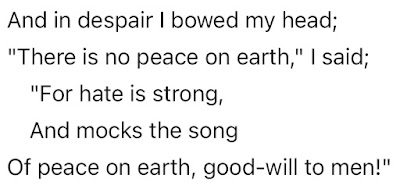
It’s one of the most recognizable phrases of the Yuletide season:” Peace on earth, goodwill to men.” Ranks up there with “Merry Christmas to all and to all a good night,” “bah-humbug,” and “Grinch’s small heart grew three sizes that day.” The line, taken from the biblical gospel of Luke, is the closing lyric at the end of every verse of “I Heard the Bells on Christmas Day.”

Poet Henry Wadsworth Longfellow, who authored the carol, was aware of his repetitive prose, commemorating his style in the first verse. “Wild and sweet the words repeat of peace on earth good will to men.” He echoed the nativity story when angels appeared to shepherds to announce the birth of Jesus. The heavenly beings divulge the who/when/where details to the migrant workers; then a whole choir appears and sings “Glory to God in the highest, and on earth peace, good will toward men.”

It’s such a familiar verse, even people who’ve never stepped foot in a church could quote it. From greeting cards to A Charlie Brown Christmas, this Bible story is ingrained in our collective psyche - an inseparable part of pop culture as much as it is a sacred religious tradition. Yet, it is woefully lacking.

Two decades ago, most of my friends (and all of my roommates) were musicians. We all challenged each other to be smarter and more artistic. We honed each other’s talents. One of these dudes had never read an entire book in his life unless required for school. When he decided to be more of a reader, the first book he chose was Plato’s Apology. He asked me if I wanted to take a class with him to study Koine Greek. How could I resist? Doesn’t everyone want to learn a dead language?

I still can’t speak the ancient Mediterranean tongue. It’s complex - lacking in punctuation and current rules of grammar. However, I do remember the alphabet, basic pronunciation, and some vocabulary. More importantly, I learned the basics of how modern scholars approach biblical translation since Koine is the language used in the most of the earliest copies of the New Testament. I learned how many of the older translations into English did not provide the most accurate translation possible. The King James Bible is rife with minor mistranslations including this verse in Saint Luke’s telling of the birth of Christ.

Here is the scripture of Luke 2:14 according to the KJV: “Glory to God in the highest, and on earth peace, good will toward men.”

And the same thing in Koine Greek: “δόξα ἐν ὑψίστοις θεῷ καὶ ἐπὶ γῆς εἰρήνη ἐν ἀνθρώποις εὐδοκίας”

Yeah, I know. You probably can’t read Greek and for the most part, neither can I. However there are a couple words I recognize from my studies during the summer of 2001. Simple ones like ἐν (en) which means in. Or καὶ (kai) the Greek word for and. Easy stuff. Seminary students would likely know words like θεῷ (Theo), which means God, and ἀνθρώποις might be familiar to anthropology students because it’s the entomological origin of their degree curriculum.

To make things easy, I’ll transliterate it: doxa en hypsistois Theo kai epi gēs eirēnē en anthropois eudokias. In a literal word for word translation into English: glory in highest to God and on earth peace among men … eudokias.

That last word, eudokias, is where it gets weird. This is where the KJV goes astray. What does the word mean? It’s also the last word in Philippians 2:13 and there, the KJV gets the translation correct: “For it is God which worketh in you both to will and to do of his good pleasure.” Eudokias only appears twice in the New Testament. The KJV the translation right in one verse but wrong in the other. How? Why? And what should it say?

Eudokias means good will or good pleasure or with pleasure or good favor or with favor. There’s a lot of different ways to interpret it; like I said, Koine Greek is a complex language.

This is how the KJV got it mixed up. They used good pleasure in Paul’s epistle and good will in the gospel. More specifically God’s good pleasure and men’s good will. On the surface it seems correct, but it’s not. There’s a mistake into how the good will was applied. The word eudokiasis a possessed word. Not possessed like a ghost, but possessed as in belonging to someone or something. This is apparent in the KJV take in Philippians. The good pleasure of eudokias belongs to God. Once you understand the weird and often confusing syntax of Koine, we find the same is true in the book of Luke. The good pleasure, good will, or good favor in the Christmas story belongs to God, not people.

A broken English translation of the verse in Luke should read “glory in highest to God and on earth peace among men of his good will.” Or men of his pleasure (awkward) or as most modern translations use, his favor. More specifically, the NIV reads “peace to those on whom his favor rests.”

It’s not peace on earth AND good will to men. It is peace on earth for those of God’s good will.

I can understand how the King James translators got it wrong and I can see what they got wrong, but I do not know why. All I can explain is the modern implications of this 400 year old mistake.

Despite growing up in a church that relied on the NIV, it’s the KJV version I can quote from rote memory because that’s the version from the Christmas song and Charles Schultz’s cartoon special. It’s the one repeated in the public square.

It would be easy to conclude peace on earth is the sole purpose of the nativity. To do so is missing the point. If Jesus came to bring peace on earth to people with whom God’s favor rests, God’s people should be peacekeepers, or rather, peace bringers.

We cannot sit back and pretend peace on earth is an abstract concept, the responsibility of the divine, and ignore the role we’re supposed to take. The birth of Jesus should give Christians a peace that surpasses all understanding - a sense of peace so strong and overwhelming, we can’t help but spread it to the world around us. Jesus didn’t come to bring peace on earth. He came to give us peace on an earth in turmoil. He lived to show us how to share that peace. And he commanded us to do the hard work of binging peace on earth.

Unfortunately in modern Christianity, especially in America, and ESPECIALLY in white evangelical culture, this message is lost. When I look at the American Evangelical Church, peace is the last adjective that comes to mind. Quarrelsome, fearful, vindictive, chaotic, divisive, greedy, violent, too busy fighting an imaginary war on Christmas to realize everything they do is antithetical to the gospel of Christ.

Not much has changed in America since Longfellow penned his poem.

I want to reclaim the spirit of Christmas. I want my fellow Christians to truly be a people of God’s good will. If there is to be peace on earth, may we be the peacekeepers who bring it to a world starving for peace and be people of eudokias.

12.16.2021

Coping Isn’t Coping

Situational depression. Or at least that’s what my therapist called it. One situation in my life sucked and another was really crappy. A + B = D for depressed. Ideally, once circumstances changed, I’d be happier.

Things did change and eventually I did feel better. I also attended therapy and took medication. I had a couple different support groups and was involved in my church. I was happy, or at least as close to happy as possible.

Biologically speaking, depression is always there. For some people, it’s a lingering presence and daily burden. For others it ebbs and flows like the tide. Today is OK but tomorrow never knows. Those with SAD (or seasonal affective disorder) fall into this latter category, their mental health dependent on the weather. My situational depression makes me a candidate for the occasionally depressed. Since it’s a chemical imbalance, there isn’t a cure, only treatment through prescriptions and counseling can reduce the symptoms. Your brain is what it is. It can be rewired but not replaced.

So this is who I am. Some days my depression is an echo in the basement of my psyche. Other days it’s the annoying neighbor throwing an all night kegger when I have to work at 5am the next morning. Some days, it’s mellow enough to be forgotten and other days it’s so loud and crippling it can’t be ignored. Some days, it is a circus clown waving in the distance, other days it’s a masked killer from a slasher flick chasing me up a flight of stairs because why wouldn’t I be foolish enough to ascend the stairs where there’s no means for me to escape - that’s what people do in horror movies.
image courtesy of Dark Sky Films

I didn’t learn about my depression and anxiety until I was in my mid-30s. My oblivious perspective didn’t mean I was not depressed prior to my diagnosis. I didn’t suddenly develop symptoms the moment my therapist gave me a label.


My journey through depression and anxiety mirrors my story of autism. I didn’t know I was on the spectrum until I was 40, but I’ve been autistic my whole life. In the same way, I didn’t know I was depressed until I was an adult. Looking back I can see I’ve struggled with depression since adolescence.

These are challenges no one should face alone. Life doesn’t come with a user guide; the closest thing we have to cheat codes are therapists. So I got one. She prescribed some drugs. So I took them. And it helped.

Mental health doesn’t have easy fixes. Therapeutic and pharmaceutical solutions are not cures, they’re temporary salves. Wonderful and helpful yet not enough to heal the deepest wounds. To cope with the stresses of life, changes in weather, and negative self talk, people plagued with depression and anxiety need to develop useful coping mechanisms.

Neurotypical people cope naturally. They do it without thinking. Bad things happen, they adjust and keep moving. They’re upset about something, they process the emotion and continue to function. It’s the natural order. However, not all brains are able to self-regulate on autopilot. That’s why good therapists teach coping mechanisms.

Some people count or take deep breaths, meditate or punch a pillow, read or play video games. I have a big challenge though: coping strategies don’t last. For example, I tap my fingers when I’m anxious and it helps me feel calm. Yet the anxiety returns the moment I stop tapping unless I’ve resolved the cause of my worried stress. However, finger tapping isn’t the only coping mechanism I’ve tried.

Doing something nice for someone else is a great anti-depressant. I’ve volunteered for various community programs, served homeless people, opened doors for strangers, participated in charity events, and donated to non-profit organizations. All of it feels great in the moment. I never feel depressed when engaging in acts of kindness. Unfortunately, I’m not able to do these happy acts all day every day. I have a regular job, kids to feed, and a farm to run. I can have the serotonin high of helping someone, only to come home confronted with the reality of laundry that never ends and fences perpetually in need of repair.

I’ve been told nature walks and spending time with animals are good for mental health. I agree. That’s why I tend to linger outside longer than necessary after doing evening barn chores. Giving ear scratches to our donkey, playing with the goats, or staring at the stars. It’s a peaceful end to an often hectic day. As refreshing as this time is, I can’t stay outside forever. The next day is coming with a new set of stressors.

I feel great at my DJ gigs; music is therapeutic. But my gigs have end times when the speakers are turned off and I must tear down my equipment. There are times throughout my day where music cannot be played in the background, whether due to business calls or a lack of accessibility. Songs, regardless of genre, calm me, but the benefit vanishes as soon as the music stops.

There are more coping methods. I could go on ad nauseam. Hopefully, you get the point. Coping is great until it isn’t. Coping doesn’t last. Coping isn’t coping. I still have to function.

Neurotypical people are able to cope without coping mechanisms. Either due to depression, anxiety, or autism, I do not posses that skill. How do I do it? I don’t know. What I do know is I wake up every day and do what must be done because there are people (and animals) who depend on me.

I’m OK, and even when I’m not, it’s OK. If you see me tapping my fingers, at least you know why.