Showing posts with label the kids. Show all posts

1.02.2025

Escapism

As America aired the epic 2024 season finale, many citizens set resolutions to better themselves in the next season. Some of these are noble ventures: quit drinking, exercise more, lose weight, or end a toxic relationship. My goal for 2025 is less admirable.

Between our government’s chronic incompetency and the voting populace who have spent the better part of the last 40 years elevating ignorance as a virtue, we all might need a little escapism for the next one to four years. I know I will. If next year might be the USA’s series finale, no better way to go out than to be entertained.

My New Year’s resolution for 2025 is to take more hikes, read more books, and watch more movies. With all the farm work we’ve had over the last seven years, I have not been able to do either as frequently as I’d prefer. I attended the cinema more in 2024 than I have in years and I hope to continue that trend next year. With such goal in mind, here are the top twenty movies coming out in 2025 I am most anticipating - sorted least to most excited to see.

20: Captain America Brave New World (Anthony Mackie, Harrison Ford) Marvel’s next movie, set to release on Valentine’s Day, was higher on my list until rumors of dismal test screenings and reshoots have me nervous. I want it to be good but worried it might be the MCU’s worst.


19: 28 Years Later (Jodie Comer, Aaron Taylor-Johnson) Hot take: I’m not a big fan of 28 Days or 28 Weeks Later. I saw them, enjoyed them, recognize their influence, but have no emotional attachment to them. That said, I’m getting burnt out on zombie movies which used to be my favorite sub genre of monster movies.


18: Karate Kid Legends (Ralph Macchio, Jackie Chan) I understand if people roll their eyes at this. Nobody asked for this movie. But I’m interested to see the karate blended with kung-fu. Ben Wang was phenomenal in American Born Chinese and could help breath new life into the franchise.


17: Elio (Yonas Kibreab, Jameela Jamil) It’s been a while since I’ve been excited for a Pixar movie - probably 2020’s Soul. But this one has aliens. While definitely aimed at kids, Pixar is dipping back into nerd territory. Even if it’s a dud, my girls will enjoy it.


16: The Running Man (Glen Powell, Katy O’Brian) Oh yay, another remake of a mediocre 80s flick. I didn’t hate the original and I’m not sure we really need a new version. However this Stephen King adaptation has one big asset in its favor: Edgar Wright directing it as well as sharing screenwriter and producer credits. My biggest fear is the dystopian premise is more plausible today than it was 38 years ago.


15: The Life of Chuck (Tom Hiddleston, Nick Offerman) I know very little about this movie other than it is about the end of the world told in reverse chronological order based on a recent Stephen King novella. It’s also got a stacked cast that includes Karen Gillan, Chiwetel Ejiofor, Mark Hamill, and Matthew Lillard.


14: Wicked: For Good (Cynthia Erivo, Ariana Grande) My inner theater geek is showing. The first part of Wicked was brilliant. My whole family enjoyed it and I can’t wait to see the finale.


13: Death of a Unicorn (Paul Rudd, Jenna Ortega) My first knowledge of this A24 movie came in the form of a YouTube add last week and it is absolutely bonkers. Another movie with a stacked cast including Téa Leoni and Will Poulter, this kind of film was made for people like me. Ortega is a little over exposed and I’d be more excited with a different actress playing Rudd’s daughter, but I’m still stoked for this one.


12: Wolf Man (Christopher Abbot, Julia Garner) How long has it been since we got a decent werewolf movie? As much as I enjoyed 1997’s An American Werewolf in Paris, I know it wasn’t a good movie. And subsequent attempts at cinematic werewolf offerings has been lackluster at best. Wolf Man might change the trend as it features a father who got bit trying to protect his kids and his wife trying to save their family.


11: Love Hurts (Ke Huy Quan, Ariana DeBose) Quan is damn near perfect in everything he touches. From Indiana Jones and Goonies as a kid to recent appearances in Everything Everywhere All at Once and Loki. I have zero reason to doubt this action comedy about a former hitman turned real estate agent being hunted by his brother. Adding Marshawn Lynch and Sean Astin to the cast is icing on the cake.


10: The Bride (Jessie Buckley, Christian Bale) / Frankenstein (Oscar Isaac, Jacob Elordi) Here’s a two for one as both movies share source material in Mary Shelley’s Frankenstein. Both give me reason to be hopeful yet I have reservations for both. The Maggie Gyllenhaal directed offering revises the original gothic setting to 1930s Chicago which is a risky move. The second, directed by Guillermo del Toro, maintains the gothic roots. Del Toro is one of my favorite directors and his previous works with creatures of fairy tales and horror will be evident here as well. My only hesitation with his version is the inclusion of Mia Goth in the cast, one of my least favorite actresses.


9: The Fantastic Four: First Steps (Pedro Pascal, Vanessa Kirby) 20th Century Fox had four shots to get this collection of heroes right and they failed every time. With the film rights restored to Marvel, I have hope this might be the one to properly capture the magic, humor, and disfunction of Marvel’s first family. Pascal as Mr Fantastic wouldn’t have been my choice but I do think Kirby as Sue Storm and Joseph Quinn as her younger brother are perfect castings. I’m also excited to see Natasha Lyonne in an unnamed role as she’s one of my favorite actresses.


8: Thunderbolts* (Florence Pugh, Sebastian Stan) This movie could be a hot mess but I don’t care. I’m happy to see David Harbor and Hannah John-Kamen reprise their roles of Red Guardian and Ghost. The trailers so far have given me something to look forward to and even if it’s terrible I have a feeling I’m still going to enjoy it.


7: Novocaine (Jack Quaid, Amber Midthunder) Oh all the movies on this list, THIS one might have the most unhinged premise and reminds me of WTF movies like Guns Akimbo and Crank. Jack Quaid was brilliant in The Boys and I’m thrilled to see him play another lovable loser, but this time as a timid wallflower who can’t feel pain but snaps when his girlfriend is taken hostage in a bank robbery.


6: Mickey 17 (Robert Pattinson, Naomi Ackie) If we could remove the Twilight series from Pattonson’s filmography, he’d be considered one of the greatest of his generation. In this sci-fi outing, he plays a person so desperate to get off earth he accepts an experimental and dangerous position in space. How dangerous? He keeps dying. Every time he dies, a new body is regenerated with his memories intact. But something goes wrong when he survives his 17th death and the 18th Mickey wants to kill him.


5: Legend of Ohci (Helena Zengel, Finn Wolfhard) A24 has a great track record creating thought provoking and visually stunning movies. I suspect this will be more of what I expected from them. It’s a kid trying to rescue a dangerous creature while her family hunts it. I don’t know how to describe it other than throwing The Village, Pan’s Labyrinth, E.T., and Earth To Echo into a blender. The end result looks beautiful and unsettling and I am eager to take my tween out to see it.


4: Mission Impossible - The Final Reconning (Tom Cruise, Hayley Atwell) After nearly 30 years, this franchise is possibly coming to an end. Or at least I hope it is. As much as I love the M:I movies, I’m ready to see an epic conclusion to this preposterous series. Dead Reckoning ended with a massive cliffhanger placing every major character in dire situations so they better wrap it up right or I’ll be pissed.


3: Sinners (Michael B Jordan, Michael B Jordan) Jordan takes on double duty portraying a pair of twins returning home to home in the depression Deep South. They find their town consumed by evil - Jim Crow bigotry, vampires, and southern supernatural traditions. Jordan reunites with director Ryan Coogler who also wrote the script and is co-producer. This movie looks like it will be thought provoking and terrifying.


2: Superman (David Corenswet, Rachel Brosnahan) Zack Snyder destroyed any interest I had in Superman. And not just once but FOUR times. My expectations for the DCEU are low but lifted a bit when WB handed full control to James Gunn because he is, as a writer and a director, someone who understands the assignment. I wasn’t impressed by the first look image, even more so for the teaser to the teaser trailer. Everything changed with the full length teaser. Lex, Lois, multiple Green Lanterns, Hawkgirl, Mr Terrific, and Kelex the robot. Oh, Krypto too. Can’t forget the super-powered dog. This might be the best Superman movie since Christopher Reeves first wore the tights.


1: Better Man (Robbie Williams, Jonno Davies) This is an odd choice to be anyone’s most anticipated movie, especially considering how much hate Williams is getting on social media. I don’t care though. I’ve been a fan of his music since the mid 90s, although I did have exposure to his band Take That is years prior. With the movie directed by the same dude that directed The Greatest Showman, and the twist of a biopic’s protagonist portrayed by a CGI monkey, this movie seems like it was made for people like me. I’ll apologize in advance to anyone who watches this with me as I’ll probably be singing along with it.


Let me know what you’re looking forward to and if any of these films are on your must-see list.

9.19.2024

Wanderlust and the Source

Bedtime is sacred in our house. Not because it’s the routine shutting off all the lights and closing our eyes to sleep. Annie and I value it because these are the precious few minutes we can chat and connect free of interruptions from kids who don’t appreciate their bedtime as much as we do.

In these final waking hours of our day we share the best and worst parts of everything happening before we got home. We air the stresses we cannot share with anyone else. We comfort each other as lovers and encourage each other as teammates. We create to-do lists and bucket lists. We set reminders on our phones so we might recall those things our ADHD is prone to forget. We mutually doom scroll social media side by side, occasionally holding our phone to the side with instructions, “Hey check this out.” We ponder the benefits and challenges of various ideas. We talk religion, sex, and politics. We discuss plans for both the immediate and distant future. And, most importantly, we dream together.

This is the key ingredient for the magic binding us together. When we think of what life will be like five years ahead or fifty years from now, we envision our hypothetical future lives as a cohesive unit. These are shared aspirations, not individual exploits. We have had this ingrained in our relationship as long as we’ve known each other. On our second date, we talked about places we’ve always longed to visit. She said she wanted to go to Scotland to see her ancestral homelands. Two of my bucket list destinations (Paisley Abbey and Loch Ness) happen to be in Scotland. We laughed and smiled at the idea of going there together and fulfilling our dreams at the same time.

Annie and I both have an insatiable wanderlust. We feel the tug of the journey on our hearts. Places exotic to historic, from pristine wilderness to ancient ruins, waterfalls and temples, castles and farmers markets. We want nothing more for our lives to go, and see, and do. We yearn to wander foreign lands and disappear for a while.
Real, actual, legitimate picture of us.

Earlier this week, I told my therapist how I believe the best education we can receive is found outside our own culture. As much as I would enjoy a trip to Disneyland to hang out at Galaxy’s Edge, I would rather visit the original Tatooine Star Wars set in Tunisia. Given the choice between a week at Universal Studios or traveling to India during Holi, I would choose the later. Annie would do the same. The selection of culture over capitalism is an easy one.

Unfortunately, Annie and I grew up believing travel was for other people. Both our families were poor and the expense of overseas excursions was too daunting - an unobtainable wish left to wither on the vines of our dying hopes. This wanderlust ached in our bones and called our spirits yet we felt confined to weekend roadtrips and local attractions. We wanted to see the world but doubted we would ever be globetrotters.

All it takes is one little break to shatter the exoskeleton of false beliefs. Two and a half years ago, a new job sent me to Tampa Bay for three weeks of training. Annie and our two youngest girls flew out to visit a weekend while I was there so we could partake in a family Florida adventure. It was the nudge we needed to shed the idea we weren’t meant to travel. How could we hold on to such a concept while doing the thing we thought we’d never be able to do. A few months later we went to Waikiki to celebrate birthdays of mine and Steven’s. Then a month later we were on a cruise boat to Alaska for our belated honeymoon. Since then we’ve made a return trip to Hawaii along with little jaunts to Cheyenne, Boise, Portland, Cranbrook BC, and multiple trips to Tacoma/Seattle/Everett.

We’re not ready to quit. Between now and the end of the year, our feet will tread ground in Mexico, Costa Rica, and Columbia adding three stamps to our passports. Not long after, I’ll be headed to Phoenix with one of my best friends for a DJ gig. Next year, Annie and I have plans to take the family yurt camping for a week and we’ve already booked a vacation to the Bahamas.

Over the last few years, we’ve suddenly began living a live we never imagined would be possible for either of us. We’re finally able to sate that insatiable wanderlust. Our journey begun, we’re only getting started.

After explaining all of this to my therapist, he shared with me a quote from Carl Jung:
According to my therapist, this is what I’m experiencing. After turning forty, I began to truly discover who I was and define my priorities. Now forty-five, I’m finally able to be the person God created me to be. Everything before this was just research. He thinks it’s awesome to watch me discover myself, to see joy unfold in real time. He’s had a front row seat to witness anxiety and depression melt away as I become the real me.

So here we are, Annie and I are world travelers, dreaming of distant shores. But I think I’ve always been one even before I was one. My wanderlust had to come from somewhere.

I was never a good student. I was lucky to get a B in anything. Through most of my academic career, I barely held on with a C average. In sixth and seventh grade, my report cards were filled with Cs and Ds. I got my first A in eighth grade - not just a basic A - but perfect scores throughout. I ended this class with 100%, an A+.

Annie and I chilled last night, enjoying our bedtime routine. I brought this up with her: my discussion at therapy, how excited we are about upcoming travel plans, and other places we want to go (side note: she’s been looking at cheap airline rates to various European locales). Then I posed the question about my school days. After a string of barely passing grades, in which class did I get my first A? She responded without hesitation.

“Geography.”

Correct answer. I struggled in traditional education until the geography class mandated for all junior high students of my generation in the Marysville school district. For the first time in my life I didn’t just succeed, I thrived.

Perhaps I missed my calling as a tour guide or a travel agent. Maybe that is my life in an alternate universe. In this dimension though, I had to wait until my 40s to figure out I was always meant to be this person. Looking back though, I should have known all along. I should have realized this fact about my personality when I was a teenager. I grokked geography because deep down my soul hungered to be there. Every map, every capital city, every monument we studied was a potential destination. I was meant to fly, or drive, or float to anywhere other than here. Or teleport if such technology ever becomes viable.

9.08.2024

When Inspiration Strikes

What does it take to be a writer? Some would advise writing a thousand words every day. The logic is sound. Composing words at such a rate would allow an author to compose a new novel every three months. Other suggestions include setting a schedule, regular time slots each (or every other) day dedicated to your craft. A few authors are lucky enough to consider writing their main source of income and they treat it like a day job with built in weekends and vacation. My recommendation? Define what it takes on your own.

I say this because I am not a normal writer. The odds of becoming a writer were never in my favor. Let me explain.
Photo courtesy of Gratisography

As a kid, I loved to read and was able to consume books well above my grade level. However, I had (have?) a learning disability making reading a slow process. I must read and reread paragraphs and pages for the sake of comprehension. My brain often rearranges word order or insert nonexistent vocabulary changing the meaning of texts on the first read. My ADHD imagination frequently distracts me from the subject matter before me, either predicting what will happen next, question what I would do in similar circumstances, or drift entirely into unrelated universes. Despite my challenges, I’ve always craved a good story; it’s been a lifelong pursuit since childhood.

Reading is an essential skill for authors. Readers are better writers because they are influenced by the syntax and cadence of other authors. If you read my work, you might see my influences from the masters of horror: Stephen King, Dean Koontz, and Anne Rice. You could recognize the blend of fantasy and mythology I’ve learned from JRR Tolkien, CS Lewis, and Max Brooks. A little deeper and you’ll discover how my skills were shaped by the poetic approach of Jackie Hill Perry, Sho Baraka, and Jason Petty (AKA Propaganda) and the inspirational works of Rob Bell, Carlos Whitaker, Rachel Held Evans, and Donald Miller.

The reading prerequisite of becoming an author is in my wheelhouse, even if it takes me much longer to read a single book than most people. However, I’d argue the content of the books I consume stick with me longer than most audiences. I can still explain plot point by plot point my favorite book from fourth grade and the novel I loved most when I was 21. My brain is disordered but it’s also Pandora’s box for trivial things.

Ask my elementary and junior high teachers if I had the potential of becoming an author, most of them would laugh at you. They might tell you I had the imagination to tell stories but lacked the attention span to actually write a book. Worse, every single one of my former testers would tell you how much I hated writing. You would hear testimony of how I actively avoided writing at all costs, even skipping homework if it required too much pencil to paper labor. They would show you examples of my horrendous penmanship, bad enough to make the sloppiest handwriting appear legible in comparison. Maybe if you’re lucky, you would meet the lone teacher who discovered I could accomplish more completing assignments and tests orally than if I had to write it all on printed worksheets.

In addition to my learning disability and my diagnosed ADHD, I was also functioning (I use that term loosely) with undiagnosed autism. By default, I interacted with my peers and saw the world differently than neurotypical kids. Without an official diagnosis, I had zero supports to navigate my environment as an autistic individual. I had to figure out how to learn on my own terms because what schools were doing for me wasn’t working.

Imagine if you will: a neurodivergent nerd with learning disabilities, from an impoverished home life, who hated writing and was a slow reader, churned through a failing education system, and frequently the target of emotional and physical bullying. That child has more potential of becoming a comedian than an author. The odds were stacked against me. But look at me now.
Wait. I still do not like my odds. I am a parent with a full time job who moonlights as a DJ, is a licensed minister, enjoys taking my wife out on dates, and lives on a farm. Where do I find the time to write? No clue. There isn’t an adequate answer for that question. It’s a thing I do without understanding how I do it. Like I said, I am not a normal writer.

My autism and ADHD do not allow for boredom, turning hobbies into obsessions and often leading down rabbit holes. My slow reading rate takes me a month to complete a book a speed reader could burn through in a couple hours. My obligations chew through time like The Very Hungry Caterpillar eating its way to the end of its story. I don’t have the freedom to set aside a few daily hours for writing or research. I don’t have the time, patience, or energy to scribble down one thousand words every day. I can only write when inspiration strikes. I’m sure other writers also work in similar spurt patterns and yet I still feel abnormal. I’m not sure how common my revolving periods of calm and flurry is inside the writing world.

My first book, ‘Kingdom of Odd’ took a little over two years to progress from the composition of the outline to completion of the first draft, and another year to slog through three revisions after feedback from beta readers. During that time, my now eleven year old was compelled to invent her own story idea for an early reader book called ‘A Unicorn Wish.’ She created the characters and setting then I helped her create an outline. Sometime while writing ‘Kingdom of Odd’ my ADHD got eager and thought of a few (several) other ideas for future books including a Christmas themed ghost story, a science fiction tale about superpowers in a global pandemic, and a picture book about love and global cultures. Those thoughts were jotted down in my phone’s notes app and I continued to focus on Kingdom of Odd. By focus, I mean I got distracted again. Inspiration struck and my autism said “Now or never buddy.” I opened a new Word document and I frantically typed a full first chapter for ‘Only for a Day’ (the superhero/pandemic one) based on the brief outline I had stored in my phone a few weeks earlier.

Nothing to worry about though. I dove back into completing ‘Kingdom of Odd,’ provided copies to some beta readers then awaited their responses. With feedback pending, I fleshed out the outline of ‘Only for a Day’ and picked up composing story where the first chapter ended. This should be the path normal authors follow: write a book, finish a book, start the next book. But I’m not a normal writer. Because I also used this time to write a complete outline for ‘The 12 Ghosts of Christmas’ including character profiles for each of the twelve ghosts. My brain also invented a few more (several) book ideas: alien invasions, dystopian futures, alternate dimensions, revenge, time travel, ghosts, and a lot more.

It’s OK though, I was focused on ‘Only for a Day.’ Then the notes and recommendations for ‘Kingdom of Odd’ were delivered and I went through rounds of edits and revisions. In January of this year, I started querying the completed manuscript to agents and returned to writing the first draft of ‘Do Dragons Sleep?’ I know what you’re thinking, that’s not ‘Only for a Day.’ Correct. But I had the idea, I created an outline and had to start the new project or else my mind would revolt. So now I’m querying a young adult medieval fantasy novel, and juggling two rough drafts, one a modern science fiction for adults, the second a young adult coming of age story with Norse influences.

Sweet. I can bounce back and forth, right? Then my wife threw me a curve ball. She thought of a horror story and wants me to help her write it. We spent a couple nights compiling an outline and character profiles. I wrote the first chapter. Now I have three works in progress. Annie wasn’t done though: she also had a plan for a children’s book. She wrote the first draft then I proposed some revisions. We got feedback from friends and family, I rewrote the tale and she set out to complete all the artwork. Once she finished the pictures, I began formatting ‘Polly was a Wog.’ So four WIPs.

Then a couple weeks ago, I was listening to a discussion on a podcast about the fear of death. Naturally this spawned an idea for another book so I added it to my notes app. However my special blend of autism and ADHD couldn’t leave a small spark alone. A day later, my mental processes stoked the embers into a consuming fire leaving me no choice than to write an intro and first scene of ‘Thanatophobia,’ a home invasion horror story and my fifth WIP.

Here’s where I stand. One book in the query trenches, three books in progress (one without an outline), and one book written but unformatted. I still have horses to feed, kids two raise, a wife to love and cherish, two more DJ gigs scheduled, a two week vacation booked with foreign travel, occasional visits to an open mic night, blog posts to publish, and weekly therapy. I haven’t even mentioned my recent foray into spoken word poetry. How do I do it all? I really, truly do not know.

4.22.2024

A swing and a ...

It is baseball season. Which means my brother is probably recording for his First Pitch Strike podcast. And if he’s not working on the podcast, he’s probably watching baseball. I know for a fact he was in Denver yesterday to watch the Mariners annihilate the Rockies in their home stadium.
Baseball runs in my family. My dad was a pitcher in high school. Growing up, the Mariners were broadcasted somewhere in our home, either on TV or the radio - sometimes both. The voice of Dave Niehaus is the sound of my childhood. Even though I didn’t play baseball, there was nothing more special than a trip to the Kingdome to watch the boys of summer play, fireworks ignited every time one of the M’s hit a home run. During my nephew’s high school days in Cheyenne, he was a star pitcher and he’s now returned to join his old team’s coaching staff. So far, two of my five kids have entered the world of America’s past time. Last summer, my eleven year old’s softball team took first place in their league.

Peewee baseball/softball is a bizarre creature. I’d call it organized chaos but there is very little organization present. I’ve observed this curiosity twice now and it wouldn’t surprise me if our youngest follows her older siblings’ footsteps.

First there’s t-ball: everybody swings and everybody runs. Sometimes they run even when they don’t get a hit. This phase is pure comedy. There are kids who don’t know what to do when they hit the ball so they stand at home plate until one of the adults drags them to first base. Other kids run the wrong direction after the hit. Inevitably, the helmets are far too big for some players, permanently obscuring their vision. Once on base, nearly every kid will keep on running until they reach home.

Years later they have it figured out. Uniforms fit and teams are sponsored by local businesses. There are strike outs and line drives. Fielders dive for balls and runners slide into bases. Kids stop swinging at every pitch, they make fewer errors, and teams become more competitive. Wins and losses suddenly matter.
Between these two stages there is another form of the game, one where the rules don’t matter and the goal is giving players experience. This is the transition time, the first year without a batting T. Coaches pitch for their own team and batters are up until they get a hit. Strike one? Cool. Keep going. Strike 13? It’ll happen eventually. Keep trying. Batters at this age are given infinite strikes. The moment their bat makes contact, everyone cheers - even if it’s a foul ball.

In the creation of a novel, there are phases. First is the raw work: plotting and planning, researching, drafting, editing, rewriting, beta readers, and more editing. Eventually you figure it out. There’s a contract signed with a publisher - perhaps with one of the big five or a small regional press or you decide to self publish. Then one day, an author walks into their favorite book store and finds their novel under new releases, debut authors, or local writers. There are no real wrong paths here. Publishing a book is a gargantuan task.

But somewhere between those two stages is something different and a million times more chaotic. Publishers don’t accept submissions from authors but they will accept them from agents. If an author hopes to get traditionally published, they need to find an agent who will sell the book to a publishing house. To secure an agent, authors submit queries to various agents. It is time consuming because every agent wants something different. If you’re not prepared for rejection, it can also be a little soul crushing.

Writers on social media jokingly call this period the query trenches as if we’re dug in for battle and we must be careful not to lift our head above ground at the wrong time.
But for me, it feels a little like peewee baseball - that first year after the batting T is removed. I get infinite pitches. I send agents information about me and my book. That’s the pitch. I’m swinging every time. I’m aiming for the fences. If your query isn’t a good fit for an agent, or they’re just not interested, they send you a rejection letter - usually a form email. That’s a strike. However, don’t despair - just like little leagues, there are no strikeouts. I get another pitch. I get another chance to swing. If it’s another strike, I’m still up to bat.

The writing community is a lot like those little league teams. As soon as an author gets a hit - an agent request for a full or partial copy of their book, or makes an offer of representation, everyone cheers. We don’t care if that author is a friend or a stranger or a competitor. A success for them means we have a chance when it’s our turn to bat. That’s what we do in the trenches. We root for other writers while we swing at pitch after pitch after pitch. From the first rejection to the fiftieth, the only way we can strike out is if we quit playing. As long as our heart is in the game, there’s always another agent.

I’m not a big baseball person. Not like my dad, brother, and nephew. I’ll attend an occasional Spokane Indians game and make it to as many of my kids’ little league games as possible. The only time I’ll watch baseball on TV is if the Mariners are playing. Being an M’s fan is a labor of love. It is truly a practice of long suffering. Perhaps being a fan of the best team to never win the World Series prepared me for the query trenches. At the end of every season, Mariners fans confidently declare “next year will be our year.” In a similar fashion, after every rejection, I tell myself “here’s to the next one.” I step back into the batter’s box ready to take another swing.

3.18.2024

Home, Away, and the Weirdness of Being

During our last trip to Hawaii, my wife and I went on a late night walk along Waikiki beach. We stopped to dance when passing by a bar with a musician playing music on an out door stage, watched some fire dancers practice free from the massive daytime crowds, and lingered along the shore while the sound of waves filled the silence around us. Backlit by the vibrance of skyscrapers and hotels with the expanse of starry skies and endless ocean before us, we soaked up all we could get. There was a life giving energy to the moment, a breath to revive our weary souls.

With my arms wrapped around Annie’s shoulders she told me how the time we spent there felt more real to her than anything else. We conversed about how important these trips were to both of us to connect with each other. It was a reminder of why we work so hard and love the way we live. We both have wandering spirits, a wanderlust hardwired into our being. It’s more than existing as soulmates, it’s as if we were created to see the world together.

We know there is life after kids, a life approaching faster that we could ever prepare. When we travel, whether it is a weeklong journey or a quick weekend excursion, we get glimpses of the way life could be, or the way it was meant to be. It’s a preview of a future when we no longer have the worry of homework, softball schedules, school dances, and convincing kids the importance of personal hygiene and household chores. Our bucket list is perpetually growing and it is our hearts desire to continually find each other through chasing destinations.

Thing is, we are not wealthy people. At least, not financially speaking. We eat cheap. We don’t maintain expensive smoking and drinking habits. We pursue affordable entertainment options. If free is an option, it’s our preferred choice. When we leave town, we stay in low cost hotels. We get the the cheap interior rooms on cruise boats. We look for bargain flights. We pack snacks for road trips. Mock us for our thriftiness but our budget consciousness enables our ability to pursue our dreams.

We also know we are blessed. We understand our traveling hobbies are not options available to everyone. We are aware we live, work, and travel to places impacted by addiction and poverty. Annie is better at it than I am, yet we both endeavor to use our privilege to benefit others. Life is fragile and there is no knowledge more present than the fact nothing is promised. We enjoy these opportunities while we can as frequently as possible because we might not be able to do this forever.

We escaped home again this last weekend for a family road trip to Boise. Saturday was one of the best days I’ve had I a long time. We visited a zoo and a historical site. We stayed in a cheap hotel. I introduced them to my favorite Mexican restaurant. My eleven year old daughter begged me to take her to more museums. We learned new things, bonded over fresh experiences, found joy together, bought souvenirs, took goofy photos, and refreshed our weary souls.
photo courtesy of Andria Casey

Now we are home again. We have resumed the regular routines of day jobs and school. My body is worn but my heart is full. Walking around downtown Spokane this morning, I had a revelation similar to the sentiments my wife expressed in Honolulu roughly this time last year.

Our time away seems more real than our time at home. Walking around downtown Spokane this morning, I sensed this oddness deep in my bones. Real life feels weird. Road trips to Seattle, Portland, Boise, and Cheyenne; flying away to Florida and Hawaii; cruises to Alaska and the Bahamas - these trips tire is out but fill our hearts. When we go we are closer to who we are to who we are than the daily grind of earning paychecks of conversing with colleagues. Our family’s heartbeat is found in miles traversed. Granted, we must return. The income of day jobs and weekend gigs fund our dream life away from home. Still, every time we go somewhere it becomes harder to readjust to normal life.

Then again, I’ve been weird my whole life. It’s time to embrace the weird until we can go away again. And again. And again.

3.04.2024

Soul Laid Bare

She is the sun on my skin and the breeze in my hair
She is nowhere to be found and absolutely everywhere
She is chaos incarnate with a divine flair
She is clothes backwards inside out and doesn’t care
She is the dance beat between the kick and the snare
She makes every mess and takes every dare
She terrifies me yet she’s a breath of fresh air
She’s my daughter and she is my soul laid bare

3.30.2023

Good Will Through Older Eyes

In the fall of 1997, 18 year old me had this massive crush on a girl I met through church. She wasn’t one of the popular kids from our youth group, a trait we shared. She could have been if she wanted to but I think she didn’t want to be a part of that inner circle. An outsider by choice. We hung out a lot and she was flirtatious. She was one of the few girls at my church that didn’t treat me like I was a weirdo. Did I need a sign to know if she was into me? Maybe. The sign was lit up in neon lights with all arrows pointed at her. If I had asked her out on a date, she would have said yes.

If.

The question of our romance remains hypothetical. A really big if. Why? Because I never asked her out.

The reasons are many. I was young and stupid. Naive. I might have had the ego and invincible arrogance of any normal newly minted adult, but I also struggled with soul crushing insecurity - a malady that would grow into diagnosed depression and anxiety as I got older. While I was 99% sure she liked me and would be willing to date me, that 1% chance was holding me back.
What if I was wrong? What if she wasn’t flirting? What if that’s just her personality? What if there was no meaning to her giggles and hair twirls while she stared at me? What if there was no emotion to the times she touched my arm or placed her hand on my back? Like a criminal trial, there was reasonable doubt. I couldn’t find her guilty of infatuation so I couldn’t sentence her to my adoration.

Like I said, I was young. And dumb.

My best friend, Jeff and I worked at a record store at the time. When the girl mentioned needing a job, I suggested she come work with us. She applied and with a good recommendation from me, she was hired. I was twitter-pated. Now I could see those eyes gazing into my deepest being six days a week instead on once a week. I could have longer conversations and feel her lingering touch more often than I had ever expected. We worked well together, occasionally took lunch breaks in tandem. I’d drop by when I wasn’t scheduled to see if she was still there; anything for a little extra time in her presence. Yet I still never asked her out. This awkward reciprocal flirting and unrequited romantic tension went on for months.

After work on Friday, December 5th, 1997, Jeff and I opened the store. He and I were the only two people employees for the first few hours of our shift. There weren’t many customers visiting that morning, so we had a lot of time to chat and goof off. When he and I talked our conversations were deeply philosophical, even if immature. Our topics usually fell into one of three topics: God, girls, and geekery. After all, we were straight dudes trying to figure out our places in this world. As for the nerd talk, Jeff was the dude who got me into comic books back in junior high. We bonded in high school drama club. We were both fans of horror and science fiction. After graduation, he and I were practically brothers, going to concerts, movies, and poker night together nearly every weekend.

That Friday, the girls topic narrowed down to one girl. The girl. The one I had been enamored with for most of the previous six months. He wanted to know why I still hadn’t asked her out. Even he could see she wanted me to ask her on a date.

I told him I couldn’t. He said I was an amateur. I told him she was beautiful, smart, fun, and different than any girl I’d ever known. He said he’d ask her out for me if I didn’t do it. I balked. I explained she was too perfect and I didn’t want to ruin what I had. He smacked the back of my head and said “Maybe you’re perfect right now” and suggested it was me I didn’t want to ruin.

How do I remember the exact day and date that conversation transpired? Because it’s the day the movie Good Will Hunting was released. After Jeff and I clocked out from work, we drove to the theater in Lynnwood and watched it. That was common for us, catching the movies we were most excited to see on opening night. We did it with everything from The Matrix to The Big Lebowski to The Mask of Zorro.

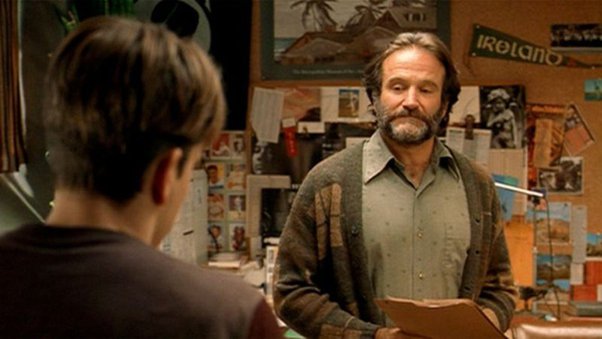
In the movie, Will (Matt Damon) told his therapist Sean (Robin Williams) about a recent date with a girl he liked. Sean asked if they were going on another date and Will said he didn’t know because he hadn’t called her back. Sean called Will an amateur.

Then Will said “Don’t worry about me. I know what I’m doin’. Yeah, but this girl was, like, you know, beautiful. She’s smart. She’s fun. She’s different from most of the girls I’ve been with.” Sean urged him to call the girl. Will continued, “Why? So I can realize she’s not that smart? That she’s fuckin’ boring? You know, I mean, you don’t. This girl’s, like, fuckin’ perfect right now. I don’t wanna ruin that.”

Sean replied, “Maybe you’re perfect right now. Maybe you don’t wanna ruin that. But I think that’s a super philosophy, Will. That way, you can go through your entire life without ever having to really know anybody.”
In the darkeness of the theater, Jeff and I turned our heads to look at each other. His expression matched mine. Jaw slack and wide eyed. Our earlier interaction matched the movie nearly word for word, just with less swearing. It’s as if Matt Damon and Ben Affleck were time travelers and they eavesdropped on our future discussion when writing this scene. We walked out of that theater questioning ourselves. “Did that really happen? Did we recreate the movie before even seeing in it? Was our life imitating art? And how could we recreate art with no prior knowledge of the art we copied?

The movie also made me cry. Seeing Matt Damon break down into tears as he and Robin Williams’ embrace at the end of the film is enough to melt the coldest heart. Good Will Hunting impacted me in other ways. Lines like “How do you like them apples” and “Go with the wrench” and “It’s not your fault” have become permanent parts of my vocabulary. As an autistic person I’ve always used song lyrics, movie dialog, and literary quotes as substitutes for original communication as a way of masking my social awkwardness. It’s called scripting.

It shouldn’t need said, but Good Will Hunting remains one of my favorite movies of all time. I’ve lost count of how many times I’ve watched it.

My oldest son has been struggling lately as he is trying to figure out how to adult. After he got some discouraging news recently, I figured he and I needed a movie night. Something to help him feel better. A reminder that it’s not his fault. Naturally, I chose Good Will Hunting. He’s roughly the same age now as when I first saw the film: halfway between 18th and 19th birthdays. He is, like I was, going through transitions, trying to discover who he is and what he wants from life. Confident yet insecure. Opinionated yet confused.

Thankfully, he really liked the movie. I don’t think my ego would have survived if he said it was dumb. Then we talked for a bit. Thomas already knew about the girl and the saga of me never asking her out. I’ve told him the whole story before because it includes one of the few times I believe I audibly heard God speaking to me. When the movie was over, he asked me if I regretted not asking the girl out, much the same way Will asked Sean if he regretted meeting his wife. I told my son no. I have a lot of regrets, but not asking that girl on a date isn’t one of them. We talked about a couple other things and Thomas let me know he felt better after watching the movie. Mission accomplished.

Aside from getting my son’s impression on one of my cinematic favorites, I also had an unexpected observation about myself.

The first time I watched this movie, I identified so much with Will. Unlike him, I wasn’t abused or shuffled around different foster homes. I had parents who loved me. I was not as violent. I didn’t smoke, didn’t drink alcohol. But I was insecure and angry like Will Hunting. Both Will the character and Nic the kid were well above average intelligence failing to live up to our potentials. I saw him as a more delinquent version of me. Repeat viewings never changed the connection I felt to Matt Damon’s creation. But something different happened last night. For the first time, I related more to Robin Williams character. I felt more like the therapist Sean than the patient Will.
It’s not 1997 anymore. I still need to improve myself. But I’m not the lost, insecure, and directionless kid I once was.

During the same counseling session where Will and Sean talked about Will’s date and the possibility of more, Sean said “You're not perfect. And let me save you the suspense, this girl you met isn't either. The question is, whether or not you're perfect for each other.” I feel this in my soul these days. Annie and I both know we’re not perfect people, but we are perfect for each other.

When Will challenges Sean, the therapist replied, “I teach this shit, I didn't say I knew how to do it.” If there was a line from Good Will Hunting that resembles who I am today, that would be it.

9.05.2022

The New Breed

Kids these days. When I hear that phrase in normal conversation, it’s usually uttered with a scowl and a hint of disdain. It’s always a complaint about the younger generation. They’re weird, disrespectful, and don’t follow any of the rules. The irony is often overlooked - the people voicing their ire against the youth are regurgitating the same complaints older folks had about them when they were teens.

Kids these days. When I say it, it’s spoken with awe and hope. They are weird, and it’s wonderful. They’re brilliant, smarter than their elders want to acknowledge. They’re devious by necessity. And they don’t do anything the way it’s always been done.

There is something different about how they rebel than generations before them. My parents’ peers rebelled with bell bottoms and long hair. My generation rebelled with ripped jeans and feedback fueled guitars. At the end of our wild days, from the elder millennials upward through the baby boomers, we found our way into the workforce just like the generations before us. We hashed out our need to be different then learned to be the same.

Kids these days don’t have the liberty to do what we did. They rebel because they don’t have any other choice. From education to business, into every corner of entertainment from sports to art, to the way government functions, kids these days are taking a different approach than the way we’ve always done it because our paths are not available to them.

Kids these days watched the concept of a career and job security evaporate for their parents and grandparents. They’ve observed the decorum of the general public devolve in recent years. They know the economy the rest of us enjoyed doesn’t exist anymore so they’re doing things differently. If they must work with the public, they’re doing it on their own terms.

20 year old musicians have never lived in a world without American Idol. Teenagers don’t know what life was like before YouTube. The idea of break out viral stars has been a part of their collective consciousness since birth. The days of mailing demo tapes to record labels is ancient history to them, and kids these days are using social media to release music whenever they want.

Literary publishing is adapting to meet younger trends. Kids these days never typed out a manuscript on a typewriter, never waited at a Kinkos while their book was printed, and never used snail mail to query agents. It was never required of them. Technology has made it easier for young writers to self publish, connect with agents, find editors, and sign deals with publishers through Twitter and TikTok.
Kids these days are accomplishing mind boggling feats in athletics, destroying nearly every record that ever existed. Technology and science has made sports safer, kids more adaptable, and injuries easier to heal.

Politics are wild for kids these days. It’s been 23 years since the Columbine shooting. New voters registering to vote for the first time in their lives have grown up with active shooter drills. There’s never been a time in their lives when mass shootings were not a thing. They’ve spent their whole lives in a post-9/11 world. The only thing they’ve experienced from our government is nepotism, deep partisan divisions, culture wars, and the ever growing wealth gap. If they seem politically radical, it’s because we created an environment that fosters racialism.

Old folks these days. Some of y’all look at kids these days the same way Anakin looked at the younglings in the Jedi Temple after he turned to the dark side. Y’all fear what you don’t understand and want to destroy anything you can’t control.
courtesy of Lucasfilm

You think kids these days are weird because they are. We made them this way. Kids these days are a new breed of human, diverging from the way things have always been done because we gave them no other choice. For better or worse, the future belongs to them. Once we’re gone, this world is theirs.

There is one thing clear to me about these younglings: they are going to change the world. They’re doing it with or without us. The rest of us need to be more like Obi Wan, less like Darth Vader. If we’re not ready to help kids these days, it’s time for us to get out of their way.
courtesy of Lucasfilm

4.21.2022

Imposter Syndrome

Somewhere out there, a debut author is struggling. They can’t believe they were lucky enough to find an agent, let alone get their book published. If you ask them, they’re not really good at writing: their story is weak, their characters are derivative of other works, and their sales numbers are a fluke. They don’t think anyone will ever read a second book from them, especially if readers understood what a hack they are.

Someone out there, a songwriter is making a living playing the music they created. They’re standing on stage in front of an audience that’s singing along. Yet they don’t understand how so many people know their music. There are hundreds of better singers and better guitarists. They wonder how they got so lucky to have fans in attendance and songs on the radio when better musicians can’t even get a gig at a seedy bar. If only people knew how talentless they were, they’d have to abandon the music industry for a normal job.

Somewhere out there is a thespian surprised to be offered a lead role after auditioning for the part. Despite acting in professional theater for decades, receiving dozens of rave reviews, and getting critical praise from local media, they don’t feel like they deserve any of it. They memorize lines and dance routines, wear stage makeup and change costumes, and faithfully attend every rehearsal and performance. Yet somewhere deep inside, they feel like a fraud.

This is what it’s like for people who experience imposter syndrome. No matter how often they’ve proven their skill and competence in their chosen craft, regardless of the level of success they achieve, they feel like an imposter. They believe themselves to be unworthy, undeserving, and incapable of the recognition they receive. They often feel guilty for their successes and deny any complimentary description of their work. Unfortunately, no amount of book, album, or ticket sales can cure imposter syndrome because it’s not an actual diagnosable disorder. It’s a reaction to external stimulation, possibly a symptom of other disorders like depression or autism.

If you feel like you’re an imposter in your occupation, rest assured you’re not alone. If you’ve ever thought to yourself “if they ever found out what I’m really like, my career would be over,” you’re in good company. Those who have publicly admitted their struggles with imposter syndrome include some people who were the best at what they do.

Like poet and civil rights activist Maya Angelou.
Or one of the stars from the Harry Potter franchise, Emma Watson.
Or the prolific writer, Hugo award winner, and delightful weirdo Neil Gaiman.
Or former First Lady Michelle Obama.
Or the 10th (and my personal favorite) Doctor, David Tennant.
Or the enigmatic and brilliant front man of Radiohead, Thom Yorke.
Or one of the celebrated and busiest stars in Hollywood, Tom Hanks.
Or the master of horror, Stephen King.

Those of you suffering with imposter syndrome can also include me in your ranks. As a writer and a DJ, I have severe doubts in my talent. No matter how frequently people tell me they enjoy my writing, I still think I’m skeptical I have what it takes to be successful. Regardless of how many clients leave positive reviews of my gigs, I don’t believe I’m that good as a DJ.

It’s not just my creative pursuits either - I feel like an imposter in almost every aspect of my life. If my kids do something amazing, I don’t understand how I got so lucky to be their dad. If someone compliments how well behaved my kids are, I think they definitely didn’t learn it from me. Almost daily, I think to myself that my kids deserve a better dad. Or my wife deserves a better husband. Or my parents deserve a better son.

I’m a farmer with imposter syndrome too. I frequently walk out to the barn thinking to myself how completely clueless I am about all of it. I’m just a nerd from the suburbs, what the hell do I think I’m doing out here taking care of chickens and goats and horses. Every time something bad happens on the farm, even if it was an act of nature, I blame myself.

I don’t need pity or sympathy. I don’t expect anyone to fix this broken spot in my brain. Rather, I offer kinship. You are not alone.
But there’s more. While I want to offer the raised fist of solidarity, I also come with a challenge. There is another place where I experience imposter syndrome, and it’s a place where I shouldn’t feel this way. While no one can cure the voices in my head telling me I’m a fraud everywhere else, this one location can be resolved: church.

Despite believing in the same God, loving the same Jesus, trusting in the same saving grace, I feel like an imposter every time I step inside a church building – like their beliefs are completely incompatible with mine. Or maybe my beliefs are incapable with theirs.

When I attend church, I sit in the pews (or a chair in a neatly arranged row) and contemplate the possible qualms the people around me might have with me. While the pastor preaches, I wonder “what if they really knew?”

If church folk knew I agree with Black Lives Matter, support athletes who kneel during the National Anthem, and think Christians are failing miserably in racial reconciliation, would they want me in their church?

If church folk knew I think the money they spend on TV monitors, soundboards, websites, video graphics, and bouncy castles could be better spent on feeding the homeless, would I be welcomed?

If they knew I was not only accepting but also affirming of the LGBT community, would they kick me out?

If they knew I disagreed with the way they presented the gospel, or if I think the way they teach biblical principles is incorrect and possibly harmful, would they call me an apostate or heathen?

If they knew I refuse to vote for a Republican, would they excommunicate me?

If they saw me drinking a mojito, or dancing while I’m DJing, or buying tickets for an R-rated movie; if they heard me cuss, or sing along with some of that “devil music,” or promote deconstruction; or if they didn’t hear me proselytize in conversations with my atheist, Muslim, and pagan friends, would they keep their distance or shun me?

I say this can be fixed because I shouldn’t have to feel like an imposter in church. That should be the one place where I belong. Since I don’t feel that way, there are two solutions.

1. I stop attending church.
2. Christians everywhere openly and honestly examine their beliefs and why they believe what they do.

The latter option would require people to change - a process that can be uncomfortable for many – even scary for some. If this were to happen, it would transform the physical spaces where Christians meet, turning them into safe spaces for members and visitors to doubt their doubts and believe their beliefs. It would be a home for those who are wandering, lost, hurting, or broken. Churches should be accepting of where and who we are now while challenging us to grow and improve. Churches should welcome and not condemn sincere questions. Diversity of thought should be invitations to productive discussions instead of angry debates.

The first option would be a whole lot easier. As tempting it is, I love God so much that I am moved to care about God’s people, even if they don’t care about me.

So I go. I feel awkward and out of place. Until American evangelicals pull their collective heads out of their collective asses, I will continue feeling like an imposter.

But what’s new? I’ve been an outcast my entire life.

3.15.2022

Light in the Darkest Hours

It was a song from an underground hip-hop collective: lo-fi beats, heavy turntablism, and cypher styled rap verses: “The Night We Called It a Day” by Deepspace5. This song (along with the rest of their debut album) helped me fall in love with the art and culture of rap music. The track opened with a melancholic acoustic guitar sample and the static of vinyl before the DJ starts scratching records. In the scratches, there’s a single spoken line, broken up with the flick of the DJ’s fingers.

“Those who need light - light-light - for those who need light in they darkest hours - in they darkest hours”
It’s like a grown up version of “This Little Light of Mine” for those who enjoy coffee shops and old school beats. Millions of kids listen to hip-hop as a means of escape. They enter it like a refuge - an oasis in the desert of urban violence. I understand them. I once used grunge and punk rock as a safe place from the torment of the bullies who verbally and physically abused me through my teen years. It was my light in my darkest hours.

Even though it’s been a while since I’ve listened to the song, I still get this Deepspace5 phrase stuck in my head, repeating like a mantra. I walk around with those nine words on repeat. For those who need light in they darkest hours. They darkest hours. Light in they darkest hours. Then I see those in their darkest hours who need some light and feel moved to speak up, to do something.

These days, those who need light in they darkest hours are easy to find. Between school shootings and police violence, natural disasters and pandemics, extreme politics and foreign wars, there’s a lot of light needed for a daunting number of people in their darkest hours.

Not everyone seeks light from darkness. Many seek light in darkness. While it seems counterintuitive, there are those who find light through scary stories. Whether told around campfires, read in pulp novels, listened to in true crime podcasts, or watched on the big screen, the elements of horror can distract us from the frights of real life. Somehow the darkness of vampires, werewolves, ghosts, and aliens are brighter than homes filled with abuse and addiction.

Kids will watch a slasher movie and think “if the final girl survives the masked serial killer hunting down teenagers, then I’ll survive my abusive parents.” Those in pain will read books about an exorcism and think “if the demons can be cast out from this possessed child, perhaps I can conquer my own demons.” Laughing at jump scares in video games help some kids feel less fear when police arrive to defuse a domestic disturbance.

So why do I love the horror genre? I was raised in a safe community by two parents who loved each other with no darkness to escape. My parents were not abusive. Despite being poor, they fed me and kept a roof over our heads. They supported my creative endeavors. I did not endure any major adolescent trauma. I never got into legal trouble. I was socially awkward but still had a few great friends. My parents didn’t even allow me to watch scary movies. Aside from being bullied, I had a decent childhood.

And I have a good life today. My parents are still together after nearly fifty years of marriage. I am married to a woman who loves me more than I knew was possible. I have a great job. I’m DJing and writing and farming and raising kids and have a life so full I could burst. Between the dogs and the horses and the family, I am surrounded by a loving support system and many reasons to celebrate. Yet I still crave books by Stephen King and Dean Koontz. I’m enraptured by movies from Jordan Peele and Guillermo del Toro. I’m still thrilled when a creepy book or game keeps me awake all night. It seems I seek darkness in my brightest hours.

Thanks to the world of podcasts, I think I understand my unique proclivities. While driving around the INW for work, I’m listening to storytellers do what they do best. Hood Politics, Murder Myth & Mystery, The Secret Room, Haileywood. If iron sharpens iron, I hope to hone my own abilities to craft engaging tales.

In a recent episode of Morbid, Alaina Urquhart and Ashleigh Kelly shared stories of haunted lighthouses in America. One of those spooky landmarks is the Bolivar Point Lighthouse in Galveston Texas.

When a hurricane entered the Gulf of Mexico in 1900, H. C. Claiborne (the lighthouse keeper) wasn’t worried. He had purchased enough food to last through the season so he and his family could remain at Bolivar Point for a few months, and the lighthouse structure was strong. Claiborne was confident it could withstand any storm.

image courtesy of Lighthouse Friends

As you could imagine, meteorology was not as technically advanced at the beginning of the 20th century as it is today. No one was sure where the hurricane would make landfall. The big waves thrust into the shores of northeastern Texas became a spectacle with thousands of curious people crowding the beaches of Galveston Island and Bolivar Peninsula. Many of the onlookers ignored the warnings of local officials urging them to move inland and seek higher ground. By the time the storm surge reached land, it was too late. They were experiencing the deadliest natural disaster in American history.

It could have been deadlier - and would have if it had not been for Claiborne. The rising waters stranded a train with more than 300 passengers near the Bolivar Point lighthouse. They waded through the waters to reach the door of the tower. Claiborne opened it up and let in at least 125 of the passengers before he had to close and barricade the door.

Those who sheltered in the stairwell of the lighthouse found safety, but not comfort. Two or three people sat on every step of the spiral stairs, from the flooded entrance to the top level where Claiborne continued to perform his duties keeping the light shining to guide wayward ships into Galveston Bay. In the dark of storm and night, Claiborne rationed his family’s food supplies to make sure the storm’s refugees had something to eat, and the crowd drank rainwater to sate their thirst. What they didn’t know of until after the storm had passed were the bodies piling up outside the lighthouse door.

The Bolivar Lighthouse was a bright spot along the Texas coast. It was a beacon for sailors seeking safe harbor. Yet its greatest moment came when the tower was plunged into darkness and one selfless man saved 125 souls from a hurricane that killed 8000.

Within a week of hearing this story, I listened to a remastered episode of Lore about more lighthouses. The show focused on the reason tales of haunted lighthouses are so prevalent. These landmarks were designed to offer light, guidance, and hope. Yet throughout history, lighthouse buildings have been filled with the loneliness of isolation. They’ve been sites of grief and tragedy; homes to mental anguish, injury, and death. Ghosts may not exist but the reasons people believe they are real are valid.

Then the show’s host, Aaron Mahnke said something that was an a-ha moment for me. From this perspective, it all makes sense.
My interests and pursuits seem unlikely. A good boy raised in a stable Christian home should have never taken a liking to the horror genre. Yet I’ve found myself thriving somewhere between The Tell-Tale Heart and 30 Days of Night. I’ve lived a blessed life while reveling in the macabre.

The book I’m working on features characters enduring some dark events. When I’m done with this, I will begin working on a Christmas themed ghost story about a man haunted by his mistakes. The stories I’m crafting are filled with grief, loss, tragedy, and death - the basis of many of the monsters which lurk in the myths and fables of scary legends and modern lore. It seems Mahnke’s hypothesis is proven in me - my tales of horror come from where my light shines brightest.

In this way, I hope to become what God created me to be: a lighthouse. A place of light and a shelter in storm, often plunged into the agony, muck, and mire of human existence. Then from the darkness, continue to illuminate a way for others to survive the strife of their own lives.

This little light of mine, I’m gonna let it shine, for those who need light in they darkest hours.

11.22.2021

There Might be Something Wrong with Me

When I was in elementary school, my parents wanted to know what was wrong with me. Well, maybe that’s a bad way of phrasing it. They didn’t think I was broken, yet they knew I wasn’t normal. So they did what any parents raising kids in the late 80s would do in their situation: they took me to a psychologist to determine why I’m weird. I walked out of the psych office with an ADHD diagnosis and a learning disability that affects the way I read.
in an absence of available pictures of me from 1987, please accept this substitute courtesy of Amblin Entertainment - disclaimer: I was never that cool

One of the tests the doctor asked me to perform was an exercise where I tapped my thumb to each individual fingertip. Starting with the index finder, then the middle, ring, pinky, then reverse to ring/middle/pointer. He explained kids with ADHD struggle with this task while other kids can do it without thinking. I had to concentrate to do complete the test - and even with total focus I still came close to screwing it up a couple times.

These days I can tap thumb to subsequent fingers back and forth at a rapid pace nearly instinctually. It’s a nervous habit for me, a tick I do whenever I’m anxious. If the same shrink who evaluated me over 30 years ago saw me again today, I’m not sure if he’d reaffirm my ADHD diagnosis because I would ace the finger tapping test with unquestionable perfection.

Neurotypical people would describe my compulsive finger taps as fidgeting. For those of us on the autism spectrum, it’s called stimming - or self stimulating. And yes, I said “us” because I have autism too. If my parents wanted to know why I was so quirky, this is why. Perhaps if Reagan era psychology had a better understanding of autism, I would have been given a proper diagnosis. (That’s not to say I don’t have ADHD. ADHD and ASD are frequent co-occurring disorders.)

Stimming helps people with autism regulate themselves. It is great for me in the moment; unfortunately, it is only beneficial while I’m doing it. If I’m unable to reel in my nerves while repetitively thumb tapping my fingers, my nervousness returns as soon as I cease my anxious habit.

I often wonder how different my life would be if the doctors of yesteryear had correctly identified they way my brain worked when my parents took me in to be evaluated. Would I have found adequate support at Pinewood? Would middle school have been more bearable? Would I have been bullied less? Would I have found helpful coping mechanisms in junior high? Would I have fit in with my peers? Would I have been a better student at MPHS? Would I have completed college and garnered a higher paying job? Would I still be who I am now?

My life followed the rough path to here – now grown with the pressures of adult responsibility causing havoc inside my autistic brain. Between parenting three teenagers, a daughter biologically born from a worthless man, and a baby quickly becoming a toddler, my time is often consumed with kids. Then I have a full time dead end job, weekend DJ gigs, a farm requiring daily work, all while trying to maintain this blog and write my first novel. House chores, errands, bills, car repairs, date nights with my wife, maintaining friendships, support groups, doctor appointments, attempting to eat a healthy diet, and manage some semblance of exercise. It frequently feels like it’s all overwhelming.

Much like Elton John, I’m still standing better than I ever did. Fueled by coffee or anxiety, I keep going, looking like a true survivor and feeling like a quirky little hyperactive kid.

Yes, I know I’m weird. It’s not easy being an adult – a thing even more complicated when you’re on the spectrum. I won’t complain though. Autism makes me a better DJ and provides me a unique perspective as a neurodivergent writer. I’m not Ok but it’s OK. There might be something wrong with me but I’m doing fine.

Still, if you see me tapping my fingers, I wouldn’t object to hearing an encouraging remark.