Showing posts with label relationships. Show all posts

12.18.2025

But what about love?

Every author has a wheelhouse. It’s the thing they compose best, penning the type of stories which interest them the most. I have mine: the nerdy genres.

My completed novel is an adventure in a Middle Earth ish setting. I’ve also finished writing an early reader kids book. My two works in progress are a Christmas themed haunted story and a modern sci-fi about superpowers during a pandemic. If you were to scroll through the list of book ideas on my phone, you’ll see a recurring theme: fantasy, science fiction, and horror.

It makes sense. I was raised on a diet of CS Lewis and Star Wars. As I got older I explored the works of H.G. Wells and Michael Crichton. I spent my high school years secretly watching Star Trek: The Next Generation and X-Files because my parents would have said no if I asked permission. I’ve devoured almost everything written by Frank Peretti, Dean Koontz, and Steven King. A few books from King’s son Joe Hill have also passed through my reading list. The scary and fantastical tales are my wheelhouse.

My wife occasionally challenges me with a genre far outside my comfort zone. “You should write a romance novel.” It’s always a hard pass for me.

“I can’t.” I tell her.

Not an erotic story. She makes sure I know she doesn’t want me to write anything steamy. What she wants from me is a cozy romance like her favorite author Nicholas Sparks.

Still, I object. It’s not a lack of desire fueling my adamant nos. There’s been an idea for a romantic comedy rattling inside my cranium for nearly three decades which I would write if I was talented enough. But I’m not, so I don’t.

Reasons I’m unable to author love stories abound. I don’t read romance novels so I’m unfamiliar with the structure and tropes of the genre. I’m still learning how to write compelling female characters. And my previous attempts at lovey dovey prose sucked. I mean that with ten toes down. They were awful.

In a writing class I took a long time ago in a galaxy far away, the instructor told us there were four primary motivations for creating any form of art: anger, sadness, fear, and love. One could argue there is a fifth inspiration: drugs. But even intoxicated people experience terror, grief, ire, and adoration. “I love you man” says the drunkest dude at every tavern in America.

The teenaged version of me got his start with poetry. It’s all cheesy in hindsight but also decent considering my lack of maturity and experiential wisdom. When I was pissed off I could use words to explain how I felt. When I was afraid, my vocabulary was big enough to feel it. When I was heartbroken, my pen and paper were the only friends who could understand. But when I was in the throes of a crush, words failed me. I didn’t want to write about it, I wanted to experience it in its fullness - natural talents be damned.

My sorrow was internalized but elation was live and in color. Of course, even though I didn’t know it at the time, I was struggling with chronic depression. The religious community around me preached how negative emotions were sinful leaving me with no safe place to express myself. Instead I scribbled away in silence. Until I was happy, then I was free to display my emotions without a worry.

When I finally fell in love, I tried writing poetry to accompany my newfound affections. The end result was terrible. I made more than one attempt. Every repeated iteration was somehow worse than the previous so I eventually quit trying. Besides, it is easier to sing along with love songs than to compose one myself.

When it comes to crazy stupid love, the deeply committed bond with nearly divine intimacy, words are not my forte. I’m not much of a romantic. Just ask my wife. I’m more goofy and awkward. Besides, other people are better at describing these emotions of tenderness and passion.

For example: I’m reading “Watching Evil Dead: Unearthing the Radiant Artist Within” by Josh Malerman. The book is about the twin trajectories of his writing career and his relationship with his wife through the perspective of introducing his wife to one of his favorite movies which she had never seen.
courtesy of Del Rey/Penguin Random House

As Malerman, his wife, and some friends prepared to press play on the DVD and watch 1981’s The Evil Dead, he says the following.

“She’s smiling and it feels like we’re alone on a gently rocking boat. Not that the world is turning but we’re out to sea and we’ve been out to sea since we met. I wonder if that’s a hallmark of love - the two of you could be anywhere but when you look at each other it’s just you two alone on the adventure.”

Just like that, the author of “Bird Box” elloquently explained how I feel about my wife better than I could have imagined on my own. Annie is my partner in adventures both past and future. We have been together for what will be ten years soon and I still get that feeling when I look at her, that sense she is the only thing that matters in my world. I’m not mad at Malerman for beating me to the punch. His words are beautiful, painting a picture I could see but never describe. It’s like he psychically delved into my temporal lobe and recognized the mess of creative ability and shortcomings and said “Me too, I got your back.”

If you want me to tell a story about an ad executive in Seattle who sees ghosts, I can do that. A tale about a kid who reappears simultaneously in multiple cities after being missing for ten years? I’m on it. A dystopian world where death is impossible? Sure, that’s in my wheelhouse. But that romantic comedy about a single lady who caught a bouquet at a wedding and rushes to get married before her best friend’s wedding? Maybe someday, but not any time soon. Although, if that someday ever arrives, my wife will be satisfied.

5.06.2025

The Curse of Creativity

Creative folks are some of my favorite people. I love artists. My dad is a woodworker, my mom a crafter and clothing maker. One of my aunts makes and sells handcrafted stuffed animals, and another aunt produces multimedia art combining photography and painting. One of my best friends is a DJ and a dancer. Throughout my adolescence and early adulthood, I surrounded myself with thespians and musicians. These are my people. As a writer and a DJ, I understand other creatives much better than humans with no artistic outlet.

When my wife and I first started dating, her artistic flair was one of the traits which attracted me to her. She was a photographer and photo editor. We knew early on in our relationship we would be able to work on our crafts separately together - independent in each other’s company. It was a beautiful symbiosis. Over time, I’ve discovered she’s more than a photographer. She’s also a painter and a jewelry maker.

As we are settling into a new house, her creative mind is overclocking. She is an overflowing fountain of decorative ideas: furniture and room colors and flooring and paint and … A couple weeks ago, she saw a picture of a mural painted in someone else’s home then decided she would do something similar in our living room. After receiving zero objections from me, she’s begun the project, still a work in progress. Last weekend, we bought a $5 end table at Habitat for Humanity and set it up in its desired location. Later that evening, she insisted we epoxy it to match the mural she’s painting. It’s now a swirly blue table and looks great.

She has a dilemma though. Her fount of ideas is relentless. It’s a never ending stream of consciousness with no off switch. I hear her say the words “What if we” at least a few times daily. These plans and thoughts and dreams erupting from her cranium are wonderful and delightful. Unfortunately, there isn’t enough time in the day to make all of her artistic longings become tangible.

I have similar struggles. As someone who has studied history and possesses an autistic knack for pattern recognition, it’s hard to watch the news and not guess what’s coming next. Sometimes my predictions are wrong - see my previous blog post for an example. But I can’t make it stop. My brain is wired to analyze if/then scenarios and morph those into digestible stories for others to consume. My furious creativity doesn’t cease at sociopolitical precognitions either. Any time I attend a baseball or hockey game, my brain constantly sorts through my internal jukebox to conjure which songs would better fit the moment than the songs selected by the stadium or arena’s in house DJ. And my writing … book ideas are piling up in the notes app on my phone and I know I’ll never live long enough to author all of them.

This is the curse of creativity. We are imaginative 24 hours a day. When we wake, when we sleep. When we struggle, when we thrive. Our brains are constantly visualizing new worlds, new words, new images, new melodies, and new possibilities. We can’t quit; it’s a part of what makes us who we are. To complicate matters - we all have day jobs. At least, those of us who haven’t retired have day jobs. Time card punches don’t stem the tide of creative musings. We get new ideas nearly all day every day. Some of us manage it better than others, and I am not one of them. But I try. My notes are meticulous and abundant. Book ideas, reminders to add certain songs into specific playlists, and board games I want to buy for family game night, I keep a record of it all. The noise never ends so I channel it as best as I can.

If this sounds like you, fear not. You are not alone. The curse of creativity is accompanied by a life of beauty, wonder, and awe. It might be devastating as much as it is comforting. In the creative curse you’ll find catharsis, healing, confusion, and purpose but only if you allow it. To thrive as an artist, you must always be ready because inspiration may strike at any (and often peculiar) moment.

My brother-in-law lives with us. He’s got a multitude of disabilities which prevent him from living independently. My wife is his caretaker and he’s our third wheel. Caring for and about disabled individuals can be frustrating so I attempt to have as much fun with him as possible. One of my methods to enjoy time together is to call him silly names. When I wake him up in the morning, or call for him to get shoes on so we can go somewhere, or bring him his bedtime snack, I’ll call him something absurd.

“Hey nacho cheese … ”
“Hey Larry Curley and Moe … ”
“Hey Macarena … ”
“Hey there Delilah … ”
“Hey Steven Michael Montgomery … ”
“Hey turducken … ”
“Hey spic n span … ”

Sometimes he’ll laugh. Sometimes he says “Stop iiiiit.” Sometimes he’ll let me know I scared him. Regardless his reaction, I always get a smile - enough to make the effort worth it.

Last night, with a banana in my hand, I approached his room intending to say “Hey dune buggy” but there was a short circuit between my frontal lobe and my lips because what I actually spoke did not follow my plan. When I say inspiration can appear at the strangest moments, the interaction with my bro-in-law last night is proof of concept. I blurted out some gibberish twist on dune buggy when the moment arrived. I handed him the banana while my hippocampus lit the beacons for Gondor. As I walked away pondering my verbal blunder I thought, “That would be a great name for the main character of a novel.” I unlocked my phone, opened the notes app, and created a reminder of an epic character name I need to use some time in the future.

What’s the name you ask? Well, an author needs to keep some secrets. I wouldn’t want to ruin the surprise.

9.19.2024

Wanderlust and the Source

Bedtime is sacred in our house. Not because it’s the routine shutting off all the lights and closing our eyes to sleep. Annie and I value it because these are the precious few minutes we can chat and connect free of interruptions from kids who don’t appreciate their bedtime as much as we do.

In these final waking hours of our day we share the best and worst parts of everything happening before we got home. We air the stresses we cannot share with anyone else. We comfort each other as lovers and encourage each other as teammates. We create to-do lists and bucket lists. We set reminders on our phones so we might recall those things our ADHD is prone to forget. We mutually doom scroll social media side by side, occasionally holding our phone to the side with instructions, “Hey check this out.” We ponder the benefits and challenges of various ideas. We talk religion, sex, and politics. We discuss plans for both the immediate and distant future. And, most importantly, we dream together.

This is the key ingredient for the magic binding us together. When we think of what life will be like five years ahead or fifty years from now, we envision our hypothetical future lives as a cohesive unit. These are shared aspirations, not individual exploits. We have had this ingrained in our relationship as long as we’ve known each other. On our second date, we talked about places we’ve always longed to visit. She said she wanted to go to Scotland to see her ancestral homelands. Two of my bucket list destinations (Paisley Abbey and Loch Ness) happen to be in Scotland. We laughed and smiled at the idea of going there together and fulfilling our dreams at the same time.

Annie and I both have an insatiable wanderlust. We feel the tug of the journey on our hearts. Places exotic to historic, from pristine wilderness to ancient ruins, waterfalls and temples, castles and farmers markets. We want nothing more for our lives to go, and see, and do. We yearn to wander foreign lands and disappear for a while.
Real, actual, legitimate picture of us.

Earlier this week, I told my therapist how I believe the best education we can receive is found outside our own culture. As much as I would enjoy a trip to Disneyland to hang out at Galaxy’s Edge, I would rather visit the original Tatooine Star Wars set in Tunisia. Given the choice between a week at Universal Studios or traveling to India during Holi, I would choose the later. Annie would do the same. The selection of culture over capitalism is an easy one.

Unfortunately, Annie and I grew up believing travel was for other people. Both our families were poor and the expense of overseas excursions was too daunting - an unobtainable wish left to wither on the vines of our dying hopes. This wanderlust ached in our bones and called our spirits yet we felt confined to weekend roadtrips and local attractions. We wanted to see the world but doubted we would ever be globetrotters.

All it takes is one little break to shatter the exoskeleton of false beliefs. Two and a half years ago, a new job sent me to Tampa Bay for three weeks of training. Annie and our two youngest girls flew out to visit a weekend while I was there so we could partake in a family Florida adventure. It was the nudge we needed to shed the idea we weren’t meant to travel. How could we hold on to such a concept while doing the thing we thought we’d never be able to do. A few months later we went to Waikiki to celebrate birthdays of mine and Steven’s. Then a month later we were on a cruise boat to Alaska for our belated honeymoon. Since then we’ve made a return trip to Hawaii along with little jaunts to Cheyenne, Boise, Portland, Cranbrook BC, and multiple trips to Tacoma/Seattle/Everett.

We’re not ready to quit. Between now and the end of the year, our feet will tread ground in Mexico, Costa Rica, and Columbia adding three stamps to our passports. Not long after, I’ll be headed to Phoenix with one of my best friends for a DJ gig. Next year, Annie and I have plans to take the family yurt camping for a week and we’ve already booked a vacation to the Bahamas.

Over the last few years, we’ve suddenly began living a live we never imagined would be possible for either of us. We’re finally able to sate that insatiable wanderlust. Our journey begun, we’re only getting started.

After explaining all of this to my therapist, he shared with me a quote from Carl Jung:
According to my therapist, this is what I’m experiencing. After turning forty, I began to truly discover who I was and define my priorities. Now forty-five, I’m finally able to be the person God created me to be. Everything before this was just research. He thinks it’s awesome to watch me discover myself, to see joy unfold in real time. He’s had a front row seat to witness anxiety and depression melt away as I become the real me.

So here we are, Annie and I are world travelers, dreaming of distant shores. But I think I’ve always been one even before I was one. My wanderlust had to come from somewhere.

I was never a good student. I was lucky to get a B in anything. Through most of my academic career, I barely held on with a C average. In sixth and seventh grade, my report cards were filled with Cs and Ds. I got my first A in eighth grade - not just a basic A - but perfect scores throughout. I ended this class with 100%, an A+.

Annie and I chilled last night, enjoying our bedtime routine. I brought this up with her: my discussion at therapy, how excited we are about upcoming travel plans, and other places we want to go (side note: she’s been looking at cheap airline rates to various European locales). Then I posed the question about my school days. After a string of barely passing grades, in which class did I get my first A? She responded without hesitation.

“Geography.”

Correct answer. I struggled in traditional education until the geography class mandated for all junior high students of my generation in the Marysville school district. For the first time in my life I didn’t just succeed, I thrived.

Perhaps I missed my calling as a tour guide or a travel agent. Maybe that is my life in an alternate universe. In this dimension though, I had to wait until my 40s to figure out I was always meant to be this person. Looking back though, I should have known all along. I should have realized this fact about my personality when I was a teenager. I grokked geography because deep down my soul hungered to be there. Every map, every capital city, every monument we studied was a potential destination. I was meant to fly, or drive, or float to anywhere other than here. Or teleport if such technology ever becomes viable.

5.15.2024

Oh to Be a Writer

During a recent dinner date, my wife and I talked about some of my recent work - primarily my fanfic suggestions for a Christmas special in the MCU along with Marvel's upcoming Deadpool and Fantastic Four movies. I admitted to Annie how all my blog posts and tweets about things I wish to see in the MCU are really auditions to be a member of Disney/Marvel’s writing team. After all, I’m just a big fan with a fondness for storytelling and thorough understanding of comic book lore. She let me know I should be careful which dreams I share with her because she might just find a way to make it happen.

Then she asked, “How does one become a writer at Marvel?”

I explained in terms I know best: music. “These behind-the-scenes roles like writers and directors, it’s like the Drake song - started from the bottom now we here. Started from the bottom now my whole team here.”

Disney is an empire. Marvel is a behemoth. The people who tell their stories don’t just show up out of nowhere. They did something small. Then more small stuff until one of those projects got attention allowing them to do bigger things. Then they make a good impression through those bigger projects until the decision makers at Marvel Studios asks “Hey, do you want to do that, but with us?”
To prove my point (because I have autism and constantly feel the need to prove myself) I did a deep dive into the writers of the MCU.

First up: Iron Man. Before writing this script Mark Fergus and Hawk Ostby wrote the critically adored Children of Men.

Zak Penn, writer for The Incredible Hulk, worked on Men in Black, Behind Enemy Lines, and Reign of Fire before penning the MCU’s second film.

The writer of Zoolander and American Psycho was selected for Iron Man 2. The two movies he did before joining the MCU were Tropic Thunder and Megamind.

Two of the three writers for Thor got noticed for their work on Agent Cody Banks.

The script team for Captain America: The First Avenger wrote five movies before working for Marvel. Three of those films were Narnia adaptations: The Lion the Witch and the Wardrobe, Prince Caspian, and Voyage of the Dawn Treader.

2012’s The Avengers was written by Joss Whedon who had a prolific career before working with Marvel. He’s most well known for two things - writing, directing, and producing Buffy the Vampire Slayer; and for being a terrible and toxic person to practically everyone who’s worked with him.

And that’s just the first phase of the MCU. They’re now in the fifth phase with phase six starting in the spring of 2025. Marvel is still using people that proved themselves elsewhere like taking a dude that wrote for Rick & Morty, The Onion News, and Jimmy Kimmel to pen the script for last year’s Quantumania.

The same is true with the MCU TV shows. Before Moon Knight, Jeremy Slater wrote for The Umbrella Academy. Michael Waldron did scripts for Rick & Morty before helming the first season of Loki.

All of these screenwriters wrote cool things, got noticed, and then joined the Marvel fold. Writing for Marvel isn’t a stepping stone, it’s the destination.

One that note ...

Hi Marvel, I’m Nicholas Casey. Author, nerd, and cinephile. I wrote a book and hope to get it published soon. I’m also a fan. Hire me. Please?

5.11.2024

Once a Poet …

My brother graduated high school in 1992 which was the end of my seventh grade classes. It’s also the year grunge broke big. Pearl Jam’s Ten was released right before school started, Nivana’s Nevermind followed a month later, and by October Soundgarden unleashed Badmotorfinger. I was immune to grunge though. Aaron was a heavy metal fan which strongly influenced my musical preferences. A year earlier, most of the kids my age listened to George Michael and MC Hammer. Thanks to my conservative religious upbringing, I was led to believe grunge was inherently evil.

That all changed when I entered eighth grade. Two big albums were dropped in the fall of 92: Core from Stone Temple Pilots and Dirt by Alice In Chains. When my math teacher offered the class permission to select background music, my friend Matt nominated Dirt. “It’s brand new, just came out.” Class lasted 40 minutes so we didn’t have time to play the whole record yet those first few tracks blew me away. Them Bones, Dam That River, Rain When I Die, Down in a Hole. Whatever worksheets we were supposed to be doing is lost to my memory. Mathematic exercises were instantly irrelevant. I spent the remainder of class staring absently at the numbers on the paper in front of me, devoting all of my attention to the driving drum beats, low bass growl, and distorted guitars. My ears clung to every lyric as the vocals alternated between Layne’s manic howl and Jerry’s moody harmonies.

Within the next year, nearly all of my school friends were starting their own bands, including Matt who brought his brand new Alice In Chains tape with him to math class. I was not a good singer and I couldn’t play any instruments but I still loved the world of creating music. Matt suggested I start writing songs. If they were good, his band might use them. I had never written a song before so I asked him for tips. His advice was to pick a random word then write about how that word made me feel. A couple nights later, while bored and sitting in the back row pew of a Sunday night church service, I used the blank space of an offering envelope to write my first song: Reach.

This was the birth of my writing journey. Those first few songs I wrote were nothing more than poetry with a repeating refrain. We lived in the Seattle suburbs, Kurt Cobain was still alive (at least for a few months longer), and I was all in with grunge. The songs I wrote never got used but I kept writing. The song structure became looser until I was writing straight poetry and (according to friends of mine) I was prolific. I continued this habit into my early twenties.

Fear, anger, and pain fueled my prose. A lot of my poetry also contained themes of unrequited love. Loss. Regret. It was the essence of all the stereotypical teenage angst you’d expect from the mid-90s.

Then I fell in love at 23 and discovered I couldn’t write a romantic poem even if my life depended on it. I’d never compose a decent love song. My poetic output decreased, eventually dwindling into nothing. By the time I was 24, I was no longer a poet.

My creative outlets shifted to essays. For twenty years I’ve maintained the storytelling tradition through both fiction and non-fiction. You can’t kill an inner poet though. In the wake of divorce, I penned a couple new poems - an act of pure catharsis. Grief and turmoil were always my greatest muses. Over the years after, I’d unearth my poetic mindset and compose something new. Then put it away and move on.

When the question of women choosing between a bear and a man recently started trending, my wife told me I should write a poem about it. I balked at the idea. I couldn’t do it - it’s been years since I’ve been a poet. I don’t have it in me anymore. Even in the middle of denying my wife’s suggestion, I already had a couple lines swimming in my cranium. Within 24 hours, I wrote a new poem: Choose the Bear.

In the days that followed, my inner poet re-emerged. Two more poems were scribed in quick succession. Annie recorded me reading Choose the Bear and you can find it on TikTok. The next poem, A Weird Combination I Know, will be shared soon but the other, Early Onset Alcoholism will remain hidden for another year. Annie is also pushing me to try out some open mic nights to share my poetry with a larger audience.

Through this process, I’m rediscovering something I knew to be true when I was a teenager: poetry has the power to divulge those feelings you can’t describe in simple conversation. Since my autistic brain has difficulty expressing my emotions, poetry is giving me a chance to process trauma and release all this grief I’ve never been able to grieve.

My wife and I have been dragged through hell the last couple years. Outside forces have been doing all they can to tear us apart but their efforts have only bound us closer together. Somehow it feels the poems I write have more power because I’m speaking for both of us.

This new creative muse is providing more than just catharsis, it’s also healing. Because there’s shit from my childhood I’ve still not processed. There’s shit from my first marriage that I’ve never talked about. And there’s shit flung at my wife and I that I’ve kept quiet.

Until now.

Annie and I have full custody of our younger two children. We only had to split custody with my older three kids. The first is 19 and lives independently. My next daughter is 17 and in the going-to-do-whatever-she-wants-to-do phase and there’s nothing I can do to stop it. My son is in jail and will be until he’s almost 18. This era of co-parenting is coming to an end.

For the last 11 years, I’ve tried as hard as I can to keep my mouth shut and take the high road. My ex-wife continues to violate our custody order and makes every attempt to stir up chaos in my life. Her reasons are unknown to me but my happiness seems to offend her. With these factors at play, my gloves are off. I have nothing to lose. We need peace and I’m finding it in poetry.

Ps: I’ve kept everything I wrote in the decade between the ages of 14 and 24. It’s all squirreled away in a box somewhere in the garage. Perhaps I’ll need to revive them and re-write them, transform them into something a little less angsty and juvenile.

3.18.2024

Home, Away, and the Weirdness of Being

During our last trip to Hawaii, my wife and I went on a late night walk along Waikiki beach. We stopped to dance when passing by a bar with a musician playing music on an out door stage, watched some fire dancers practice free from the massive daytime crowds, and lingered along the shore while the sound of waves filled the silence around us. Backlit by the vibrance of skyscrapers and hotels with the expanse of starry skies and endless ocean before us, we soaked up all we could get. There was a life giving energy to the moment, a breath to revive our weary souls.

With my arms wrapped around Annie’s shoulders she told me how the time we spent there felt more real to her than anything else. We conversed about how important these trips were to both of us to connect with each other. It was a reminder of why we work so hard and love the way we live. We both have wandering spirits, a wanderlust hardwired into our being. It’s more than existing as soulmates, it’s as if we were created to see the world together.

We know there is life after kids, a life approaching faster that we could ever prepare. When we travel, whether it is a weeklong journey or a quick weekend excursion, we get glimpses of the way life could be, or the way it was meant to be. It’s a preview of a future when we no longer have the worry of homework, softball schedules, school dances, and convincing kids the importance of personal hygiene and household chores. Our bucket list is perpetually growing and it is our hearts desire to continually find each other through chasing destinations.

Thing is, we are not wealthy people. At least, not financially speaking. We eat cheap. We don’t maintain expensive smoking and drinking habits. We pursue affordable entertainment options. If free is an option, it’s our preferred choice. When we leave town, we stay in low cost hotels. We get the the cheap interior rooms on cruise boats. We look for bargain flights. We pack snacks for road trips. Mock us for our thriftiness but our budget consciousness enables our ability to pursue our dreams.

We also know we are blessed. We understand our traveling hobbies are not options available to everyone. We are aware we live, work, and travel to places impacted by addiction and poverty. Annie is better at it than I am, yet we both endeavor to use our privilege to benefit others. Life is fragile and there is no knowledge more present than the fact nothing is promised. We enjoy these opportunities while we can as frequently as possible because we might not be able to do this forever.

We escaped home again this last weekend for a family road trip to Boise. Saturday was one of the best days I’ve had I a long time. We visited a zoo and a historical site. We stayed in a cheap hotel. I introduced them to my favorite Mexican restaurant. My eleven year old daughter begged me to take her to more museums. We learned new things, bonded over fresh experiences, found joy together, bought souvenirs, took goofy photos, and refreshed our weary souls.
photo courtesy of Andria Casey

Now we are home again. We have resumed the regular routines of day jobs and school. My body is worn but my heart is full. Walking around downtown Spokane this morning, I had a revelation similar to the sentiments my wife expressed in Honolulu roughly this time last year.

Our time away seems more real than our time at home. Walking around downtown Spokane this morning, I sensed this oddness deep in my bones. Real life feels weird. Road trips to Seattle, Portland, Boise, and Cheyenne; flying away to Florida and Hawaii; cruises to Alaska and the Bahamas - these trips tire is out but fill our hearts. When we go we are closer to who we are to who we are than the daily grind of earning paychecks of conversing with colleagues. Our family’s heartbeat is found in miles traversed. Granted, we must return. The income of day jobs and weekend gigs fund our dream life away from home. Still, every time we go somewhere it becomes harder to readjust to normal life.

Then again, I’ve been weird my whole life. It’s time to embrace the weird until we can go away again. And again. And again.

3.15.2024

The Disconnect and Ties that Bind Part Two

My maternal grandfather was genealogist. He started while he was still a teacher but his hobby became his passion after retirement. Not only did he track his own heritage as far back as he could go, he also studied the family trees of his kids’ spouses. He was fascinated by the family lineages of everyone he met. Thanks to his efforts, and the stories told by my paternal grandmother, I know as much about my family as possible.

I know my roots. I feel it in the lyrics of My Culture when Maxi Jazz raps, “Like a lifeline, I light lines ‘cause my compassion is deep for the people who fashioned me, my soul to keep and this is who I happen to be. If I don't see that I'm strong, then I won't be. This is what my Daddy told me, I wished he would hold me a little more than he did. But he taught me my culture and how to live positive. I never want to shame the blood in my veins and bring pain to my sweet grandfather's face in his resting place. I made haste to learn and not waste everything my forefathers earned in tears for my culture.”

From a passenger on the Mayflower, to Norwegian immigrants joining early settlers in Minnesota. The German, Irish, and Scottish ancestors. My distant Samoan cousins. Forefathers (and foremothers) who were farmers and pastors, advocates and survivors. Their stories twist my DNA and flow through my blood.

I know who I am. And yet, I don’t.

Comprehension of names, birthdays, occupations don’t tell a complete story. There is a limited amount to be learned from marriage licenses, immigration papers, and death certificates. I strive to leave a legacy worthy of my family but they are not my tribe. When my parents got married in the early 70s, they began a westward migration. I grew up completely disconnected from my heritage. Between my dad being a workaholic and our family living below the poverty line I barely knew my aunts, uncles, and cousins. I rarely saw my grandparents. My familial tribe had communities in Cheyenne and Oklahoma while I was the left coast stranger in the Emerald City suburbs.
image courtesy of the City of Marysville

My being is more defined by coming of age as a Seattleite during the grunge era than by my heritage. There’s a playlist in Spotify serving as the soundtrack to my life which will tell you more about who I am than you could learn from anyone sharing my surname or my mom’s maiden name. Separated from those clans, I had to find my own tribes.

I’ve been pretty open about the state of my childhood. It was not an enjoyable experience. I am still struggling with the trauma of being a bullied kid, of poverty, of undiagnosed mental illness, of religious fundamentalism. Finding my tribe was not an easy task.

On a five hour road trip with my dad last summer, he admitted his greatest fear while I was a kid was that he’d lose me. Which brings me back to the 1 Giant Leap song. In the second verse, Robbie Williams sang, “Hello Dad, remember me? I'm the man you thought I'd never be.” Then continued, “I'm the one who you told look don't touch. I'm the kid who wouldn't amount too much.” My parents didn’t think I’d ever be much of anything because they didn’t know if I’d survive long enough.

My father is a smart man. He could see my symptoms of depression before I recognized them myself. He knew the degree of which I was bullied and abused by my peers and didn’t know how to help. He watched as I slowly faded into the background and was terrified I’d become a suicide statistic.

I was raised in the boys will be boys era. When the kids who got their asses kicked were given the same punishment as the kid who dealt the ass kicking. When autism and neurodivergence were woefully misunderstood and under-diagnosed. When kids with learning disabilities were treated like bad students. When kids were better seen and not heard. When terms like nerd and geek were still vindictive insults. And I suffered all of it. If you ask my wife, I bear the scars and some of the wounds have yet to heal.

The saddest aspect of my lonely story is how the one place that should have been safe for me, the place that should have been most welcoming was just like everywhere else. My church should have loved me the way I was, the way God created me, but they could be just as hostile and ostracizing as the kids at school. Nowhere was safe.

So I found my tribe with the freaks and geeks, the outcasts and underdogs, the athletically un-gifted, the last ones picked, the tortured geniuses, artists and music makers, agents of chaos, the misunderstood wanderers, and anyone who never fit in or felt like they belonged.

A funny thing about life stories: they don’t always follow the hero’s journey. Life isn’t a three act play hitting all of the beats of plot and structure. There are unexpected turns warping our expectations. As the adage says: truth is stranger than fiction.

The church youth group of my youth wasn’t the happy home it should have been, but it was still home. No matter how desperately I tried, it was clear I was never going to be a part of the in crowd. However I was still in the crowd. Years, distance, and education have provided me a new perspective on this weird little tribe of teens inside our religious subculture. I am much more forgiving these days and a lot less desperate to fit in.

Because humans are tribal by nature, we always look to the best and strongest and bravest to lead and protect. In our strange tribe, that bigger stronger leader was never going to be me. It was a sociological impossibility. I was short, uncoordinated, poor, not conventionally attractive, and socially awkward. I was a weird little dork. Through time and space I’ve also come to realize the teasing they foisted on me wasn’t all mean spirited. Obviously some of it was, but some of it was good natured too.

I no longer blame them for their cruelty. It’s hard being a teenager. While I wasn’t like them, according to science we were identical. We were undergoing physical and neurological changes, our brain chemistry and hormone levels were constantly in flux, the rules transitioned from how we were treated as children to the way we would be treated as adults, culture around us was shifting throughout the 90s. We were all trying to find our place while figuring out who we were and how we related to each other all at the same time. It would be unrealistic to expect any of us to navigate such a confusing era with grace and perfect kindness.

Looking at that time of my life in the rear view mirror, once again I feel disconnected. Because I left. I got out. I moved away. All of those kids who were once my church family are practically strangers. They’re now pastors, teachers, missionaries, community leaders, realtors, mechanics, engineers, and doing their own things with their own families.

I don’t miss being the weird kid. I don’t miss the way my peers treated me like I was a second class citizen. I don’t miss being overlooked and maltreated. But I miss them. I miss the community we had. Despite the pain they caused me, I love these people dearly. In the midst of what was a tumultuous time of my life, my happiest memories all involve my youth group tribe. I will forever be bound to them through the shared experiences of our formative years.

Every now and then, I wonder if it would be feasible to get the old gang back together again. For us to collect in one place one last time. Jimmy and Sue. Kari and Dan. Shane. The twins. Megan. Nikolai. Pike. Nettles. Jennifer. Travis. Erin. Marcus. The younger siblings (Chris, Nathan, Adam, and Chad). Perhaps we could gather together a Dennys, order coffee and fries, chat for hours, then leave our tip among the avant-garde displays made from salt, pepper, ketchup, and coffee creamer. Like we used to do.
Sure, such a reunion is logistically impossible. But it could be fun. I am curious what it would be like to see them all again. If for no other reason, I’d want to do it for my culture.

3.14.2024

The Disconnect and Ties that Bind Part One

In the earliest records of human history, people formed in tribalistic cultures. Families, tribes, sects, and clans. Every ancient society on every continent has documented their beginnings in small groups warring over limited resources of food, water, clothing, and shelter. Whether nomadic or settled, humans coalesced into factions based on shared values and lineage.

For thousands of years, humanity flourished in tribalism. This gave us the epic tales of folklore. In them we find the gods and legends of Egypt and Greece; tales of heroes and dragons; adventures, explorers, Vikings, and warriors. The earth experienced plagues and cataclysms, but its inhabitants endured because their tribes were united with common purpose.

Neighboring populations didn’t always get along so the survival of our clans depended on the biggest, the bravest, and the strongest among us to lead, guide, and protect us from those who wish to do us harm. We looked to the smartest and most beautiful to continue our bloodlines. We created popularity contests out of necessity because their success meant we could live and hopefully thrive.

From the indigenous populations of Australia and America, to the biblical Israelites, to the Chinese dynasties, to the feudalism of Western Europe, we found our identities, our health, and safety in the numbers and proximity of our people. Over time, these sects grew. They became villages and hamlets, then cities and nations. Divisions and culture formed around heritage, religion, geography, language, mythology, tragedies, kings, and lords.

Then something funny happened. The Industrial Revolution made life easier. Citizens of industrialized countries migrated from agrarian lifestyles to urban developments. As culture modernized, we lost the need for strength and courage to survive. We no longer needed the muscles and calluses of manual labor to tend to our own crops. The talent and focus needed to stitch fabrics together became a hobby instead of a mandatory skill. We could get the food and clothing we needed from markets and mercantiles.

Who needs to build their own hoses when specialized laborers could do it for you? Who needs giants to protect us when the government has armies? Who needs a bodyguard when you can buy your own weapons? Why protect your outskirts with roving bands armed with spears and swords when walls and secure border crossings will work more efficiently?

The neighboring towns were no longer rival clans, they were fellow countrymen. Our enemies were further away. The ever-present dangers and perils of pre-industrialization was a thing of the past. We were new people with modern needs and worries.

However, our tribalism was still hardwired into the human brain. Our communities might not need to bond they way we once did to survive, yet the human spirit still craves the bonds of community. Without the impetus for a tribe that lives together and fights together, we created new tribes with different purposes. The popularity contests continued in different domains.

Middle school cliques, political parties, college alumni, fraternal organizations, religious denominations, athletic franchises, MMORGPs, artist co-ops, book clubs, chosen families, and countless other ways we can find a way to say “these are my people, this is my tribe.” Our clans are bigger than they used to be. We can find kinship with strangers thousands of miles away. We can bond with individuals we may never meet in ways completed foreign to our ancestors.
Image courtesy of Lukas Zischke

Even though we no longer need the smartest and strongest to lead us, we still seek them out - even if we don’t know them personally. We find our leaders in hero worship, celebrity gossip, reality TV, social media influencers, and ballot boxes.

Modern civilization is completely disconnected from how we functioned for millennia. At the same time, we are bound to the ways historical cultures shaped our brains. Try as hard as we might to escape our past, the past is never truly dead.

Because my brain thinks through a filter of movie quotes and song lyrics, it is music which helped me comprehend our anthropology. My Culture by 1 Giant Leap featuring Maxi Jazz and Robbie Williams specifically speaks of this connection between our heritage, our biology, and the functions of modernity.

“I am the sum total of my ancestors, I carry their DNA. We are representatives of a long line of people and we cart them around everywhere: this long line of people that goes back to the beginning of time. And when we meet - they meet other lines of people. And we say: bring together the lines of me.”


I will remember.

2.24.2024

Of Elk and Maddening Times

Pick an animal. Any animal. You will surely find symbolism for that creature within the indigenous cultures native to the lands forming the wildlife’s natural habitats. From Africa to Europe to the Americas to South East Asia. As long as humans have interacted with the animal kingdom, we have looked to our furry, feathered, and scaled friends to derive meaning, provide sustenance, and deliver omens.

In recent years, I’ve grown fascinated with mythologies from around the world. I’ve studied the gods of ancient Egypt and the convoluted stories of Norse mythos. I’ve researched the religious pantheon of Greece, India, and Japan. I’ve delved into the mythological creatures of the Irish, Scottish, and British lore.

This intellectual quest is not a search for faith. I already have a core set of beliefs and am not looking to upgrade or replace. However, I’ve reached a phase in my life where I care more about why people believe what they believe than what they actually believe. The human mind intrigues me. While I am skeptical the appearance of a beast or a constellation can predict my future, I think it’s important to understand how cultures of our history interpreted the world around us and how it shaped their lives and folklore. From totems to spirit animals, creatures great and small had deep meaning to peoples of every continent.

Especially as I get my skin decorated with ink. This fall I will have a sloth added to my arm, with plans for a crow, mountain goat, jackalope, sasquatch, and the jörmungandr to be a part of my collection of tats as soon as possible. Yes, I realize three of those are mythical creatures, yet even the cryptids and beasts of myths are important in understanding why people do what they do. Because of my tattoo dreams, I have spent a significant amount of time studying the symbolism of these animals and more (bees, bunnies, sharks, hummingbirds, etc).

Which brings us to the elk. This grand species of the deer family once populated most of North America (with one subspecies stretching into Mexico), Northern Europe, and northern Asia which exposed elk to a wide variety of ancient cultures from the Pacific coast, to Scandinavia, into the northern islands of Japan. Unfortunately, elk went extinct in much their former lands, now remaining in the Cascade and Rocky Mountains of US and Canada, and the eastern regions where Russia, Mongolia, and China meet.

For Buddhists in eastern Asia, elk were seen as messengers and guided lost travelers away from peril. Seeing an elk in the wild would lead people to believe they were enlightened. They thought elk represented a search for truth, harmony with nature, and the ability to live peacefully without attachment.

The Celts saw nobility, pride, independence, strength, and endurance in elk. They believed elk guided heroes through danger and on secret quests. In Ireland, elk were omens of success if seen during the harvest season.

The Norse connected elk to Freyr, the god of peace, sunshine, and rain. For them, the animal represented peace, prosperity, and … um … reproductive potency.

Myths and legends about elk varied across America depending on the tribe. Most groups revered elk for their strength, stamina, and noble appearance. When hunted for sustenance, Native Americans used every part of the elk for food, clothing, shelter, and jewelry. The elk was essential to the Osage creation story. Lakota Sioux saw them as symbols of good fortune in hunting. It was a sacred animal for the Cherokee nation. In the Pacific Northwest there were legends of elk finding women captured by enemy tribes then leading them back home. Depending on the region, elk represented attributes like pride, independence, freedom, guidance, protection, success, triumph, survival, prosperity, and overcoming obstacles.

Knowing these things, imagine my delight seeing this herd after leaving the house earlier this week, on my way to set up my first DJ gig of 2024.

This last year has been difficult at our house. Outside forces have brought Annie and me closer together than ever before, yet our souls are wounded and our spirits are weary. We have shed a lot of tears and prayed with broken hearts. When confronted with a deluge of discouragement and tragedy, it would be nice to get a sign – something to remind us that everything is going to be OK.

Mythologies and folklore are something people invented. Yet they are real as a way we have handed down stories through generations from one to the next. In many ways, what is fact or fiction is irrelevant. These beliefs, traditions, and superstitions existed for a reason. Once you dig into the different stories, you begin to see a commonality between this culture and that culture, from one region to another. With elk, there are similarities connecting people separated by oceans and vast distances.

Nearly all ancient populations thought bull elks signified attributes like strength, confidence, and determination. They found qualities like protection, providence, and provision in cow elks. When they spotted a whole herd, most cultures interpreted it as a sign of community and the need to rely on those around you. There is a universal certainty an elk crossing your path was a suggestion to change course. In dreams, it was commonly believed elk represented fortitude, resilience, and overcoming trials.

Seeing a herd of animals won’t change the course of my life, even creatures as majestic as the elk. Still, the myths about elk are too consistent to be accidental. Folklore survives because it teaches us lessons about our people, our land, and our selves. If I am superstitious to think finding a herd of elk grazing in a field along the road is a sign from God that my community has my back, so be it. Nothing is harmed feeling a bit more confident and determined from the tales of my ancestors.

1.13.2024

My Grandmother, Eshet Chayil

Author and Christian influencer Rachel Held Evens often used the Hebrew phrase eshet chayil, translated to mean woman of valor. Taken from the 31st chapter of Proverbs: “eshet chayil who can find? She is worth more than rubies.” In Hebrew, the word chayil suggests bravery, courage, and strength. If one marries a woman of valor, she sets the tone of love and growth for everyone around her.

This term fascinated me from the first moment I learned it. I wanted to write about it but could not find a fitting way until Grandma Casey passed away the evening on January 3rd. She was a woman who embodied strength and courage. Looking at her, you would never expect it - she was eshet chayil in the most unlikely figures.

Why so unlikely? She should not have lived. Conceived in unfortunate circumstances, born with a defect that should have given her a premature life expectancy, and raised as an unwanted child, Lois Casey was a woman who defied all odds. To see her, you would never know she was winning in a life where the cards she was dealt were stacked against her. However, I didn’t know she was a woman of such valor until later in life.

My earliest memories were the weekly phone calls which served as our Saturday morning alarm clock. It was 8am in Yukon but 6am on the west coast. She would greet me and my brother with love and compassion then talk with my dad to stay current with the events of our lives. One summer, my brother and I spent part of our vacation staying at her house. She spoiled us, it was the first time I ever ate Fruity Pebbles. It was a cereal my parents would never buy for us but grandma believed kids deserved to eat fun food. This was the grandma I grew up with. Cheerful, good natured, caring, and a little rambunctious.

When I was a teenager, grandma revealed to us the truth of her birth and childhood, stories she had not told anyone. It was then we began to see the warrior spirit inside her petite frame, wrinkled skin, and gentle voice. She remained faithful to loving her husband, her kids and grandkids, her church, and her friends. She welcomed strangers and acted as their host as if she were entertaining Jesus. She took her role as a Christian seriously and devoted her life to being the voice and hands of God to anyone who needed it.

The disability she was born with should have stunted her life span, instead it only stunted her height, and it could not withhold the giant inside her. She prayed with unimaginable power. If she was going to pray for you, it was known she would be relentless in her appeals to God until she got an answer. She was a firecracker with the passion aflame in her eyes. The compassion she carried ignited her, directing everything she did. Grandma Casey was fierce in the lengths she went to demonstrate God’s love for everyone she encountered.

When Grandpa Casey passed, she could have enjoyed her latter years as a doting grandmother. Instead she became ordained and devoted her life to ministry. She became an inspiring beacon of light. She taught us to expect the unexpected, to see miracles in the most mundane and unlikely places.

For as long as I can remember, I’ve known Grandma was praying for me. She prayed for my health and protection through the most devastating days of my life. She prayed for my success in the throws of defeat. She prayed that I would love others and be completely loved. No matter my circumstances, I knew the power of grandma’s prayers and the encouragement of her words were only a phone call away. Seven and a half years ago, I made such a phone call to return the favor.

When my wife and I first met, we didn’t want to publicize it. We wanted to take the time to get to know each other before we introduced our friends and family. We kept it secret for a few months, not mentioning the details of our dates on social media, and enjoying this period of newfound romance free from outside influences. Around this same time, Grandma’s health began to decline. My dad texted me one day to let me know she had been moved to hospice and would likely be with us for only a few more days.

Sitting that night in my church parking lot, I dialed her phone number and had a beautiful conversation with her. I also let her know I had found someone special. I broke my rules for grandma because I could not bear the thought of her leaving this world without knowing I was going to be OK. Grandma Casey was the first person on this planet to know I had fallen in love. I did so because she was a woman of valor. I knew that if she would be in prayer through her dying breath, she would include my future wife in her appeals before God.

Then, as often was the case with Grandma Casey, a miracle happened. Her health mended and life continued. She remained a warrior. She bravely approached the end of her life, giving time for my father, my aunt Iona, and my aunt Phyllis to visit and spend time at her side, sharing with them the unassailable joy and stubborn will God created deep in her soul.

Slowly, age took over. Her body and mind weakened. Yet her spirit persevered. In her final days, she continued to demonstrate courage and strength. She was ready to see Jesus face to face. She was ready to be reunited with her Harvey. She was ready to go home.

Today, and in the years to come, it is my hope for those who knew her to remember her as a warrior - brave and bold with a mischievous streak. I will forever know her as a Proverbs 31 lady, eshet chayil, a woman of valor.

She kept her head in all situations, endured hardship, and did the work of an evangelist. She fought the good fight, finished the race, and kept the faith. Now she has been awarded a crown of righteousness. Today she stands in strength and glory, receiving the words “Well done Lois Casey, good and faithful servant. Welcome home.”

3.30.2023

Good Will Through Older Eyes

In the fall of 1997, 18 year old me had this massive crush on a girl I met through church. She wasn’t one of the popular kids from our youth group, a trait we shared. She could have been if she wanted to but I think she didn’t want to be a part of that inner circle. An outsider by choice. We hung out a lot and she was flirtatious. She was one of the few girls at my church that didn’t treat me like I was a weirdo. Did I need a sign to know if she was into me? Maybe. The sign was lit up in neon lights with all arrows pointed at her. If I had asked her out on a date, she would have said yes.

If.

The question of our romance remains hypothetical. A really big if. Why? Because I never asked her out.

The reasons are many. I was young and stupid. Naive. I might have had the ego and invincible arrogance of any normal newly minted adult, but I also struggled with soul crushing insecurity - a malady that would grow into diagnosed depression and anxiety as I got older. While I was 99% sure she liked me and would be willing to date me, that 1% chance was holding me back.
What if I was wrong? What if she wasn’t flirting? What if that’s just her personality? What if there was no meaning to her giggles and hair twirls while she stared at me? What if there was no emotion to the times she touched my arm or placed her hand on my back? Like a criminal trial, there was reasonable doubt. I couldn’t find her guilty of infatuation so I couldn’t sentence her to my adoration.

Like I said, I was young. And dumb.

My best friend, Jeff and I worked at a record store at the time. When the girl mentioned needing a job, I suggested she come work with us. She applied and with a good recommendation from me, she was hired. I was twitter-pated. Now I could see those eyes gazing into my deepest being six days a week instead on once a week. I could have longer conversations and feel her lingering touch more often than I had ever expected. We worked well together, occasionally took lunch breaks in tandem. I’d drop by when I wasn’t scheduled to see if she was still there; anything for a little extra time in her presence. Yet I still never asked her out. This awkward reciprocal flirting and unrequited romantic tension went on for months.

After work on Friday, December 5th, 1997, Jeff and I opened the store. He and I were the only two people employees for the first few hours of our shift. There weren’t many customers visiting that morning, so we had a lot of time to chat and goof off. When he and I talked our conversations were deeply philosophical, even if immature. Our topics usually fell into one of three topics: God, girls, and geekery. After all, we were straight dudes trying to figure out our places in this world. As for the nerd talk, Jeff was the dude who got me into comic books back in junior high. We bonded in high school drama club. We were both fans of horror and science fiction. After graduation, he and I were practically brothers, going to concerts, movies, and poker night together nearly every weekend.

That Friday, the girls topic narrowed down to one girl. The girl. The one I had been enamored with for most of the previous six months. He wanted to know why I still hadn’t asked her out. Even he could see she wanted me to ask her on a date.

I told him I couldn’t. He said I was an amateur. I told him she was beautiful, smart, fun, and different than any girl I’d ever known. He said he’d ask her out for me if I didn’t do it. I balked. I explained she was too perfect and I didn’t want to ruin what I had. He smacked the back of my head and said “Maybe you’re perfect right now” and suggested it was me I didn’t want to ruin.

How do I remember the exact day and date that conversation transpired? Because it’s the day the movie Good Will Hunting was released. After Jeff and I clocked out from work, we drove to the theater in Lynnwood and watched it. That was common for us, catching the movies we were most excited to see on opening night. We did it with everything from The Matrix to The Big Lebowski to The Mask of Zorro.

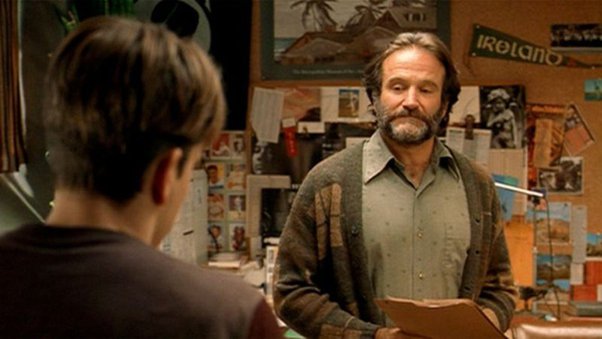
In the movie, Will (Matt Damon) told his therapist Sean (Robin Williams) about a recent date with a girl he liked. Sean asked if they were going on another date and Will said he didn’t know because he hadn’t called her back. Sean called Will an amateur.

Then Will said “Don’t worry about me. I know what I’m doin’. Yeah, but this girl was, like, you know, beautiful. She’s smart. She’s fun. She’s different from most of the girls I’ve been with.” Sean urged him to call the girl. Will continued, “Why? So I can realize she’s not that smart? That she’s fuckin’ boring? You know, I mean, you don’t. This girl’s, like, fuckin’ perfect right now. I don’t wanna ruin that.”

Sean replied, “Maybe you’re perfect right now. Maybe you don’t wanna ruin that. But I think that’s a super philosophy, Will. That way, you can go through your entire life without ever having to really know anybody.”
In the darkeness of the theater, Jeff and I turned our heads to look at each other. His expression matched mine. Jaw slack and wide eyed. Our earlier interaction matched the movie nearly word for word, just with less swearing. It’s as if Matt Damon and Ben Affleck were time travelers and they eavesdropped on our future discussion when writing this scene. We walked out of that theater questioning ourselves. “Did that really happen? Did we recreate the movie before even seeing in it? Was our life imitating art? And how could we recreate art with no prior knowledge of the art we copied?

The movie also made me cry. Seeing Matt Damon break down into tears as he and Robin Williams’ embrace at the end of the film is enough to melt the coldest heart. Good Will Hunting impacted me in other ways. Lines like “How do you like them apples” and “Go with the wrench” and “It’s not your fault” have become permanent parts of my vocabulary. As an autistic person I’ve always used song lyrics, movie dialog, and literary quotes as substitutes for original communication as a way of masking my social awkwardness. It’s called scripting.

It shouldn’t need said, but Good Will Hunting remains one of my favorite movies of all time. I’ve lost count of how many times I’ve watched it.

My oldest son has been struggling lately as he is trying to figure out how to adult. After he got some discouraging news recently, I figured he and I needed a movie night. Something to help him feel better. A reminder that it’s not his fault. Naturally, I chose Good Will Hunting. He’s roughly the same age now as when I first saw the film: halfway between 18th and 19th birthdays. He is, like I was, going through transitions, trying to discover who he is and what he wants from life. Confident yet insecure. Opinionated yet confused.

Thankfully, he really liked the movie. I don’t think my ego would have survived if he said it was dumb. Then we talked for a bit. Thomas already knew about the girl and the saga of me never asking her out. I’ve told him the whole story before because it includes one of the few times I believe I audibly heard God speaking to me. When the movie was over, he asked me if I regretted not asking the girl out, much the same way Will asked Sean if he regretted meeting his wife. I told my son no. I have a lot of regrets, but not asking that girl on a date isn’t one of them. We talked about a couple other things and Thomas let me know he felt better after watching the movie. Mission accomplished.

Aside from getting my son’s impression on one of my cinematic favorites, I also had an unexpected observation about myself.

The first time I watched this movie, I identified so much with Will. Unlike him, I wasn’t abused or shuffled around different foster homes. I had parents who loved me. I was not as violent. I didn’t smoke, didn’t drink alcohol. But I was insecure and angry like Will Hunting. Both Will the character and Nic the kid were well above average intelligence failing to live up to our potentials. I saw him as a more delinquent version of me. Repeat viewings never changed the connection I felt to Matt Damon’s creation. But something different happened last night. For the first time, I related more to Robin Williams character. I felt more like the therapist Sean than the patient Will.
It’s not 1997 anymore. I still need to improve myself. But I’m not the lost, insecure, and directionless kid I once was.

During the same counseling session where Will and Sean talked about Will’s date and the possibility of more, Sean said “You're not perfect. And let me save you the suspense, this girl you met isn't either. The question is, whether or not you're perfect for each other.” I feel this in my soul these days. Annie and I both know we’re not perfect people, but we are perfect for each other.

When Will challenges Sean, the therapist replied, “I teach this shit, I didn't say I knew how to do it.” If there was a line from Good Will Hunting that resembles who I am today, that would be it.

7.21.2022

The Hateful Faith

Growing up as a church kid in the 80s & 90s, I’m aware there are aspects of my youth most would consider abnormal. I’m OK with that. I have come to terms with the weirdness of my evangelical roots. Even though I’ve flown away from the nest, it’s still the beast who raised me.

While rote memorization of scripture is common in many religious communities, mine focused on recalling a select few verses stripped of context and prioritized word for word accuracy over a thorough understanding and the complete text. One of those verses came from the gospel of Matthew: “You will be hated by everyone because of me but the one who stands firm until the end will be saved.”

Unfortunately, like many other things, the focus on this verse was dumbed down and twisted. Many of my youth group peers interpreted it to mean “People hate us because we’re Christians. If people don’t like us, it’s because we’re right!” Rather than using this as a command to relax when mistreated, it became a self fulfilling prophecy. We can see it happening today: Christians who are hostile and rude to nonbelievers then celebrate victory when their vitriol is returned with anger.

“Hah!” They say. “I told you so. See, they hate us because we’re Christians.”

It’s as if those church kids I grew up with wanted their struggle to be against flesh and blood because it’s more tangible than the spiritual forces of evil in heavenly realms described in scripture. I used to hang out with guys who wanted a little more physical combat in their metaphysical spiritual warfare.

By the time I was in high school, I was prepared with years of reminders - they’re going to hate you. I was fully prepared for my non-Christian classmates to treat me like shit because I believed in Jesus.

Then something unexpected happened. The people who supported my faith the most were people that didn’t share my faith. Instead of hating me because I was a Christian, they were accepting of me, as I was, Christianity included.

Against all logic, those who hurt me most were people who supposedly shared my faith. I was never truly welcomed or accepted in my youth group. There, I was a weirdo, the outcast, the last one picked, the often picked on. The churches who taught me we were strangers and aliens in this world made me feel like an alien among them. Those who claimed the banner of Christ acting so unlike Christ.

Being a teenager is confusing for most everyone - my church home made those years even more perplexing for me. I was loved and respected by people who were supposed to hate me, but mistreated by the spiritual family who should have been my safe place.

I still believe following Christ is following an idea that miracles happen. My continuing faith in God is a true miracle as life has given me every reason to run the opposite direction. It’s for this reason I understand how and why anyone else makes that choice.

This has been the heart and soul of my deconstruction. How do I continue to love a God served by the same folks who have wounded me so deeply? How to I practice my faith when those who taught it to me act contrary to the doctrines they gave me? How do I heal from the wounds inflicted by people who should have loved me unconditionally? None of it makes sense yet I’m convinced answers are out there.

Some things never change. 25 years after graduating high school, the harshest and most hateful treatment I receive still comes from Christians. These people tell me to follow Jesus, and when I say I am, they reply “No, not like that.” These people trained me to love my neighbor but constantly remind me which neighbors they don’t love. They instructed me to act humbly while they pursued power. If I say “I love God,” they reply “No you don’t.” I tell them I’m leaving toxic communities and they respond with toxic behavior.

I get it. Deconstruction is the evangelical boogie man du jour. Celebrity pastors (a thing that should not be) rant about it being “sexy” or demonic. Even Christian musicians rant against deconstruction between songs. Speaking of which, when did John Cooper (of Skillet) stop preaching the gospel and become an asshole for Jesus?

These people cause so much pain, division, strife. Yet, if I take my faith seriously, I’m supposed to love them too. I’m obligated to love the friends, coworkers, acquaintances, and former mentors who curse, ridicule, and condemn me. I don’t know of any way to do that except love them from a distance.

My original plan for this blog post was to wrap it up with an observation about the anger and madness demonstrated by Christians in the public square of media and politics. The odium they display doesn’t surprise me because I’ve experienced their ire my entire life. If Jesus told his followers to prove their discipleship through their love for one another, the hateful behavior of mainline evangelicals is anti-Christ. That’s how I thought this post would end. Then something funny happened.

These days, it takes me a couple weeks to compose a blog entry. Writing the first draft, revisions and re-writes, grammatical editing, beta reads and feedback, a final round of corrections and adaptation, finally the selection and formatting of imagery - all before I click the publish button. Somewhere in the middle of this process, I managed to ruffle some feathers on social media because I shared a quote from a Lutheran minister. Predictably, it was my church friends who were most offended. Here’s the quote:

One of the hateful faithful is a former coworker and ex-Mormon. She felt it was her religious duty to rebuke me, condemn me, and eventually unfriend me. The weirdest part of the exchange is how her arguments against me were all built on false assumptions. She kept leveling accusations against me with no basis in anything I said or posted. Those claims she made include the following:
• That I’m violating scripture because I’ve given up meeting with other Christians.
• That I’m ignoring what God is telling me to do.
• That scripture is absolutely worthless to me.
• That I think the church is all bad.
• That scripture has nothing to do with my decisions or ideology.
• That I’m creating God in my own image.
• That I’m looking for the world’s approval.
• That I’m playing the victim.
• That I’m being led by feelings and bad theology.
• That I claim to have access to a higher spiritual plane no one else can reach.
• That my god is myself and my opinions.
• That I’m a part of a cult.


Her crusade against me is as meaningless as it is invalid. But that’s OK, she’s free to believe whatever she wants about me. The timing of her attacks were peculiar though considering I was in the middle of writing a blog about her kind of Christianity. Without realizing the irony of her own behavior, she was proving why I posted what I posted. The Bible told me I would be reviled because I follow Christ and so far, it hasn’t been wrong - even if the hatred is coming from other Christians like my former friend.

What’s the point of all of this? Well, if you tell me you feel like Christians hate you, it’s OK - they hate me too. If you don’t want anything to do with the institutions who claim to be followers of Jesus while acting nothing like Jesus, I get it. Me too. You’re not alone and I believe in a God who loves you even if their followers don’t. And no matter what people think of me or my theology, I will chose to love when everyone else chooses the opposite.

11.22.2021

There Might be Something Wrong with Me

When I was in elementary school, my parents wanted to know what was wrong with me. Well, maybe that’s a bad way of phrasing it. They didn’t think I was broken, yet they knew I wasn’t normal. So they did what any parents raising kids in the late 80s would do in their situation: they took me to a psychologist to determine why I’m weird. I walked out of the psych office with an ADHD diagnosis and a learning disability that affects the way I read.
in an absence of available pictures of me from 1987, please accept this substitute courtesy of Amblin Entertainment - disclaimer: I was never that cool

One of the tests the doctor asked me to perform was an exercise where I tapped my thumb to each individual fingertip. Starting with the index finder, then the middle, ring, pinky, then reverse to ring/middle/pointer. He explained kids with ADHD struggle with this task while other kids can do it without thinking. I had to concentrate to do complete the test - and even with total focus I still came close to screwing it up a couple times.

These days I can tap thumb to subsequent fingers back and forth at a rapid pace nearly instinctually. It’s a nervous habit for me, a tick I do whenever I’m anxious. If the same shrink who evaluated me over 30 years ago saw me again today, I’m not sure if he’d reaffirm my ADHD diagnosis because I would ace the finger tapping test with unquestionable perfection.

Neurotypical people would describe my compulsive finger taps as fidgeting. For those of us on the autism spectrum, it’s called stimming - or self stimulating. And yes, I said “us” because I have autism too. If my parents wanted to know why I was so quirky, this is why. Perhaps if Reagan era psychology had a better understanding of autism, I would have been given a proper diagnosis. (That’s not to say I don’t have ADHD. ADHD and ASD are frequent co-occurring disorders.)

Stimming helps people with autism regulate themselves. It is great for me in the moment; unfortunately, it is only beneficial while I’m doing it. If I’m unable to reel in my nerves while repetitively thumb tapping my fingers, my nervousness returns as soon as I cease my anxious habit.

I often wonder how different my life would be if the doctors of yesteryear had correctly identified they way my brain worked when my parents took me in to be evaluated. Would I have found adequate support at Pinewood? Would middle school have been more bearable? Would I have been bullied less? Would I have found helpful coping mechanisms in junior high? Would I have fit in with my peers? Would I have been a better student at MPHS? Would I have completed college and garnered a higher paying job? Would I still be who I am now?

My life followed the rough path to here – now grown with the pressures of adult responsibility causing havoc inside my autistic brain. Between parenting three teenagers, a daughter biologically born from a worthless man, and a baby quickly becoming a toddler, my time is often consumed with kids. Then I have a full time dead end job, weekend DJ gigs, a farm requiring daily work, all while trying to maintain this blog and write my first novel. House chores, errands, bills, car repairs, date nights with my wife, maintaining friendships, support groups, doctor appointments, attempting to eat a healthy diet, and manage some semblance of exercise. It frequently feels like it’s all overwhelming.

Much like Elton John, I’m still standing better than I ever did. Fueled by coffee or anxiety, I keep going, looking like a true survivor and feeling like a quirky little hyperactive kid.

Yes, I know I’m weird. It’s not easy being an adult – a thing even more complicated when you’re on the spectrum. I won’t complain though. Autism makes me a better DJ and provides me a unique perspective as a neurodivergent writer. I’m not Ok but it’s OK. There might be something wrong with me but I’m doing fine.

Still, if you see me tapping my fingers, I wouldn’t object to hearing an encouraging remark.