Showing posts with label food. Show all posts

3.18.2024

Home, Away, and the Weirdness of Being

During our last trip to Hawaii, my wife and I went on a late night walk along Waikiki beach. We stopped to dance when passing by a bar with a musician playing music on an out door stage, watched some fire dancers practice free from the massive daytime crowds, and lingered along the shore while the sound of waves filled the silence around us. Backlit by the vibrance of skyscrapers and hotels with the expanse of starry skies and endless ocean before us, we soaked up all we could get. There was a life giving energy to the moment, a breath to revive our weary souls.

With my arms wrapped around Annie’s shoulders she told me how the time we spent there felt more real to her than anything else. We conversed about how important these trips were to both of us to connect with each other. It was a reminder of why we work so hard and love the way we live. We both have wandering spirits, a wanderlust hardwired into our being. It’s more than existing as soulmates, it’s as if we were created to see the world together.

We know there is life after kids, a life approaching faster that we could ever prepare. When we travel, whether it is a weeklong journey or a quick weekend excursion, we get glimpses of the way life could be, or the way it was meant to be. It’s a preview of a future when we no longer have the worry of homework, softball schedules, school dances, and convincing kids the importance of personal hygiene and household chores. Our bucket list is perpetually growing and it is our hearts desire to continually find each other through chasing destinations.

Thing is, we are not wealthy people. At least, not financially speaking. We eat cheap. We don’t maintain expensive smoking and drinking habits. We pursue affordable entertainment options. If free is an option, it’s our preferred choice. When we leave town, we stay in low cost hotels. We get the the cheap interior rooms on cruise boats. We look for bargain flights. We pack snacks for road trips. Mock us for our thriftiness but our budget consciousness enables our ability to pursue our dreams.

We also know we are blessed. We understand our traveling hobbies are not options available to everyone. We are aware we live, work, and travel to places impacted by addiction and poverty. Annie is better at it than I am, yet we both endeavor to use our privilege to benefit others. Life is fragile and there is no knowledge more present than the fact nothing is promised. We enjoy these opportunities while we can as frequently as possible because we might not be able to do this forever.

We escaped home again this last weekend for a family road trip to Boise. Saturday was one of the best days I’ve had I a long time. We visited a zoo and a historical site. We stayed in a cheap hotel. I introduced them to my favorite Mexican restaurant. My eleven year old daughter begged me to take her to more museums. We learned new things, bonded over fresh experiences, found joy together, bought souvenirs, took goofy photos, and refreshed our weary souls.
photo courtesy of Andria Casey

Now we are home again. We have resumed the regular routines of day jobs and school. My body is worn but my heart is full. Walking around downtown Spokane this morning, I had a revelation similar to the sentiments my wife expressed in Honolulu roughly this time last year.

Our time away seems more real than our time at home. Walking around downtown Spokane this morning, I sensed this oddness deep in my bones. Real life feels weird. Road trips to Seattle, Portland, Boise, and Cheyenne; flying away to Florida and Hawaii; cruises to Alaska and the Bahamas - these trips tire is out but fill our hearts. When we go we are closer to who we are to who we are than the daily grind of earning paychecks of conversing with colleagues. Our family’s heartbeat is found in miles traversed. Granted, we must return. The income of day jobs and weekend gigs fund our dream life away from home. Still, every time we go somewhere it becomes harder to readjust to normal life.

Then again, I’ve been weird my whole life. It’s time to embrace the weird until we can go away again. And again. And again.

4.10.2022

Who’s to Blame?

Allow me to overstate the obvious: everything is getting expensive lately. The burdensome costs of basic needs are crippling the average American and if things don’t change soon, we will see a new boon for poverty and crime rates. Welcome to the third world ‘Murica. Was it worth it?

I’ll skip the statistics because I’m sure you’ve seen them. Those graphs comparing tuition rates and average annual incomes make it easy to see how working your way through college is a thing of the past. Access to higher education is increasingly unattainable without entering a lifetime of crippling debt. Or the charts showing the increasing new car prices year after year. Gone are the days of purchasing a reliable vehicle for a thousand dollars. You get what you pay for and many new cars cost more than their owners make in a year. More debt.

What about the necessities? Food, clothing, housing – all of it quickly becoming unaffordable for the average citizen. While a rich person and a poor person will pay the same amount for a gallon of milk, it’s more expensive for the person who makes less than $30k a year than it is for the person who makes $30k a week. Gas prices are making pedestrian commutes appealing. People with limited means are turning thrift shops into haute couture. And don’t even get me started on the real estate market, mortgage prices, or average costs of rent.
As someone who was weaned on Reaganomics then came of age in the relative peace and prosperity of the Clinton era, none of this makes sense to me. Well, actually, the numbers and statistics make sense. The natural unintended consequences make sense. The “I told you this would happen” makes sense. The functions of economic policies make sense (even if absurd). But the logic of it all doesn’t compute. The fact we allowed things to get so wild and out of control befuddles me. The believable concept of hard work being the keys to your future isn’t ancient history. I was raised in a world rewarding ingenuity and initiative. We don’t live in that world anymore. Our founding fathers’ ideal of life, liberty, and the pursuit of happiness now has a qualifying addendum: as long as you can afford it.

Why? How did we get here? Whose fault is it? Who’s to blame?

You could blame the president. He creates policy regarding foreign trade, interest rates, and where we get crude oil. You could blame Biden for not acting fast enough to hold back the tide of hyperinflation or for enacting laws you think exacerbate the situation. So sure, blame him but he’s only a small part of the problem.

You could also blame past administrations. The effects of presidential policies don’t end the day they leave office. Decisions made by one individual could have consequences that last decades. So sure, you could blame them but they’re only a small part of the problem.

You could blame Congress for passing legislation detrimental to the common interest of the average American citizen. Or criticize them for being so preoccupied with infighting and partisan chicanery they end up doing nothing to help the people they represent. So sure, you could blame them but they’re only a small part of the problem.

You could blame special interest groups and lobbyists financing our representatives who enact laws that benefit them but no one else. Big oil, big pharma, big banks, big tobacco, big guns, all prosper and escape accountability while the rest of us suffer. So sure, you could blame them but they’re only a small part of the problem.

You could blame massive corporations for abusing and controlling the market. Huge conglomerations buy out their competition and diversify their offerings so everything we buy is sold by a select few of these giants of consumerism. Kraft, Coca-Cola, General Mills, Disney, Johnson & Johnson, JP Morgan, Comcast, Luxottica, Pfizer, MetLife. We don’t like monopolies in theory but in practice they exist. They control the prices we pay for nearly everything. So sure, you could blame them but they’re only a small part of the problem.

You could blame the ultra-rich. People like Elon Musk, Bill Gates, Warren Buffet, Jeff Bezos, Mark Zuckerberg. They use their massive wealth to enforce their desires and avoid legal ramifications of anything shady they have (maybe, possibly, allegedly) done. Their riches protect them from the turmoil of our economic crisis – completely detached from the reality of normal American struggles. They manipulate our culture to fit their dreamscapes while the wealth gap grows wider. So sure, you could blame them but they’re only a small part of the problem.

You could blame utility companies. They continually raise rates, testifying before regulatory commissions these price hikes are urgent needs to remain in operation. Meanwhile, they’re raking in record profits and their CEOs live lavish lives on generous incomes. So sure, you could blame them but they’re only a small part of the problem.

You could blame Wall Street. These investment bankers, stock traders and analysts, hedge funds buyers, aggressive investors, corporate raiders, and people who profit on the misfortunes of others. They live, work, and play in a fantasy land where all of the rules are made up. They’re able to succeed while the rest of the economy crashes. And because our nation’s economic health is based on the winnings of the stock market gambling, they’re a protected class. These white collar crooks make money while the rest of us struggle. So sure, you could blame them but they’re only a small part of the problem.

You could blame the regulations that make it more expensive to operate a business. Or the businesses that exploited our environment and flaunted our safety making such regulations necessary. Or a workforce demanding livable wages. Or the staffing shortages in restaurants, retail stores, hotels, and other hospitality jobs. Or the mistreatment of low-wage workers. Or the supply chain issues. Or increased shipping costs. Or crumbling infrastructure. All little issues that contribute to the rising cost of goods and services. So sure, you could blame them but they’re only a small part of the problem.

You could blame our culture. For generations, we have lived beyond our means with expenses greater than our incomes - living off credit. We have transformed keeping up with the Joneses into a lifestyle. Our rampant consumerism and demands for instant gratification returns a self-sabotaging cost. The suppliers of the things we want and need know we will pay any price to get what we want and need. So sure, you could blame us but we’re only a small part of the problem.

The fact of the matter is we can’t blame one individual or a single group. Or at least we shouldn’t. There isn’t any one person or group of people responsible.

How did we get here? Whose fault is it? Who’s to blame? It’s all of the above. It’s the system that governs our lives. It’s unfettered capitalism. It’s rampant greed. It is flawed and corrupted. It only benefits the rich and powerful. We believed the myth of trickledown economics. We voted against our own interests over and over again. We did this to ourselves. We allowed it to happen.

If you insist on blaming something for our economic woes, make sure you blame *gestures wildly* everything.

11.22.2021

There Might be Something Wrong with Me

When I was in elementary school, my parents wanted to know what was wrong with me. Well, maybe that’s a bad way of phrasing it. They didn’t think I was broken, yet they knew I wasn’t normal. So they did what any parents raising kids in the late 80s would do in their situation: they took me to a psychologist to determine why I’m weird. I walked out of the psych office with an ADHD diagnosis and a learning disability that affects the way I read.
in an absence of available pictures of me from 1987, please accept this substitute courtesy of Amblin Entertainment - disclaimer: I was never that cool

One of the tests the doctor asked me to perform was an exercise where I tapped my thumb to each individual fingertip. Starting with the index finder, then the middle, ring, pinky, then reverse to ring/middle/pointer. He explained kids with ADHD struggle with this task while other kids can do it without thinking. I had to concentrate to do complete the test - and even with total focus I still came close to screwing it up a couple times.

These days I can tap thumb to subsequent fingers back and forth at a rapid pace nearly instinctually. It’s a nervous habit for me, a tick I do whenever I’m anxious. If the same shrink who evaluated me over 30 years ago saw me again today, I’m not sure if he’d reaffirm my ADHD diagnosis because I would ace the finger tapping test with unquestionable perfection.

Neurotypical people would describe my compulsive finger taps as fidgeting. For those of us on the autism spectrum, it’s called stimming - or self stimulating. And yes, I said “us” because I have autism too. If my parents wanted to know why I was so quirky, this is why. Perhaps if Reagan era psychology had a better understanding of autism, I would have been given a proper diagnosis. (That’s not to say I don’t have ADHD. ADHD and ASD are frequent co-occurring disorders.)

Stimming helps people with autism regulate themselves. It is great for me in the moment; unfortunately, it is only beneficial while I’m doing it. If I’m unable to reel in my nerves while repetitively thumb tapping my fingers, my nervousness returns as soon as I cease my anxious habit.

I often wonder how different my life would be if the doctors of yesteryear had correctly identified they way my brain worked when my parents took me in to be evaluated. Would I have found adequate support at Pinewood? Would middle school have been more bearable? Would I have been bullied less? Would I have found helpful coping mechanisms in junior high? Would I have fit in with my peers? Would I have been a better student at MPHS? Would I have completed college and garnered a higher paying job? Would I still be who I am now?

My life followed the rough path to here – now grown with the pressures of adult responsibility causing havoc inside my autistic brain. Between parenting three teenagers, a daughter biologically born from a worthless man, and a baby quickly becoming a toddler, my time is often consumed with kids. Then I have a full time dead end job, weekend DJ gigs, a farm requiring daily work, all while trying to maintain this blog and write my first novel. House chores, errands, bills, car repairs, date nights with my wife, maintaining friendships, support groups, doctor appointments, attempting to eat a healthy diet, and manage some semblance of exercise. It frequently feels like it’s all overwhelming.

Much like Elton John, I’m still standing better than I ever did. Fueled by coffee or anxiety, I keep going, looking like a true survivor and feeling like a quirky little hyperactive kid.

Yes, I know I’m weird. It’s not easy being an adult – a thing even more complicated when you’re on the spectrum. I won’t complain though. Autism makes me a better DJ and provides me a unique perspective as a neurodivergent writer. I’m not Ok but it’s OK. There might be something wrong with me but I’m doing fine.

Still, if you see me tapping my fingers, I wouldn’t object to hearing an encouraging remark.

10.10.2021

Deconstructing Love

True love waits. At least, that’s what I was taught when I was growing up. My adolescence began with the birth of grunge and graduated with the publication of I Kissed Dating Goodbye. In the years between 1991 and 1997, purity culture took root in evangelical churches, leaving its well intentioned mark (ahem, scars) on my generation. Looking back, I am fairly confident this is the source my emotional baggage and the reason I am a psychological mess.

My experience isn’t unique. Instagram, Tik Tok, YouTube, and Twitter are littered with the wreckage of grownups like me, who lived through the 90s, and flailed our way through the last 20 years wondering what the hell happened to us. One testimonial after another, first hand accounts, teary-eyed disclosures, secrets people kept buried for decades. Even the author of I Kissed Dating Goodby disavowed his book as garbage, apologized for the harm he caused, and delivered a TED Talk admitting he was wrong.

But why? What was so misguided about the pursuit of purity? How did messages about abstinence and love lead to an abundance of former youth group kids trying to navigate adulthood through sexual dysfunction, broken marriages, depression, anxiety, body dysmorphia, and abysmal self-loathing? I have some thoughts.
Photo courtesy of Gratisography

1. It used confusing terminology. Dating was discouraged as if it was sinful. They taught us dating and breaking up only to date and break up with someone new created an unfaithful pattern we would take into marriage, ultimately leading to an inevitable divorce. Instead, boys were told to court girls. The emphasis in courtship was to prepare you for marriage. Unfortunately, neither term (dating or courting) are in the Bible and such teaching completely ignored biblical wedding traditions. Sexual lessons resembled American Puritan values more than those of the first century church. Besides, there really isn’t any actual difference between the two. You can still break up courtship just like a dating relationship. Dating can prepare you for marriage just like courting. Courting is nothing more than a fancy term for dating. Condemning one in favor of the other is like kicking your own ass.

2. It misunderstood human biology and brain chemistry. As a result, boys were provided excuses and girls got assigned blame. The church took scientific ideas about hormones and attraction, made dozens of assumptions, then spit out restrictive rules with neither scientific or biblical basis. Boys like me were instructed to avoid all temptations, but we were also told we were helpless to resist our urges. Girls were never cautioned against their temptations, rather they were warned to not be a temptation for boys. When boundaries were pushed and broken, the same people who claimed boys will be boys also asked the girls what they were wearing.

3. It demonized everything. The music we listened to, the nooks and magazines we read, the movies and television shows we watched, all of it was painted with a broad brush of being inherently evil. Any mention of sex was taboo, depictions of romance in pop culture, and secular descripdeclarations of love were deemed the devil’s attempt to lead us astray. We were encouraged to boycott everything from Disney to Levi’s for their unholy embrace of love outside of God’s design. This fostered an unhealthy “us vs them” mindset which festered into the isolationist beliefs currently staining our world.

4. It turned modesty and purity into idols. The Bible frequently talks about having a pure heart. The lone biblical reference to dressing modestly was about about wealth - modesty over extravegance. I don’t want to claim that either are bad things. However, these admirable goals become problematic when they become the most important thing. Christians should strive to be Christlike above all other things. What good is remaining sexually pure if you’re dishonest? Does dressing modestly matter if you’re cruel to those who don’t? The book of 1 Peter says “be holy because I am holy.” Not “be pure.” When you preach “don’t have sex” more frequently than “pursue God” purity is an idol. When boys can wear tank tops but girls can’t, modesty is an idol.

5. It failed to teach the true meaning of love. The 13th chapter of Corinthians listed off qualities of love - the things it is and the things it’s not. You know what word isn’t there? Pure. Neither is the word modest. Yet somehow, the pastors and leaders running youth groups when I was a teen seemed to to preach and teach modesty and purity as if they were the essence of love. And waiting? The phrase “true love waits” was inescapable. While the first definition provided in Paul’s letter to the church in Corinth says “love is patient,” true love is more than just waiting. I love French fries but if I wait to long to eat them, they’ll get cold and gross. There is so much variety in both the meaning and application of love glossed over or deemed unimportant. Perhaps it’s the laziness of the conservative evangelical movement or the unfortunate inadequacies of the English language, but the depths and power of love were never discussed with my generation. We never pondered the mystery of how the word we use to explain how we feel about a romantic partner is the same word describing our appetite for pizza. True love doesn’t just wait. It’s committed. It’s a bond of friendship and intimacy. It’s familial and erotic. And it is a long suffering which ensures hardships and continues to love when everything else has given up. These truths were never a part of the Wednesday night youth group discussions at Marysville Nazarene through the 90s. Judging from conversations I have had with friends across the US; from stories told and retold through books, blogs, seminars, and videos by exvangelicals, I know my experience isn’t an anomaly.

Why does any of this matter? How did these teachings of purity culture warp how my generation viewed ourselves and approached relationships? What led these good intentions to cause so much damage? We can follow purity teaching to its furthest logical conclusion and we see this in the behaviors and outlook of my peers who, like me, grew up in 90s era churches.

Using confusing terminology creates confusing boundaries. At many Christian colleges, there was an impression that any boy asking a girl out for a date – even something as innocent as getting a cup of coffee – meant the boy was interested in marrying the girl. It left people clueless about the intentions of anyone thinking they’re cute or even saying “hi.” It made maintaining friendships with members of a different gender difficult, if not impossible. It led to numerous unhappy couples who rushed into marriage without learning the kinds of things you learn while dating.

Giving boys excuses for their behaviors while blaming girls for the same actions creates an environment where rape and sexual assault thrive. It fosters men’s worst proclivities, allowing them to be abusers with a free pass. This is why #yesallwomen, #metoo, and #churchtoo have all been trending topics over the past few years.

Demonizing every product of pop culture teaches kids to be ashamed for liking the things they like. They feel bad for listening to their favorite songs or watching a popular TV show. They hide their interests and nothing good happens in hidden shame. They grow up developing guilty pleasures and destructive addictions. Make the topic of sex taboo and you get people embarrassed to discuss it – even in the confines of an intimate relationship.

The focus on purity and modesty distract from other essential qualities: kindness, humility, fidelity, affability, honesty, and perseverance. Kids were instructed to be sexually pure but they weren’t taught how to be good people. They’re awkward and malicious but at least they’re virgins.

When the only message kids get about sex and love is “true love waits until marriage,” you get young adults in a hurry to get married just to have sex – like it’s the only reason to get married. They’re ignorant of the nuances, commitment, and passion it takes to have a healthy and happy marriage. They’ve been told to wait but not what to do when the waiting is over.

My generation took the tenets of purity culture and thought we had the secret to lasting wedded bliss and yet so many of us still found our marriages ending in divorce. Many of us abandoned the ideas of purity culture, evangelicalism, and even Christianity due to the harm caused by the faulty teachings of our youth. However, what hurt me the most and twisted my psyche in ways I’m still trying to untangle were the incompatible and contradictory elements of what I was taught.

One of the most fundamental beliefs of the Christian faith is God IS love. From the youngest ages, we were taught this through song: “Jesus loves me this I know, for the Bible tells me so.” Over and over, teachers and pastors and church elders reminded us: God loves you unconditionally. According to scripture, there’s nothing we could do that could separate us from God’s love for us. Then as we got older, we began hearing different messages from the church. Leaders started telling us we were unlovable. We were taught that we did not deserve love – especially if we didn't adhere to purity rules. God loves you but you’re worthless. God loves you but you’re undeserving.
Photo courtesy of Gratisography

This is one of the many reasons why I deconstructed. Despite a crippling deprecating image of self, I did everything right. I believed God loved me and I didn’t deserve it. I waited for marriage. I married a Christian woman. I remained faithful. I was active in church. I followed the doctrine of purity culture. And I still got divorced. Doing all of the “correct” things doesn’t guarantee success. Purity doesn’t inoculate you from the pain and suffering of broken relationships. Even the author of I Kissed Dating Goodbye ended his marriage. Purity teachings doesn’t work. Looking at the tattered lives of my generation, it’s safe to say it did more harm than good.

Now I’ve deconstructed what I thought love was. I meditated on 1 Corinthians 13. I studied every mention of love in scripture. I read all of the Bible stories of sex and marriage from Genesis to The Song of Solomon to Revelation. I concluded the evangelical church led me astray.

The Bible teaches all people – men and women were created in the image of God. If (as I was taught) we are unworthy of love, then God would also be unworthy of love as we reflect God’s image. This idea of being unconditionally loved by a worthless lover is illogical; I refuse to believe it. It is also completely unbiblical. The book of 1 John tells us “God is love.” If we bear his image, then humanity was created to love and be loved. We need love and deserve love.

It’s time to reclaim the definition of real love. The type of love that is selfless and kind. The love that is devoted in the midst of hard times.The love that celebrates the successes of others. The love that lifts and elevates their communities. The love that flourishes in equality and justice. Love that always protects, always trusts, always hopes, always perseveres. Love that loves the way God loves us. A love that loves when it waits and loves when it doesn’t wait. A love that deserves love.

The kind of love that craves Chinese food on a stormy night. That too.


ps: I love you

4.22.2021

Through the lense of a former 90s youth group kid.

If you're a long time reader you probably know I grew up in a conservative evangelical church. I was also a teenager in the Seattle suburbs during the grunge era. Those years were the Wild West of youth ministry. Youth pastors today want to be relatable and relevant. Youth leaders back then wanted to know how much crazy shit they could get teens to do before the kids revolted. If youth pastors were mad scientists, we were the guinea pigs.

One of the most predominant highlights of any church youth event during the 90s is what I’ve lovingly (and regrettably) described as pudding through the nose games. They didn’t actually consist of slurping pudding through your nose, but the nasal consumption of a Snack Pack was always a possibility. These games were designed to induce a gag factor, inspire PG-13 levels of comedic violence, or encourage what modern youth leaders call “purple.” No idea what I’m talking about? Allow me to provide some examples.

The Toothpick Lifesaver relay. Teams lined up boy/girl/boy/girl with toothpicks in our mouths. Without using our hands, a package of Lifesavers had to be passed toothpick to toothpick from one end of the line to the other. And we had to start over if the candied fruit flavored ring was dropped. First team to pass along all 14 candies through every member wins.
image courtesy of Sterling College

Or The Chip Race. In this game, a boy and girl held a potato chip between their lips while trying to reach the finish line before the other couples. If the chip broke or was dropped, the pair had to start over.

Or Wink’em Blink’em. Everyone of one gender stood in a circle while kids of the other gender sat in front of them with one empty seat. The person behind the empty chair winked at someone who tried to escape the grasp of the person standing behind them to sit in the empty seat. Originally, the rules stated the fleeing player would be stopped with a tap on the shoulder but my generation never liked rules. When we played this game (it was a favorite at Marysville Naz) we played it like a full contact sport. The standing player could use any means necessary to stop the runner. Nights with Wink’em Blink’em on the itinerary usually ended with pulled hair, scratches down the back, torn t-shirts, and rug burns on the knees and elbows. Ironically, the popular kids were more likely to be tackled or dragged than the uncool kids like me.

Or the Caterpillar Relay. Teams laid face down and shoulder to shoulder on the beach to form a human caterpillar. (Note: I said caterpillar, not centipede. That's something wildly different.) The person at the end of the end of their team's line rolled over all of their teammates to the front of the line where they resumed the face down position as other players rolled over the top of them. New competitors began rolling as soon as they were the last in line. First team to get their whole caterpillar across the finish line won.

Or Eat That Food. This was played like Name That Tune but with food. Teen versus adult volunteer took turns claiming they could eat a food item in a certain number of bites, each challenge lower than the previous. If that number reached a point where one player couldn't eat the food in fewer bites than the other, they dared the other player to "Eat it." If a player scarfed the item within the promised number of bites, they won. They would lose by failing to complete the challenge or throwing up. I saw people eat a whole can of spam in one chipmunk-cheeked bite, pour an entire tin of Altoids into their open maw, chomp a foot long raw carrot with a diameter of their in three bites, cram a king size Snickers in their mouth while drinking a can of Pepsi, and chug a large jar of applesauce in a single gulp. There was always a garbage bin on stage for vomit.

And Shaving Cream Wars. A section of the football field was cordoned off to separate spectators and warriors. Teenaged campers and adult leaders purchased hundreds of cans of shaving cream to battle each other in a one vs all battle royale. Combatants ran around with aerosol cans of shaving cream, filling their hands with foam, and smearing it into the faces and onto the bodies of other willing participants. Extreme players Duct taped their shaving cream cans into their hands with fingers hovering above the spray triggers.
image courtesy of Baltimore Sun

Between the inappropriate entertainment, the purity culture teachings, and attempts to dictate what kinds of movies we could watch or music we could listen to, my generation was subjected to an ongoing clash of contradictions and double standards. It is no surprise why so many of my peers have left the church in the decades since then.

Youth group was weird enough bit summer camps is where it got really awkward. Teen camp had a different theme every year and games were tailored to match the theme. One year our theme was “The Doctor is In.” Bed pans (if you couldn’t already tell where this was going) were used in a majority of the games that year. One of those bedpan games was a root beer relay. Teams lined up 20 yards away from a bedpan filled with root beer. Everyone was given a straw to hold with their mouth. First person in their team’s line ran to the bedpan, laid face down with hands behind their back, and drank through their straw. As soon as they sucked up as much root beer as they could, they ran back to their team and the next person sprinted to lie down and chug through their straw, then repeat until their team drank all of the root beer. First team to finish a half dozen 2 liters won.

If you’re thinking it would have been funnier for the camp organizers to use Mountain Dew, I agree. However, despite the shades of violence and confusing sexual boundaries, there were still lines that Nazarenes were not brave enough to cross.

I thought this game would be easy. I could guzzle a can of Dr Pepper in one shot - proved it a couple times before. Drinking soda should be easier with a straw, right? Wrong, so very wrong.

When my turn came, I ran the 20 yards as fast as my scrawny teenaged legs would carry me. I laid down in the prone position, hands clasped behind my back, dunked my straw into the warm brown liquid, and began to sip. Then I discovered something: I couldn’t drink. I could barely breathe. Gravity pulled my body weight down onto my lungs and I lacked any alternative to support that weight because my hands were clasped behind my back. The position of my hands also stretched out my chest cavity and tightened my pectoral muscles making it difficult to expand my rib cage. My ability to draw a breath was smothered.

Instinctively, my brain knew breathing was more important than drinking soda. My desire to live outweighed my hopes to win a pudding through the nose game. I couldn't drink even if I wanted to. I got up, ran back to my line, and hoped everyone else on my team had better luck than me.

To be clear, while I was scrawny weakling, I was also healthy. I kept fit by spending summers hiking all over the Northern Cascades and walking/biking everywhere during the school year. I didn’t have asthma, didn’t smoke, didn’t suffer any underlying health issues. I was a normal (even if socially awkward) teenager, spry and energetic. Yet despite everything in my respiratory favor, I still struggled to breath when laying prone with my hands behind my back. I can’t imagine doing the same thing with a police officer kneeling on my neck.

I have frequently pondered this story from my youth while watching the Derek Chauvin trial over the last couple weeks. It’s been heavy on my mind. Watching the videos, listening to testimony and cross examination, I keep imagining myself in George Floyd’s place.
image courtesy of Dazed & Confused Magazine

Laying prone with your hands behind your back isn’t like getting a back massage as Chauvin’s lawyer claimed during closing arguments. If it was difficult for me to breathe in that position as a healthy teenager with no weight on my neck, logic leads me to believe it would impossible for George Floyd to do the same under the weight of Derek Chauvin.

That is a conclusion any reasonable person should be able to understand. Thankfully, the jury agreed.

12.29.2020

What It’s Like to Be Me: All Falls Apart Pt 8, Coping Mechanisms

We all know the childhood proverb, what doesn’t kill you makes you stronger. I prefer the grown up version of the same saying: what doesn’t kill you gives you a lot of unhealthy coping mechanisms and a really dark sense of humor.

Divorce didn’t kill me and it did give me a dark sense of humor. Music has always been my coping mechanisms. Healthy or not, I’ve found solace in song. Coping with divorce wasn’t any different than any other challenge in my life. These songs didn’t just help me cope, they explain how I coped.

Sometime Sunday: “Home
Mikee Bridges sings of two homes in this lament, not knowing a physical home while looking forward to a spiritual home. Regardless of where I’ve lived, I never really felt like it was home. Losing the house I bought in the divorce and being forced into a small apartment reinforced the unanchored feeling of this song, “Home is a place I’ve never been.” Yet I shared Mikee’s hope in something more, “I’ll hold on to Sunday, a first time to come home.”

Pearl Jam: “In Hiding
I didn’t leave the apartment much, spent my time watching movies, paying video games, or writing. I did like the song said, “I shut and locked the front door, no way in or out, I turned and walked the hallways and pulled the curtains down.” Church on Friday nights and Sunday mornings. A small group meeting on Monday nights. Work five days a week. But if there was nowhere I needed to be, I was in hiding.

Matchbox Twenty: “Unwell
Symptoms of narcissistic abuse are varied and I didn’t experience all of them. However, I did suffer from insomnia, fatigue, depression, and anxiety. Other symptoms get weird: inability to trust yourself or others, feelings of isolation, difficulty making decisions. Narcissistic abuse makes you think you’re crazy. It’s a sensation described in this song, “I can hear them whisper, and it makes me think there must be something wrong with me, out of all the hours thinking somehow I've lost my mind”

Macklemore & Ryan Lewis with XPerience: “Let’s Eat
If I had one truly unhealthy coping mechanism, it was food. Comfort food. Fast food. Stress eating. Boredom eating. Social eating. Workplace potlucks. Whatever weight I lost when Bekah and I first separated, I gained it back after the divorce plus some. I know exactly what Macklemore is talking about when he raps, “I was gonna get skinny for the summer, I was gonna start doing my crunches, but looking down at my stomach, I'mma go to the beach, but I'm not taking my shirt off in public.” My craving for something spicy for lunch after church on Sundays every week worked against the efforts I made to get skinny again. Then again, “You know I feel good about this cake” can only be a viable way to cope for so long. My post-divorce body got to be the heaviest I’ve ever been.

Sick Puppies: “White Balloons
After a lifetime struggling with insecurity, divorce practically confirmed by biggest fear: I was insignificant. As a newly single man, and a single dad, I felt like a ghost – unseen and misunderstood. I heard my state of mind echoed in this song, “What’s inside of me is invisible to most even in clear view.” In my ghostly phase, there was a lot of change as I rediscovered/redefined who I was.

Of Monsters and Men: “I of the Storm
Another song speaking about feeling like a ghost, this one didn’t just address my inner turmoil, it described my appearance. “Until all you'll see is my ghost, empty vessel, crooked teeth.” There was a loneliness as I coped with grief, I was out of place and ungrounded. “I am a stranger, I am an alien inside a structure.” I had my kids and I had my job but aside from those two things, I felt lost and defeated.

11.29.2020

The Covid Effect

It’s been a year (give or take a couple weeks) since the initial cases of Covid-19 were reported in the city of Wuhan. A little more than a month later, the first documented cases would appear in the US and we were given warnings this would turn into a global pandemic. In the following months, the Coronavirus overwhelmed our culture impacting every American – some through getting sick but most through changes in lifestyle. 

When states begin implementing various orders to wear masks or close non-essential businesses, we thought it would only be a few weeks and life would get back to normal. Spring and summer passed with the pandemic dominating headlines, controlling American life, and a menagerie of state or municipality protections remaining in place. Now in autumn with winter upon us, we’re seeing new government measures issued to try and contain this virus and it seems things will never be the same. 

It’s obvious the shelter in place directives interrupted the way Americans live, work, and play. The three Es of education, employment, and entertainment all drastically altered how they exist and operate. When this pandemic is over (and it will be over eventually) it’s likely some of the changes in our lifestyle will never return to the way it was before. 

But is that a bad thing? 

There is cause for concern, elements of American culture in need of repair. We’re facing an enormous mental health crisis as isolation is not good for the human psyche. There is a generation of school kids falling behind as they’re missing essential learning while schools are scrambling to prevent making the pandemic worse. The masses of newly unemployed workers will need to find new jobs. Many who contracted Covid-19 and recovered have been and will be suffering long term effects of the virus. 

There is also reason for hope. Fewer pollutants have been released into our atmosphere and waterways because less people are travelling. Reduced exhaust and fossil fuel usage means we’re breathing cleaner air; rivers and lakes are clearer. People are paying better attention to basic hygiene – doing the things they should have always been doing like washing their hands frequently, sanitizing high use surfaces, exercising, spending time in the wilderness, and eating at home instead of getting fast food. There’s a greater attention on science and increased appreciation for nurses and doctors. Individuals are investing in acts of kindness and generosity in ways to inspire and renew faith in humanity. 

In this pandemic, as with most things, both the good and the bad inhabit the same space. 

But what about the post Corona life? What lasting affect will Covid have on our culture? With a few different possible vaccines on the horizon, I think it might be beneficial to speculate on what our world will be like after life returns to normal. Or if it ever will be normal again. 

Since business as usual went on lockdown last spring, corporate America adjusted. In the process, we learned to use technology to our advantage, canceling non-essential meetings and moving important group conversations into virtual spaces like Zoom or Google Meet. Employers got creative giving more employees the option to work from home. New remote jobs became available. Those still working on site have been encouraged to stay home when they’re sick. These are changes to American life I hope never return to the way things were before. 

I am optimistic supervisors, managers, directors, and CEOs everywhere have learned some things are better for an email and not every idea is worth a half hour meeting in a conference room. I wish for telecommuting becomes more prevalent as it will make our workforce larger and more diverse. More people working is good for the economy and more people working from home is good for the environment. Side note: I don’t miss my 25 minute commute to the office. I hope more people consider the health of their neighbors, friends, and colleagues before leaving the home with flulike symptoms. As much as we all hate wearing masks, people should keep them – not to wear indefinitely, but for times of illness. Maybe if people wore masks any time they were sick, we would live in a healthier society by limiting the spread of the flu, common cold, and other contagious diseases.
(psst, wear a mask) 


Still, there are things I miss in this Covid world. When this is all over, I hope some elements from our former lives resume as soon as possible. I miss concerts and movie theaters. I miss hanging out in coffee shops. I miss seeing smiles on strangers’ faces. I miss parades and festivals and farmers markets. Of everything we’ve lost, there is experience I miss more than anything else and I hope it isn’t gone forever: the samples at Costco. 

Please bring back the samples as soon as it is safe to do so.

11.25.2020

The First Thanksgiving

American history is filled with epic stories, memorable tales to promote the American spirit and teach the shared values of our nation. Some of these stories are true, others a complete fabrication. Most are based on actual events yet omit a few key details. The first Thanksgiving is one of those famous accounts, historically accurate to a point, yet incomplete. 

The main beats of the story are known to anyone who grew up in the USA. Settlers of the Plymouth Colony, the Pilgrims, had a rough start in the New World. Of the 100 passengers from the Mayflower who founded the village, only half lived a year in America. Their first winter was bitter, cold, and cruel. 50 of them died before spring. They feared they might not survive another winter until they met Squanto. Squanto was a Native of one local tribe. He taught the white folks to grow corn and catch fish. With his help, they learned to store their goods to endure the colder seasons of the region. The chief from another local tribe brought supplies to the new villagers to help them build their town and extra food when provisions sent from England were insufficient. After the Pilgrims’ first successful harvest, four women prepared a feast so the town could rejoice and be thankful for their bounty. They returned the generosity of the neighboring tribe by inviting them to dine with the townsfolk.
image courtesy of History Channel 

All of which is true. Except there are some key details missing, starting with Squanto whose real name was Tisquantum. They shortened his name as a way to mock him. Tisquantum was the lone survivor of his tribe – the rest had died from an epidemic disease. The land chosen by the Pilgrims to build their village was home to Tisquantum’s tribe, abandoned when they perished. While Tisquantum helped the Pilgrims learn to survive, he fell ill a year later and passed away. Despite receiving help from Tisquantum and the tribal leader Massasoit, the friendly relationship between the Wampanoags soured over time. Indigenous culture was incompatible with the strict puritan religious values professed by the Pilgrims. The European immigrants saw the local tribes as savage people who should assimilate and convert religions, or be banished. Soon the there would be a war between the colonists and the Natives. Finally, the Plymouth Plantation continued to struggle economically after their first feast. Many of the founders left to start their own settlements elsewhere in the colony. Eventually, the smaller Plymouth Colony was absorbed by the larger Massachusetts Colony. 

The tragic bits from the legend of the first Thanksgiving have become footnotes to the historical record. We remember the highlights and retell the sanitized version. Yet the parts we edit out of the story are still important. The fragile truce between the Pilgrims and the Wampanoags provides context to King Phillip’s War 50 years after the first Thanksgiving in Plymouth. The way the settlers treated Tisquantum reflects the way white people exploited Native Americans like Pocahontas and Sacagawea to further their own interests. Their tension was a precursor to the India Wars against Sitting Bull and Crazy Horse or the Apache US conflict against Geronimo. 

The whole story might not be a happy story, yet to fully understand history we need to know the sections left out by elementary historians. We need to see the ugly alongside the beautiful. Hopefully we learn from the worst of our stories so we are not doomed to repeat our mistakes. 

When we talk about our firsts, there will be a lot of bumbling errors. Often our folly makes those events memorable. Like my first Thanksgiving outside of my parent’s place. 

At the end of the summer of ’99, Travis, Shane, and I moved to Nampa and rented an off campus apartment so Travis didn’t have to spend his senior year living in a dorm room. Autumn came. None of us had the time or finances to travel back to Seattle for Thanksgiving; it was the first we would experience the holiday without our families. Along with our mutual friend Nick, we devised a plan to celebrate on our own. We brainstormed the menu, listing off the traditional foods our families served every year and created a shopping list. We went to the grocery store as a team and filled a cart with festive ingredients and split the bill four ways. We divided the cooking duties and prepared the meal as close to what our families served as we were able. We invited Travis and Nick’s girlfriends to join us and set our table for six. 

The happy version of this experience is a success story. We came, we saw, we conquered. It’s a tale of friends coming together to replicate a family event in the dearth of actual family. If I ended the story there, all of it would be true, but it wouldn’t be complete. Our dinner wasn’t super smooth. Shane used a full ten pound bag of spuds for his mashed potatoes, the finished product didn’t even fit in the biggest bowl we had. The turkey was a little dry and overcooked. I burnt the rolls. Still, we dined as if it as the finest meal ever prepared. Most of the dishes we cooked were completely consumed, with one exception: the cranberry sauce.
image courtesy of 12 Tomatoes 

 As we cleared the table of dirty dishes and empty platters, we discovered the cranberries still standing in the shape of the can it came in, untouched with a clean spoon sitting next to it. The four of us questioned each other – why didn’t anyone eat the cranberry sauce? Turns out, none of us liked cranberry sauce, neither did our two guests. Why did we buy it and serve it? Turns out it was something each of our families served every year so we included it because we thought it’s something needed. However, we never took the time to ask if any of us would eat it. We just assumed everyone else liked it. 

When I tell people the story of my first Thanksgiving on my own, I always talk about the cranberry sauce. Our mistake is an object lesson of the dangers of making assumptions. It’s a reminder of the value of getting complete input from invested parties before taking action. It’s an example of how the way things have always been done isn’t the way it must be done. And it makes me laugh every time I recall the dumbfounded looks on our faces as we realized the error of our ways. 

America looks to the Pilgrims as their epic first Thanksgiving. I recall the cranberry sauce for my own epic first Thanksgiving. 

I have a feeling there are going to be a lot of first Thanksgivings this year. More people will be staying home, less travelling to visit extended families. Dining room tables will be missing settings for cousins, aunts, and uncles. Meals will feed five instead of twenty-five. Several brave chefs will be baking a turkey for the first time on their own. Many Americans will be eating their first Thanksgiving meal not prepared by their parents or not hosted at their grandparents. 2020 is there year several of us will just hibernate. 

We know because we’re one of those families. Annie has always celebrated Thanksgiving at her grandma’s house with her siblings, large extended family, plus everyone’s spouses and kids. I’ve joined her the last couple years as a buffet of food is spread out in the kitchen, soda is stocked in the cooler on the side porch, football plays on the TV in the living room, and kids run wild and free through the woods behind their house. Grandma canceled Thanksgiving this year because of the pandemic and Annie’s numerous relatives are adopting alternate plans. We are staying at our farm and cooking our own holiday meal for the first time ever. 

Look, I know 2020 has sucked. It’s been a rough time for a lot of people. Lonely holidays absent the family who typically populate our memories are not the ideal end caps to a rotten year. However, your revised holiday doesn’t have to match the dismal spirit of the year though. Sure, it won’t be perfect, but it shouldn’t be terrible either. 

Embrace the mistakes because there will be mistakes. Hopefully, you learn from your errors. The Pilgrim’s mistreatment of Tisquantum should teach us that generosity often comes from places we don’t deserve. Their crumbling relationship with the Wampanoags is a warning against burning bridges. On a less destructive scale, my untouched cranberry sauce is a lesson to do better research before taking action. Sometimes, the bad parts of our stories make us cringe, other times they make us laugh. Either way, they should remain a part of our stories. 

Firsts are memorable for a reason. Make yours epic. America’s first Thanksgiving is the stuff of legends because of the lessons it teaches about survival, charity, and gratitude. My first Thanksgiving in Nampa is a personal legend because we were young, dumb, and trying to figure out how to survive on our own. If this is your first Thanksgiving removed from your usual traditional family gatherings, you have the opportunity to make it legendary too. Perhaps you might begin a new tradition to follow for years to come.

5.30.2020

Pondering 40

A year ago, my fortieth birthday arrived and was pleasantly celebrated then ended without much fanfare. However, I crossed this milestone with a measure of optimism. I reached 40 years of life with a wonderful and beautiful standing beside me, supporting me and encouraging me. The two of us had solid plans for our lives and dreams to pursue. I had been losing weight thanks to a healthier diet and more active lifestyle. Our kids were happy, the farm was functioning, and life was good. By the end of the year, we were celebrating New Years Eve with games, drinks, friends, and laughter. 

 Then 2020 began. 

 I know it’s been a tough year for everyone. Weird weather. Earthquakes in the Inland Northwest. Murder hornets. And a pandemic that closed schools and businesses everywhere. Government orders to shelter in place. It’s like the events of the last five months have been scripted by a sadistic 10-year-old member of the Future Anarchists of America. 

 We’ve promised our kids tickets to their first big grown up concert for their sixteenth birthdays. Christian turns sixteen in September so we got tickets to the Hella Mega Tour in Seattle: Green Day, Weezer, and Fall Out Boy. Thanks to the Coronavirus, that tour has been delayed until 2021. 


We had planned and saved and budgeted and planned some more to make a road trip to Cheyenne for Frontier Days in July. This is the first year I’ve planned to take the whole family, and I haven’t been there since I was a teenager. Unfortunately, this is the year it’s canceled. Another casualty of COVID-19.


However, as this year is wild and unprecedented for all Americans, it isn’t the global health crisis that completely derailed the optimism I held last May. I turned 40 in good health and great spirits. This year, things got weird.

In January, we discovered Annie was pregnant. That was a bit of a surprise. Since then, we’ve been hustling to amass all of the necessities of welcoming a newborn to the world, reorganizing the house to fit the eighth member of the family into our small home, and taking measures to protect the baby’s health. All of this during a pandemic making it harder to shop for baby goods and challenging to navigate hospitals for prenatal doctor appointments.


If that wasn’t enough, this is the year my body decided to fall apart. For most of my life, I’ve been healthy. As a kid, I was rarely sick and never missed school due to illness. I reached adulthood healthy and active. As a grown up, my biggest health issue was obesity. Despite being overweight, I didn’t have any other issues. My heart was strong, I had never broken a bone, never endured surgery for any reason, never been hospitalized. My only adult trips to the ER was for a bloody nose that wouldn’t stop bleeding and for chest pains that were diagnosed as a strained muscle. 

My streak of good health ended in 2020. In March, my gut started to hurt with what I thought was constipation. After three days of pain, I drove myself to the ER. They ran labs and took CT scans. Then I was admitted for an extended stay. My diagnosis: acute diverticulitis with perforation. In plain English, my colon was infected and it ruptured, leaving a hole in a place where a hole should not exist. 

When I was discharged, they sent me home with a prescription for a couple different antibiotics, instruction to rest and avoid heavy lifting, a low fiber diet for a couple weeks to be replaced by a high fiber diet, a list of foods to avoid, and hopes that my colon would heal on its own. 

A month later, the stabbing pains returned, worse than before. This time, Annie drove me to the hospital. I was admitted again. The diverticulitis had not healed. The perforation remained, and the infection was worse. In addition to the infected colon, they also discovered an abscess leaning against my bladder. Doctors did a procedure to drain the abscess and scheduled a partial colectomy. When it was time for surgery, plans changed and they gave me an ileostomy instead. They also discovered the infection spread to my appendix so they took that out at the same time. When the operation was complete, my small intestines were disconnected from my large intestines. If you’re familiar of how the body functions after such a procedure, you know what I had attached to my stomach. If you don’t know, you could google it, but I recommend you don’t want to know. 

With protective measures in place at hospitals concerning the pandemic, visitors were not allowed during my second stay at the hospital. This left me lonely and restricted to FaceTime to talk to Annie and the kids. My older daughter struggled with this predicament. More than just missing me, she hated the idea of me being sick and stuck at the hospital. According to her, I was the one who stayed, who was always there. Suddenly, her vision of me was no longer true. I was discharged on her birthday, and the phone call to tell her the news that Sunday morning is probably the best gift I could have given her. And her reaction was priceless.


The Wednesday before my 41st birthday, I returned to the care or surgeons to have an ileostomy takedown – a reversal of the surgery I had four weeks earlier. The doctors reconnected my small and large intestines, and sent me back home to rest and recover. 

My recovery is going well. However, these last few months are not what we imagined they would be. For me to be hospitalized twice while Annie to be pregnant and for all of this to happen during this moment of history seems like a cruel joke. It is also peculiar for my body to suddenly start falling apart after a lifetime of remarkably good health and the progress and changes I’ve made to be healthier. 

2020 in review so far inspires one singular question. What in the name of all that is good and holy is going on? When I pondered what it meant to be 40, this is not what I had in mind.


3.09.2020

Tortured

The last solid food I ate was Wednesday and I will not be able to eat solid food again until at least tomorrow. Why? Doctor’s orders. I was admitted to the hospital for a perforated and infected colon. It’s a level of pain I’ve never before endured and not one I would recommend experiencing. Medical staff had me on an IV drip and a clear liquids diet until my discharge at which point I graduated to a clear and full liquid diet. I can’t eat real food, but I can ingest anything that would melt at room temperature.

It’s difficult to explain how hungry I feel. I am reminded of the emptiness in my stomach every time an advertisement for a restaurant specialty or grocery item plays on TV. You really don’t realize how heavily food is advertised until a doctor places you on a liquids only diet. Every edible product in every commercial looks like it might be the most delicious treat ever cooked by God or human. Even foods you wouldn’t normally consume.

For example, I don’t like seafood. Can’t stand it. One of the most commonly aired commercials during my hospital stay was for Arby’s new fish sandwiches. After being confined for 24 hours without any solid food, and delivered meals consisting of chicken broth and jello, those fish sandwiches started looking tempting and tasty.

image courtesy of Arby's

This is the depths of hunger I attempted to describe to my kids when their mom brought them to visit on Thursday night. They came around dinner time. Room service delivered my liquid meal seconds after they arrived. They were curious about my food and I had to stop my daughter from stealing my honey packet. I told them they couldn’t begin to understand how hungry I was at that moment. “Those Arby’s commercials for fish sandwiches? They look delicious and I hate seafood.”

The kids laughed but Bekah had a different response: “Speaking of which, did you know Wendy’s serves breakfast now?”

Of course I knew that. It’s also the kind of food I should avoid for the rest of my life. But as soon as she mentioned it, I was hungry enough I could have probably eaten every breakfast item on their menu. She proceeded to describe in mouth watering detail Wendy’s potato wedges. She was torturing me. Intentionally. We’ve been divorced for several years but I’m sure she still finds immense satisfaction in teasing me.

When it was time for them to go, Chloe wanted to stay. She and Christian both had school the next day so Bekah reminded them they’d need to exit if they wanted time to watch a movie before bed. The kids both stalled and lingered a little longer so Bekah tried a new tactic. “C’mon. We gotta go. If you want to get Chinese food, we have to leave now. Do you want Chinese? We're going to go get Chinese.”

The last thing I heard as they left was Christian pleading, “Mom please stop.”

The torture didn’t end the moment my ex-wife was out of earshot. I was discharged the next day and out of the hospital before lunch. I stopped by my office to talk to my boss and walked in while site leadership was serving barbecued burgers and potato chips for an employee appreciation day. Annie asked me to deliver a bacon cheeseburger and fries on my way to see her. Friday night, Chloe baked a chocolate cake. Saturday morning, Christian cooked pancakes from scratch. Saturday night, I picked up three medium pizzas from Dominos. Sunday morning, I got donuts from the donut shop and fried bacon for a special breakfast. I didn’t eat any of it.

Instead of the parade of delectable delights moving through my kitchen, I’ve survived on jello and protein drinks. And I am starving. Figuratively speaking.


Those fish sandwiches still look amazing. And I don’t even like fish.

2.15.2020

Pepperoni Pizza Flowers


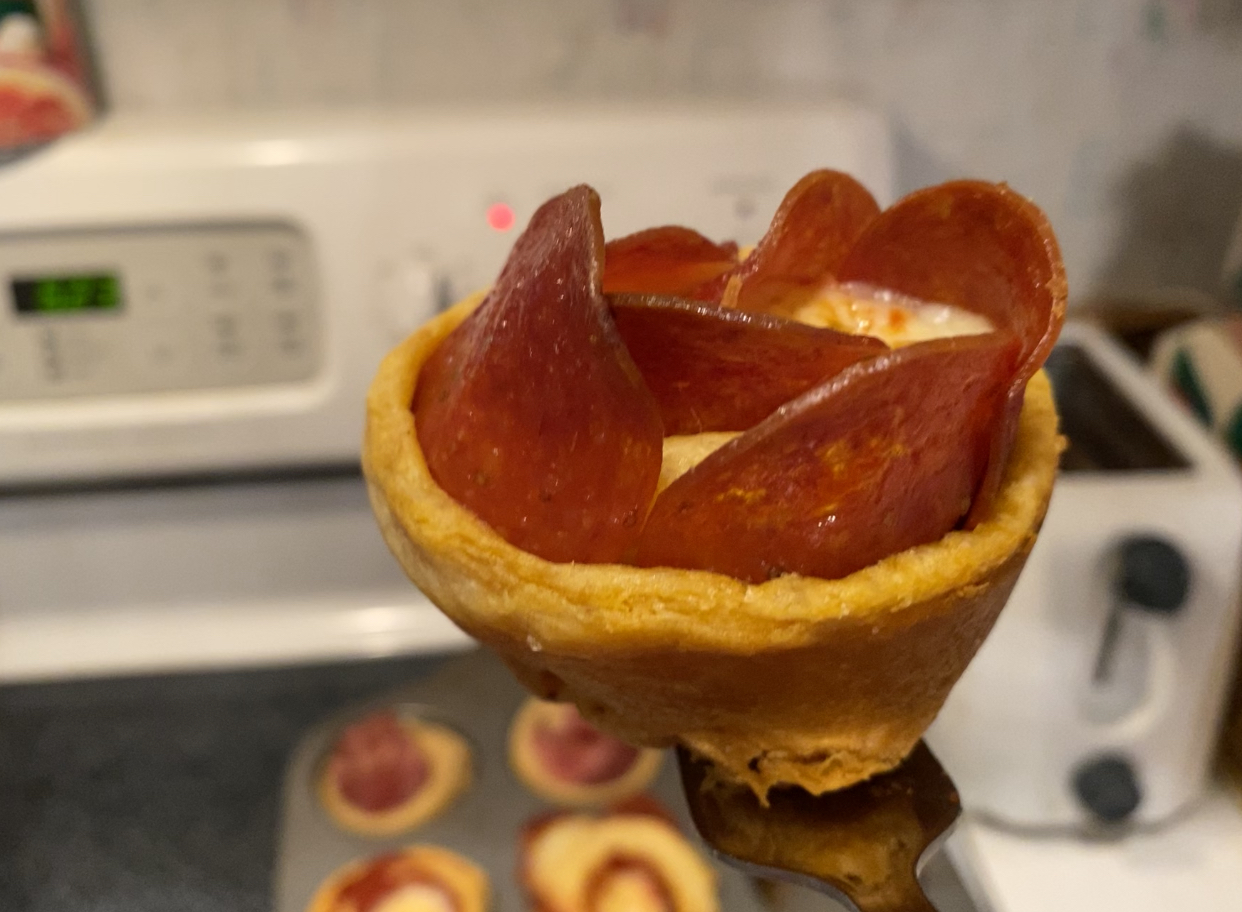
Years ago, a bunch of my single friends and I had an anti-Valentines party. Everyone brought food and candy and candy to share. We played a lot of Mario Kart. Hoping to impress, I found this recipe and it was a hit. Four years later, I have my whole family with me and decided to try it again. Result? They liked it. Here's how you can make it too.

First, gather the ingredients.

However, the crescent rolls are perforated into triangles. For the flowers, you need to transform them into rectangles.

On each rectangle, add a little bit of sauce, some pepperoni slices, and a pinch of cheese. Make sure half of the pepperoni is on the dough, while the other half protrudes above it.

Next, fold the bottom of the dough up over the pepperoni so the cheese and sauce does not leak out.

Take the folded strip and roll it up. The pepperoni sticking out at the top become flower petals.

It should form a swirl of nothing but dough on the bottom.

And, because my daughters don't like pepperoni, I made a few flowers with sliced ham.

Place each roll inside a greased muffin pan.

The oven should be preheated according to the instruction on the crescent roll packaging. Stick the pans in the oven. You'll need them to bake a few minutes longer than the instruction suggest.

And then they're done! Pull them out when the dough turns golden brown. Use the extra sauce for dipping and serve with a veggie side dish.

Whether you're cooking for friends, family, or yourself, I hope you enjoy these as much as we did at our house.

YUM