My brother graduated high school in 1992 which was the end of my seventh grade classes. It’s also the year grunge broke big. Pearl Jam’s Ten was released right before school started, Nivana’s Nevermind followed a month later, and by October Soundgarden unleashed Badmotorfinger. I was immune to grunge though. Aaron was a heavy metal fan which strongly influenced my musical preferences. A year earlier, most of the kids my age listened to George Michael and MC Hammer. Thanks to my conservative religious upbringing, I was led to believe grunge was inherently evil.
That all changed when I entered eighth grade. Two big albums were dropped in the fall of 92: Core from Stone Temple Pilots and Dirt by Alice In Chains. When my math teacher offered the class permission to select background music, my friend Matt nominated Dirt. “It’s brand new, just came out.” Class lasted 40 minutes so we didn’t have time to play the whole record yet those first few tracks blew me away. Them Bones, Dam That River, Rain When I Die, Down in a Hole. Whatever worksheets we were supposed to be doing is lost to my memory. Mathematic exercises were instantly irrelevant. I spent the remainder of class staring absently at the numbers on the paper in front of me, devoting all of my attention to the driving drum beats, low bass growl, and distorted guitars. My ears clung to every lyric as the vocals alternated between Layne’s manic howl and Jerry’s moody harmonies.
Within the next year, nearly all of my school friends were starting their own bands, including Matt who brought his brand new Alice In Chains tape with him to math class. I was not a good singer and I couldn’t play any instruments but I still loved the world of creating music. Matt suggested I start writing songs. If they were good, his band might use them. I had never written a song before so I asked him for tips. His advice was to pick a random word then write about how that word made me feel. A couple nights later, while bored and sitting in the back row pew of a Sunday night church service, I used the blank space of an offering envelope to write my first song: Reach.
This was the birth of my writing journey. Those first few songs I wrote were nothing more than poetry with a repeating refrain. We lived in the Seattle suburbs, Kurt Cobain was still alive (at least for a few months longer), and I was all in with grunge. The songs I wrote never got used but I kept writing. The song structure became looser until I was writing straight poetry and (according to friends of mine) I was prolific. I continued this habit into my early twenties.
Fear, anger, and pain fueled my prose. A lot of my poetry also contained themes of unrequited love. Loss. Regret. It was the essence of all the stereotypical teenage angst you’d expect from the mid-90s.
Then I fell in love at 23 and discovered I couldn’t write a romantic poem even if my life depended on it. I’d never compose a decent love song. My poetic output decreased, eventually dwindling into nothing. By the time I was 24, I was no longer a poet.
My creative outlets shifted to essays. For twenty years I’ve maintained the storytelling tradition through both fiction and non-fiction. You can’t kill an inner poet though. In the wake of divorce, I penned a couple new poems - an act of pure catharsis. Grief and turmoil were always my greatest muses. Over the years after, I’d unearth my poetic mindset and compose something new. Then put it away and move on.
When the question of women choosing between a bear and a man recently started trending, my wife told me I should write a poem about it. I balked at the idea. I couldn’t do it - it’s been years since I’ve been a poet. I don’t have it in me anymore. Even in the middle of denying my wife’s suggestion, I already had a couple lines swimming in my cranium. Within 24 hours, I wrote a new poem: Choose the Bear.
In the days that followed, my inner poet re-emerged. Two more poems were scribed in quick succession. Annie recorded me reading Choose the Bear and you can find it on TikTok. The next poem, A Weird Combination I Know, will be shared soon but the other, Early Onset Alcoholism will remain hidden for another year. Annie is also pushing me to try out some open mic nights to share my poetry with a larger audience.
Through this process, I’m rediscovering something I knew to be true when I was a teenager: poetry has the power to divulge those feelings you can’t describe in simple conversation. Since my autistic brain has difficulty expressing my emotions, poetry is giving me a chance to process trauma and release all this grief I’ve never been able to grieve.
My wife and I have been dragged through hell the last couple years. Outside forces have been doing all they can to tear us apart but their efforts have only bound us closer together. Somehow it feels the poems I write have more power because I’m speaking for both of us.
This new creative muse is providing more than just catharsis, it’s also healing. Because there’s shit from my childhood I’ve still not processed. There’s shit from my first marriage that I’ve never talked about. And there’s shit flung at my wife and I that I’ve kept quiet.
Until now.
Annie and I have full custody of our younger two children. We only had to split custody with my older three kids. The first is 19 and lives independently. My next daughter is 17 and in the going-to-do-whatever-she-wants-to-do phase and there’s nothing I can do to stop it. My son is in jail and will be until he’s almost 18. This era of co-parenting is coming to an end.
For the last 11 years, I’ve tried as hard as I can to keep my mouth shut and take the high road. My ex-wife continues to violate our custody order and makes every attempt to stir up chaos in my life. Her reasons are unknown to me but my happiness seems to offend her. With these factors at play, my gloves are off. I have nothing to lose. We need peace and I’m finding it in poetry.
Ps: I’ve kept everything I wrote in the decade between the ages of 14 and 24. It’s all squirreled away in a box somewhere in the garage. Perhaps I’ll need to revive them and re-write them, transform them into something a little less angsty and juvenile.
An exploration of parenthood, corporate life,
Showing posts with label poetry. Show all posts
5.11.2024
Once a Poet …
Labels:
blogging,
family,
health,
life,
music,
nic's history,
poetry,
relationships,
school,
writing
3.04.2024
Soul Laid Bare
She is the sun on my skin and the breeze in my hair
She is nowhere to be found and absolutely everywhere
She is chaos incarnate with a divine flair
She is clothes backwards inside out and doesn’t care
She is the dance beat between the kick and the snare
She makes every mess and takes every dare
She terrifies me yet she’s a breath of fresh air
She’s my daughter and she is my soul laid bare
12.23.2021
Peace on Earth or Something Like It
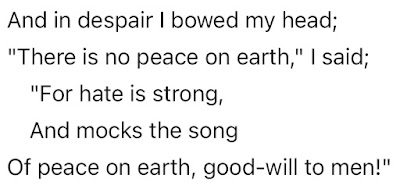
It’s one of the most recognizable phrases of the Yuletide season:” Peace on earth, goodwill to men.” Ranks up there with “Merry Christmas to all and to all a good night,” “bah-humbug,” and “Grinch’s small heart grew three sizes that day.” The line, taken from the biblical gospel of Luke, is the closing lyric at the end of every verse of “I Heard the Bells on Christmas Day.”
Poet Henry Wadsworth Longfellow, who authored the carol, was aware of his repetitive prose, commemorating his style in the first verse. “Wild and sweet the words repeat of peace on earth good will to men.” He echoed the nativity story when angels appeared to shepherds to announce the birth of Jesus. The heavenly beings divulge the who/when/where details to the migrant workers; then a whole choir appears and sings “Glory to God in the highest, and on earth peace, good will toward men.”
It’s such a familiar verse, even people who’ve never stepped foot in a church could quote it. From greeting cards to A Charlie Brown Christmas, this Bible story is ingrained in our collective psyche - an inseparable part of pop culture as much as it is a sacred religious tradition. Yet, it is woefully lacking.
Two decades ago, most of my friends (and all of my roommates) were musicians. We all challenged each other to be smarter and more artistic. We honed each other’s talents. One of these dudes had never read an entire book in his life unless required for school. When he decided to be more of a reader, the first book he chose was Plato’s Apology. He asked me if I wanted to take a class with him to study Koine Greek. How could I resist? Doesn’t everyone want to learn a dead language?
I still can’t speak the ancient Mediterranean tongue. It’s complex - lacking in punctuation and current rules of grammar. However, I do remember the alphabet, basic pronunciation, and some vocabulary. More importantly, I learned the basics of how modern scholars approach biblical translation since Koine is the language used in the most of the earliest copies of the New Testament. I learned how many of the older translations into English did not provide the most accurate translation possible. The King James Bible is rife with minor mistranslations including this verse in Saint Luke’s telling of the birth of Christ.
Here is the scripture of Luke 2:14 according to the KJV: “Glory to God in the highest, and on earth peace, good will toward men.”
And the same thing in Koine Greek: “δόξα ἐν ὑψίστοις θεῷ καὶ ἐπὶ γῆς εἰρήνη ἐν ἀνθρώποις εὐδοκίας”
Yeah, I know. You probably can’t read Greek and for the most part, neither can I. However there are a couple words I recognize from my studies during the summer of 2001. Simple ones like ἐν (en) which means in. Or καὶ (kai) the Greek word for and. Easy stuff. Seminary students would likely know words like θεῷ (Theo), which means God, and ἀνθρώποις might be familiar to anthropology students because it’s the entomological origin of their degree curriculum.
To make things easy, I’ll transliterate it: doxa en hypsistois Theo kai epi gēs eirēnē en anthropois eudokias. In a literal word for word translation into English: glory in highest to God and on earth peace among men … eudokias.
That last word, eudokias, is where it gets weird. This is where the KJV goes astray. What does the word mean? It’s also the last word in Philippians 2:13 and there, the KJV gets the translation correct: “For it is God which worketh in you both to will and to do of his good pleasure.” Eudokias only appears twice in the New Testament. The KJV the translation right in one verse but wrong in the other. How? Why? And what should it say?
Eudokias means good will or good pleasure or with pleasure or good favor or with favor. There’s a lot of different ways to interpret it; like I said, Koine Greek is a complex language.
This is how the KJV got it mixed up. They used good pleasure in Paul’s epistle and good will in the gospel. More specifically God’s good pleasure and men’s good will. On the surface it seems correct, but it’s not. There’s a mistake into how the good will was applied. The word eudokiasis a possessed word. Not possessed like a ghost, but possessed as in belonging to someone or something. This is apparent in the KJV take in Philippians. The good pleasure of eudokias belongs to God. Once you understand the weird and often confusing syntax of Koine, we find the same is true in the book of Luke. The good pleasure, good will, or good favor in the Christmas story belongs to God, not people.
A broken English translation of the verse in Luke should read “glory in highest to God and on earth peace among men of his good will.” Or men of his pleasure (awkward) or as most modern translations use, his favor. More specifically, the NIV reads “peace to those on whom his favor rests.”
It’s not peace on earth AND good will to men. It is peace on earth for those of God’s good will.
I can understand how the King James translators got it wrong and I can see what they got wrong, but I do not know why. All I can explain is the modern implications of this 400 year old mistake.
Despite growing up in a church that relied on the NIV, it’s the KJV version I can quote from rote memory because that’s the version from the Christmas song and Charles Schultz’s cartoon special. It’s the one repeated in the public square.
It would be easy to conclude peace on earth is the sole purpose of the nativity. To do so is missing the point. If Jesus came to bring peace on earth to people with whom God’s favor rests, God’s people should be peacekeepers, or rather, peace bringers.
We cannot sit back and pretend peace on earth is an abstract concept, the responsibility of the divine, and ignore the role we’re supposed to take. The birth of Jesus should give Christians a peace that surpasses all understanding - a sense of peace so strong and overwhelming, we can’t help but spread it to the world around us. Jesus didn’t come to bring peace on earth. He came to give us peace on an earth in turmoil. He lived to show us how to share that peace. And he commanded us to do the hard work of binging peace on earth.
Unfortunately in modern Christianity, especially in America, and ESPECIALLY in white evangelical culture, this message is lost. When I look at the American Evangelical Church, peace is the last adjective that comes to mind. Quarrelsome, fearful, vindictive, chaotic, divisive, greedy, violent, too busy fighting an imaginary war on Christmas to realize everything they do is antithetical to the gospel of Christ.
Not much has changed in America since Longfellow penned his poem.
I want to reclaim the spirit of Christmas. I want my fellow Christians to truly be a people of God’s good will. If there is to be peace on earth, may we be the peacekeepers who bring it to a world starving for peace and be people of eudokias.
Poet Henry Wadsworth Longfellow, who authored the carol, was aware of his repetitive prose, commemorating his style in the first verse. “Wild and sweet the words repeat of peace on earth good will to men.” He echoed the nativity story when angels appeared to shepherds to announce the birth of Jesus. The heavenly beings divulge the who/when/where details to the migrant workers; then a whole choir appears and sings “Glory to God in the highest, and on earth peace, good will toward men.”
It’s such a familiar verse, even people who’ve never stepped foot in a church could quote it. From greeting cards to A Charlie Brown Christmas, this Bible story is ingrained in our collective psyche - an inseparable part of pop culture as much as it is a sacred religious tradition. Yet, it is woefully lacking.
Two decades ago, most of my friends (and all of my roommates) were musicians. We all challenged each other to be smarter and more artistic. We honed each other’s talents. One of these dudes had never read an entire book in his life unless required for school. When he decided to be more of a reader, the first book he chose was Plato’s Apology. He asked me if I wanted to take a class with him to study Koine Greek. How could I resist? Doesn’t everyone want to learn a dead language?
I still can’t speak the ancient Mediterranean tongue. It’s complex - lacking in punctuation and current rules of grammar. However, I do remember the alphabet, basic pronunciation, and some vocabulary. More importantly, I learned the basics of how modern scholars approach biblical translation since Koine is the language used in the most of the earliest copies of the New Testament. I learned how many of the older translations into English did not provide the most accurate translation possible. The King James Bible is rife with minor mistranslations including this verse in Saint Luke’s telling of the birth of Christ.
Here is the scripture of Luke 2:14 according to the KJV: “Glory to God in the highest, and on earth peace, good will toward men.”
And the same thing in Koine Greek: “δόξα ἐν ὑψίστοις θεῷ καὶ ἐπὶ γῆς εἰρήνη ἐν ἀνθρώποις εὐδοκίας”
Yeah, I know. You probably can’t read Greek and for the most part, neither can I. However there are a couple words I recognize from my studies during the summer of 2001. Simple ones like ἐν (en) which means in. Or καὶ (kai) the Greek word for and. Easy stuff. Seminary students would likely know words like θεῷ (Theo), which means God, and ἀνθρώποις might be familiar to anthropology students because it’s the entomological origin of their degree curriculum.
To make things easy, I’ll transliterate it: doxa en hypsistois Theo kai epi gēs eirēnē en anthropois eudokias. In a literal word for word translation into English: glory in highest to God and on earth peace among men … eudokias.
That last word, eudokias, is where it gets weird. This is where the KJV goes astray. What does the word mean? It’s also the last word in Philippians 2:13 and there, the KJV gets the translation correct: “For it is God which worketh in you both to will and to do of his good pleasure.” Eudokias only appears twice in the New Testament. The KJV the translation right in one verse but wrong in the other. How? Why? And what should it say?
Eudokias means good will or good pleasure or with pleasure or good favor or with favor. There’s a lot of different ways to interpret it; like I said, Koine Greek is a complex language.
This is how the KJV got it mixed up. They used good pleasure in Paul’s epistle and good will in the gospel. More specifically God’s good pleasure and men’s good will. On the surface it seems correct, but it’s not. There’s a mistake into how the good will was applied. The word eudokiasis a possessed word. Not possessed like a ghost, but possessed as in belonging to someone or something. This is apparent in the KJV take in Philippians. The good pleasure of eudokias belongs to God. Once you understand the weird and often confusing syntax of Koine, we find the same is true in the book of Luke. The good pleasure, good will, or good favor in the Christmas story belongs to God, not people.
A broken English translation of the verse in Luke should read “glory in highest to God and on earth peace among men of his good will.” Or men of his pleasure (awkward) or as most modern translations use, his favor. More specifically, the NIV reads “peace to those on whom his favor rests.”
It’s not peace on earth AND good will to men. It is peace on earth for those of God’s good will.
I can understand how the King James translators got it wrong and I can see what they got wrong, but I do not know why. All I can explain is the modern implications of this 400 year old mistake.
Despite growing up in a church that relied on the NIV, it’s the KJV version I can quote from rote memory because that’s the version from the Christmas song and Charles Schultz’s cartoon special. It’s the one repeated in the public square.
It would be easy to conclude peace on earth is the sole purpose of the nativity. To do so is missing the point. If Jesus came to bring peace on earth to people with whom God’s favor rests, God’s people should be peacekeepers, or rather, peace bringers.
We cannot sit back and pretend peace on earth is an abstract concept, the responsibility of the divine, and ignore the role we’re supposed to take. The birth of Jesus should give Christians a peace that surpasses all understanding - a sense of peace so strong and overwhelming, we can’t help but spread it to the world around us. Jesus didn’t come to bring peace on earth. He came to give us peace on an earth in turmoil. He lived to show us how to share that peace. And he commanded us to do the hard work of binging peace on earth.
Unfortunately in modern Christianity, especially in America, and ESPECIALLY in white evangelical culture, this message is lost. When I look at the American Evangelical Church, peace is the last adjective that comes to mind. Quarrelsome, fearful, vindictive, chaotic, divisive, greedy, violent, too busy fighting an imaginary war on Christmas to realize everything they do is antithetical to the gospel of Christ.
Not much has changed in America since Longfellow penned his poem.
I want to reclaim the spirit of Christmas. I want my fellow Christians to truly be a people of God’s good will. If there is to be peace on earth, may we be the peacekeepers who bring it to a world starving for peace and be people of eudokias.
Labels:
a manifesto,
advice,
books,
ethics,
friends,
holidays,
life,
music,
nic's history,
observations,
poetry,
religion
9.09.2020
Like a Plane in the sunset
Waiting on you has been like a pilot flying a plane into the sunset being the last human to see the beautiful sight before the world is cast into darkness.
Waiting on you has been like a little kid at bedtime hoping to stay awake a little longer - just five more minutes daddy please.
Waiting on you has been like ordering a meal at a popular restaurant, anticipation filled with aromas from the kitchen so strong you can taste the food before it even arrives.
Waiting on you is like a baseball game and the home team has the bases loaded when the star player steps up to bat, as the first pitch is thrown you know it’s going to be a grand slam.
Waiting on you has been like a comedian telling a a funny story and she takes a deep breath after delivering the punchline before the crowd erupts with laughter.
Waiting on you has been like a hike in the woods on a spring day while the roar of a waterfall grows increasingly louder long before it’s visible through the trees.
Waiting on you has been like a radio station playing your favorite song as you reach your destination so you let the engine idle until the song is over because you need to sing along with every note.
Waiting on you has been like savoring every moment every rainy day, of every mile driven on a road trip, of every sloppy wet kiss given by a dog, of barbecue smoke, family movie nights, freshly baked chocolate chip cookies, foggy mornings, and a comfortable bed at the end of a long day.
No longer waiting on you has been a fulfillment of joy, anticipation and preparation subsided, to have you here and hold you in our arms knowing some day you will protest bedtime, tell jokes, climb mountains, and giggle after puppy kisses.
Until then, I’ll forever be a pilot flying my plane into your sunset.
1.11.2018
A Lost Generation
My generation doesn't have a name so you might not have heard of us.
Generation X ended in the late 70's, Millinials started in the early 80's, and we were born somewhere in between.
A gap generation.
No one talks about my generation.
My generation has always been on the edge of something.
We were born with the death of disco and graduated high school when ska got popular.
We were too young to relate to Reality Bites and too old to relate to Superbad.
We inherited our older siblings' sense of apathy and borrowed a sense of entitlement from our younger siblings.
I guess we got the worst of both worlds.
We were the last generation to watch Saturday morning cartoons and the first generation to watch Nickelodeon.
Now we are Cartoon Networks' target audience.
We were the last generation to experience analog technology and the first generation to experience digital technology.
We are the only generation to be raised on both.
We were guinea pigs.
The test subjects.
Our education was an experiment with mixed results.
We learned from both Mr. Rogers and Super Mario.
We watched the rise and fall of AOL.
We were in school before and after Google.
We perfected social media and made it unbearable.
We were weened on vinyl records, spent our childhoods with cassette tapes, took our CD collections to high school, and binged on MP3s in our college years.
We know we should feel nostalgic for one of those mediums but we're not sure which.
We were the last generation to buy VHS, the first to stream movies, and we still lovingly hold on to our DVD collections.
We turned Blockbuster into a ghost town and we were the first residents of Netflix.
We can't live without the internet but still remember when we lived without the internet.
My generation is both listless and motivated.
We are filled with both hope and despair.
The odds are stacked against my generation.
We can't get low tech jobs because they're filled by an older and more experienced generation.
We can't get high tech jobs because they're filled by an younger and more experienced generation.
Our parents' generation didn't need a college degree to get a career.
Our kids' generation won't have a career without a college degree.
We split the difference.
We are everything and we are nothing.
We are sandwiched between a generation that's broken and the generation that broke them.
We are permanently stuck in the middle.
Labels:
life,
observations,
poetry,
random thoughts,
rants,
writing
3.13.2017
Evolution of a Writer
Before I was a blogger, I was a poet. Actually, I was a songwriter first. Well, that still isn’t accurate. Before I was anything, I avoided writing everything.
In my earliest memories, I did as little writing as possible. In preschool, when the teachers were teaching us to write our own names, I shortened Nicholas to Nic because I didn’t want to take the time to write my whole name. In elementary school, homework was often incomplete if it was done at all. My handwriting was sloppy. Other kids could write a full page in the time it took me to scribble one full paragraph; I was slow so I figured it wasn’t my thing.
There had to be something wrong with me. My grades were suffering because of it. I was smart (I tested into the highest tier of IQ for my age group) yet I was rarely able to focus in class and barely survived with grades somewhere between needs improvement and mediocre.
One summer, my parents tried to fix it. School was out and they were determined to turn me into a better student by the following September. On a warm weekend, we went over to some friends of my parents for a barbecue. I liked going there because their boys were close to my age and they had a ColecoVision with several games including my favorites: BurgerTime and Pitfall. During this visit, my parents set a restriction: before I could play video games I had to copy three pages word-for-word from a book called Medical Mysteries. It was a tortuous task and unforgettable experience. I complained the whole time and when I was done my hands hurt so much that I didn’t feel like playing any games. My parent’s efforts failed; I still hated to write and school continued to be a struggle.
In seventh grade, my friend Matt introduced me to grunge. Our math teacher allowed us to pick out the music to play while we completed our worksheets. Matt had a copy of the Sap EP that Alice in Chains had released earlier that month. Soon, like most other junior high aged kids in the Seattle suburbs, I thought grunge was the coolest thing in the world. A year later, Matt told me he was in a band. I asked him who wrote their songs and he said, “We do, it’s easy – think of a word and write about it.” As our eighth grade year was coming to an end, he told me that if I wrote a song for his band, they might use it.
Over the summer, I penned my first song. It was called Reach. I wrote it on the blank side of an offering envelope during a Sunday night church service while I probably should have been listening to the pastor. Of course, it wasn’t a complete song – just words. I could hear the melody in my head but since I couldn’t play any instruments, the music portion of the song was never created. When we returned to school to start ninth grade, Matt was still in a band but I never gave him the lyrics to Reach. I was insecure and filled with the self-loathing teenaged angst my generation perfected in the 90s. I was sure my work wasn’t good enough.
I kept writing though, suddenly finding enjoyment in placing words on paper. For a while, I stuck with the basic verse chorus verse song structure, fully intending to find a guitarist who could help add music to match what I imagined when I created the lyrics. Eventually though, the song craft morphed into poetry and prose. It wasn’t good poetry by any measure. I was a nerdy high school kids so there were limits to my talents. But it sustained me through the latter half of my teen years as I filled up notebook after notebook with my own creative work.
The poetic writing continued into my early 20s. Then I met a girl and I really liked her. Unfortunately, my creative spark vanished. I would try and write a poem but instead stare at a blank page wondering if I had run out of words. I couldn’t write a love song if my life depended on it. Apparently, heartbreak, anger, and frustration were better motivators than feelings of infatuation and romance. With the rhythms and rhymes gone from my imagination, my writings morphed again. I started emailing letters – essays to my dad. I wrote about people who were making waves in pop culture. I argued that if Christians really believed what the bible says, we should pray for these people instead of criticizing them.
That girl and I got married. We packed up everything we owned and moved to South Dakota. During the two-day drive from Coeur d’Alene to Sioux Falls, I was either driving or reading. My new father-in-law wrote fan-fiction and he had a short story he was going to submit into a contest. Even though his story was set in a universe fandom that I didn’t follow, I still read it. I thought it was good; the story was engaging and entertaining. Then somewhere between Sturgis and Wall, an inescapable thought hit me: I could totally do this. Not necessarily authoring fan-fiction but writing stories. I’ve always been a good story teller, all I had to do was commit it to ink and paper.
I tried. I thought I could write the next great novel. Unfortunately, I had a bad case of ‘Ooooh, Shiny.’ Every time I had an idea for a book, I composed a chapter or three then got distracted by other ideas. Even if I plotted out the entire story line ahead of time, I couldn’t create more than a few chapters before giving up. Life got complicated. We had a kid, and my wages were our only income so writing took a back seat for a while.
Then came this blog. I’ve already described how this thing I do evolved from a whim because a coworker was doing it to being The Faithful Geek. Now I’m making efforts to make this worth something and turn it into tangible income. (Speaking of which, help a starving artist and click on some ads.) I’m hustling to complete my work-in-progress so I can turn it into a marketable manuscript. I am a writer – four words my parents would have never imagined me saying that summer they tried to fix my school habits 30 years ago. It is amazing how this activity I once loathed has become my passion.
I’ve been thinking about my old poetry a lot lately. Thinking about digging it up, polishing it off, and rewriting some of it. Maybe publishing some here. This afternoon, I realized something. It’s only been the last few years I’ve considered myself a writer but I’ve been one for a lot longer. It’s been nearly 23 years since I wrote my first song. Now, blogging has brought me through adopting kids, corporate restructuring, divorce, and returning to college. I might not have much to offer, but I can write. I don’t know what the future holds for my craft, but I do know writing is the thing I can’t not do.
In my earliest memories, I did as little writing as possible. In preschool, when the teachers were teaching us to write our own names, I shortened Nicholas to Nic because I didn’t want to take the time to write my whole name. In elementary school, homework was often incomplete if it was done at all. My handwriting was sloppy. Other kids could write a full page in the time it took me to scribble one full paragraph; I was slow so I figured it wasn’t my thing.
There had to be something wrong with me. My grades were suffering because of it. I was smart (I tested into the highest tier of IQ for my age group) yet I was rarely able to focus in class and barely survived with grades somewhere between needs improvement and mediocre.
One summer, my parents tried to fix it. School was out and they were determined to turn me into a better student by the following September. On a warm weekend, we went over to some friends of my parents for a barbecue. I liked going there because their boys were close to my age and they had a ColecoVision with several games including my favorites: BurgerTime and Pitfall. During this visit, my parents set a restriction: before I could play video games I had to copy three pages word-for-word from a book called Medical Mysteries. It was a tortuous task and unforgettable experience. I complained the whole time and when I was done my hands hurt so much that I didn’t feel like playing any games. My parent’s efforts failed; I still hated to write and school continued to be a struggle.
In seventh grade, my friend Matt introduced me to grunge. Our math teacher allowed us to pick out the music to play while we completed our worksheets. Matt had a copy of the Sap EP that Alice in Chains had released earlier that month. Soon, like most other junior high aged kids in the Seattle suburbs, I thought grunge was the coolest thing in the world. A year later, Matt told me he was in a band. I asked him who wrote their songs and he said, “We do, it’s easy – think of a word and write about it.” As our eighth grade year was coming to an end, he told me that if I wrote a song for his band, they might use it.
Over the summer, I penned my first song. It was called Reach. I wrote it on the blank side of an offering envelope during a Sunday night church service while I probably should have been listening to the pastor. Of course, it wasn’t a complete song – just words. I could hear the melody in my head but since I couldn’t play any instruments, the music portion of the song was never created. When we returned to school to start ninth grade, Matt was still in a band but I never gave him the lyrics to Reach. I was insecure and filled with the self-loathing teenaged angst my generation perfected in the 90s. I was sure my work wasn’t good enough.
I kept writing though, suddenly finding enjoyment in placing words on paper. For a while, I stuck with the basic verse chorus verse song structure, fully intending to find a guitarist who could help add music to match what I imagined when I created the lyrics. Eventually though, the song craft morphed into poetry and prose. It wasn’t good poetry by any measure. I was a nerdy high school kids so there were limits to my talents. But it sustained me through the latter half of my teen years as I filled up notebook after notebook with my own creative work.
The poetic writing continued into my early 20s. Then I met a girl and I really liked her. Unfortunately, my creative spark vanished. I would try and write a poem but instead stare at a blank page wondering if I had run out of words. I couldn’t write a love song if my life depended on it. Apparently, heartbreak, anger, and frustration were better motivators than feelings of infatuation and romance. With the rhythms and rhymes gone from my imagination, my writings morphed again. I started emailing letters – essays to my dad. I wrote about people who were making waves in pop culture. I argued that if Christians really believed what the bible says, we should pray for these people instead of criticizing them.
That girl and I got married. We packed up everything we owned and moved to South Dakota. During the two-day drive from Coeur d’Alene to Sioux Falls, I was either driving or reading. My new father-in-law wrote fan-fiction and he had a short story he was going to submit into a contest. Even though his story was set in a universe fandom that I didn’t follow, I still read it. I thought it was good; the story was engaging and entertaining. Then somewhere between Sturgis and Wall, an inescapable thought hit me: I could totally do this. Not necessarily authoring fan-fiction but writing stories. I’ve always been a good story teller, all I had to do was commit it to ink and paper.
I tried. I thought I could write the next great novel. Unfortunately, I had a bad case of ‘Ooooh, Shiny.’ Every time I had an idea for a book, I composed a chapter or three then got distracted by other ideas. Even if I plotted out the entire story line ahead of time, I couldn’t create more than a few chapters before giving up. Life got complicated. We had a kid, and my wages were our only income so writing took a back seat for a while.
Then came this blog. I’ve already described how this thing I do evolved from a whim because a coworker was doing it to being The Faithful Geek. Now I’m making efforts to make this worth something and turn it into tangible income. (Speaking of which, help a starving artist and click on some ads.) I’m hustling to complete my work-in-progress so I can turn it into a marketable manuscript. I am a writer – four words my parents would have never imagined me saying that summer they tried to fix my school habits 30 years ago. It is amazing how this activity I once loathed has become my passion.
I’ve been thinking about my old poetry a lot lately. Thinking about digging it up, polishing it off, and rewriting some of it. Maybe publishing some here. This afternoon, I realized something. It’s only been the last few years I’ve considered myself a writer but I’ve been one for a lot longer. It’s been nearly 23 years since I wrote my first song. Now, blogging has brought me through adopting kids, corporate restructuring, divorce, and returning to college. I might not have much to offer, but I can write. I don’t know what the future holds for my craft, but I do know writing is the thing I can’t not do.
Labels:
blogging,
books,
family,
life,
music,
nic's history,
poetry,
religion,
video games,
work,
writing
7.03.2016
Is It Bliss?
The proverb proposes “ignorance is bliss.” I have often wondered the origin of the phrase with some strange hope to travel back in time, prevent its adoption into popular usage – like a literary terminator sent into the past to kill what would destroy us, forever protecting our lexicon.
Is ignorance really bliss? What does that even mean?
Alas, I am not a T-800, nor do I possess Arnold Schwarzenegger’s physique. What I do have is access to the internet and my google-fu is strong. I don’t have to ignorantly wonder about useless trivia for all eternity. If I want to know where something originated, I only need to spend a few of minutes with a search engine and diligent study.
While the powers to defy boundaries of time and space belong only to The Doctor and his companions: I can peruse the texts of history and Thomas Gray is safe from my intellectual wrath.
Who is Thomas Gray? Gray was an eighteenth century poet, a scholar and a professor at Cambridge University. By all accounts, he was an intelligent and eloquent man. He spent most of his free time reading or playing a harpsichord. He had an interest in botany, physical sciences, and locations of antiquity. His most famous poem ‘Elegy Written in a Country Churchyard’ contained lines that immediately found their way into common use in the English language – phrases like “celestial fire” and “kindred spirit.”
Thomas Gray is also to blame for first penning the words “ignorance is bliss.” It is found in the final stanza of his poem, ‘Ode on a Distant Prospect of Eton College.’
Over the past 270 years, the original meaning of Gray’s words has been replaced. Gone is the loving nostalgia of faded youth. Gone is the fond remembrance of being in school and getting an education. Instead, the final eight words of a beautiful poem are immortalized and taken as gospel: happiness is found in ignorance and wisdom is foolish. Modern America has embraced these words to become a higher calling – that idiocy is something to which we should aspire. Ignorance is bliss. I do not think it means what you think it means.
Where did we go wrong? How did we come to interpret this work of prose into a twisted American ideal? It couldn’t have been at the birth of our nation. A little more than forty years after Gray’s Ode was published, Benjamin Franklin wrote his autobiography which contained his list of thirteen virtues for moral perfection: Temperance, Silence, Order, Resolution, Frugality, Industry, Sincerity, Justice, Moderation, Cleanliness, Tranquility, Chastity, and Humility. While recognizing it was impossible to be perfect, attempting to reach perfection made Ben better and happier.
Please note, Franklin did not list ignorance as a virtue. Yet a large portion of American culture lives as if it was, gleefully bragging about their disdain for any semblance of intellect. This is the culture that turned Honey Boo Boo into a star, clings to debunked conspiracy theories, and denigrates those with Ivy League degrees as elitists. We use ignorance as an excuse; we cannot be held accountable for things of which we were not aware, dodging personal responsibility in an effort to maintain our pursuit of happiness. We never have to be wrong nor do we ever need to be challenged. This trend is alarming, but nowhere does it concern me more than within the church.
It needs to stop. We can no longer demonize scientific inquiry as some great evil. We can no longer shun those with an insatiable appetite for knowledge. We can no longer discourage education.
If we as Christians believe in a God who literally created everything, then we must also believe the same God created the seismic shifts and eons of erosion that formed our continents and gave shape to our mountains and coastlines. If we believe in a God who was the creative spark at the origin of our species, we must also believe the same God gave us brains and intends for us to use them. If we believe in a God who wove the tapestries in this world of scenic vistas teaming with wildlife, we must also believe the same God wants us to care for and preserve that natural world. If we believe in a God who decorated the heavens with countless stars and distant galaxies, we must believe the same God wants us to explore those extraterrestrial depths and understand our universe.
That is the kind of God that King Solomon worshiped. He did not see ignorance as a virtue. Rather he valued wisdom. In the biblical book of Proverbs, Solomon wrote, “Hold on to wisdom, and it will take care of you. Love it, and it will keep you safe. Wisdom is the most important thing; so get wisdom. If it costs everything you have, get understanding. Treasure wisdom, and it will make you great; hold on to it, and it will bring you honor. It will be like flowers in your hair and like a beautiful crown on your head.”
The Apostle James encourages his readers to ask God for wisdom if we lack it because God will give it to us generously and without reproach.
It is wisdom, not ignorance that will take care of us. It is wisdom, not ignorance that makes us great. We should be asking for wisdom, not ignorance. Because God gives wisdom, not ignorance.
Knowledge and wisdom are both spiritual gifts. We need to stop treating them as taboo topics or nefarious qualities. If we are to abide by the words of the first chapter of Isaiah, wisdom is essential.
Wash yourselves; make yourselves clean;
remove the evil of your deeds from before my eyes;
cease to do evil,
learn to do good;
seek justice,
correct oppression;
bring justice to the fatherless,
plead the widow's cause.
Come now, let us reason together, says the Lord:
though your sins are like scarlet,
they shall be as white as snow;
though they are red like crimson,
they shall become like wool.
Justice requires wisdom. Caring for the orphan and widow takes wisdom. God is clearly asking his people to think. He wants us to reason together. Rational, critical thinking.
Does that mean we should ignore Thomas Gray’s poem? Of course not, but we should put it into context. He was looking at a younger generation as a reflection his own days of youth. He wondered if knowledge of the future would ruin their joy. If you knew what would happen to you over the next twenty years, would it inspire you or discourage you? Gray figured it would be better for kids to be unaware of the pains and trials of their future as it would diminish their joy.
To be ignorant of the past is dangerous. To be ignorant of current events is irrational. But to be ignorant of the future? Well, that is bliss.
Is ignorance really bliss? What does that even mean?
Alas, I am not a T-800, nor do I possess Arnold Schwarzenegger’s physique. What I do have is access to the internet and my google-fu is strong. I don’t have to ignorantly wonder about useless trivia for all eternity. If I want to know where something originated, I only need to spend a few of minutes with a search engine and diligent study.
While the powers to defy boundaries of time and space belong only to The Doctor and his companions: I can peruse the texts of history and Thomas Gray is safe from my intellectual wrath.
Who is Thomas Gray? Gray was an eighteenth century poet, a scholar and a professor at Cambridge University. By all accounts, he was an intelligent and eloquent man. He spent most of his free time reading or playing a harpsichord. He had an interest in botany, physical sciences, and locations of antiquity. His most famous poem ‘Elegy Written in a Country Churchyard’ contained lines that immediately found their way into common use in the English language – phrases like “celestial fire” and “kindred spirit.”
Thomas Gray is also to blame for first penning the words “ignorance is bliss.” It is found in the final stanza of his poem, ‘Ode on a Distant Prospect of Eton College.’
Over the past 270 years, the original meaning of Gray’s words has been replaced. Gone is the loving nostalgia of faded youth. Gone is the fond remembrance of being in school and getting an education. Instead, the final eight words of a beautiful poem are immortalized and taken as gospel: happiness is found in ignorance and wisdom is foolish. Modern America has embraced these words to become a higher calling – that idiocy is something to which we should aspire. Ignorance is bliss. I do not think it means what you think it means.
Where did we go wrong? How did we come to interpret this work of prose into a twisted American ideal? It couldn’t have been at the birth of our nation. A little more than forty years after Gray’s Ode was published, Benjamin Franklin wrote his autobiography which contained his list of thirteen virtues for moral perfection: Temperance, Silence, Order, Resolution, Frugality, Industry, Sincerity, Justice, Moderation, Cleanliness, Tranquility, Chastity, and Humility. While recognizing it was impossible to be perfect, attempting to reach perfection made Ben better and happier.
Please note, Franklin did not list ignorance as a virtue. Yet a large portion of American culture lives as if it was, gleefully bragging about their disdain for any semblance of intellect. This is the culture that turned Honey Boo Boo into a star, clings to debunked conspiracy theories, and denigrates those with Ivy League degrees as elitists. We use ignorance as an excuse; we cannot be held accountable for things of which we were not aware, dodging personal responsibility in an effort to maintain our pursuit of happiness. We never have to be wrong nor do we ever need to be challenged. This trend is alarming, but nowhere does it concern me more than within the church.
It needs to stop. We can no longer demonize scientific inquiry as some great evil. We can no longer shun those with an insatiable appetite for knowledge. We can no longer discourage education.
If we as Christians believe in a God who literally created everything, then we must also believe the same God created the seismic shifts and eons of erosion that formed our continents and gave shape to our mountains and coastlines. If we believe in a God who was the creative spark at the origin of our species, we must also believe the same God gave us brains and intends for us to use them. If we believe in a God who wove the tapestries in this world of scenic vistas teaming with wildlife, we must also believe the same God wants us to care for and preserve that natural world. If we believe in a God who decorated the heavens with countless stars and distant galaxies, we must believe the same God wants us to explore those extraterrestrial depths and understand our universe.
That is the kind of God that King Solomon worshiped. He did not see ignorance as a virtue. Rather he valued wisdom. In the biblical book of Proverbs, Solomon wrote, “Hold on to wisdom, and it will take care of you. Love it, and it will keep you safe. Wisdom is the most important thing; so get wisdom. If it costs everything you have, get understanding. Treasure wisdom, and it will make you great; hold on to it, and it will bring you honor. It will be like flowers in your hair and like a beautiful crown on your head.”
The Apostle James encourages his readers to ask God for wisdom if we lack it because God will give it to us generously and without reproach.
It is wisdom, not ignorance that will take care of us. It is wisdom, not ignorance that makes us great. We should be asking for wisdom, not ignorance. Because God gives wisdom, not ignorance.
Knowledge and wisdom are both spiritual gifts. We need to stop treating them as taboo topics or nefarious qualities. If we are to abide by the words of the first chapter of Isaiah, wisdom is essential.
Wash yourselves; make yourselves clean;
remove the evil of your deeds from before my eyes;
cease to do evil,
learn to do good;
seek justice,
correct oppression;
bring justice to the fatherless,
plead the widow's cause.
Come now, let us reason together, says the Lord:
though your sins are like scarlet,
they shall be as white as snow;
though they are red like crimson,
they shall become like wool.
Justice requires wisdom. Caring for the orphan and widow takes wisdom. God is clearly asking his people to think. He wants us to reason together. Rational, critical thinking.
Does that mean we should ignore Thomas Gray’s poem? Of course not, but we should put it into context. He was looking at a younger generation as a reflection his own days of youth. He wondered if knowledge of the future would ruin their joy. If you knew what would happen to you over the next twenty years, would it inspire you or discourage you? Gray figured it would be better for kids to be unaware of the pains and trials of their future as it would diminish their joy.
To be ignorant of the past is dangerous. To be ignorant of current events is irrational. But to be ignorant of the future? Well, that is bliss.
7.19.2013
Help Wanted: Artists
A while back, I wrote a series on the church and its relationship with artists. Through that, I expressed some frustrations, concerns, and yearning for something better. In the first post of that series, I wrote, "We can do better than that." Not only are we capable of doing better, we need to. Now, I'm going to do something about it.
And you can help. You. Those of you that consider yourselves an artist. Honestly, I don't care if anyone else thinks of you as one. What matters is what you think.
If you're a photographer, an actor, a musician, a first time novelist furiously typing out your manuscript, or the crafty type selling your handmade products on Etsy, this is for you. If you do your art for free or if it is your paycheck, this is for you.
Please click HERE and take a quick survey. Five questions, and only a couple minutes of your time.
Your input will be greatly appreciated.
And you can help. You. Those of you that consider yourselves an artist. Honestly, I don't care if anyone else thinks of you as one. What matters is what you think.
If you're a photographer, an actor, a musician, a first time novelist furiously typing out your manuscript, or the crafty type selling your handmade products on Etsy, this is for you. If you do your art for free or if it is your paycheck, this is for you.
Please click HERE and take a quick survey. Five questions, and only a couple minutes of your time.
Your input will be greatly appreciated.
12.26.2006
The 12 Days After Christmas
The first day after Christmas, my true love gave to me
Leftovers from Christmas dinner
The second day after Christmas, my true love gave to me
Two unwrapped gifts
And leftovers from Christmas dinner
The third day after Christmas, my true love gave to me
Three gift cards to redeem
Two unwrapped gifts
And leftovers from Christmas dinner
The fourth day after Christmas, my true love gave to me
Four late Christmas cards
Three gift cards to redeem
Two unwrapped gifts
And leftovers from Christmas dinner
The fifth day after Christmas, my true love gave to me
Five rooms to clean
Four late Christmas cards
Three gift cards to redeem
Two unwrapped gifts
And leftovers from Christmas dinner
The sixth day after Christmas, my true love gave to me
Six trash bags to take out
Five rooms to clean
Four late Christmas cards
Three gift cards to redeem
Two unwrapped gifts
And leftovers from Christmas dinner
The seventh day after Christmas, my true love gave to me
Seven shirts - don't fit right
Six trash bags to take out
Five rooms to clean
Four late Christmas cards
Three gift cards to redeem
Two unwrapped gifts
And leftovers from Christmas dinner
The eighth day after Christmas, my true love gave to me
Eight hours back for my employer
Seven shirts - don't fit right
Six trash bags to take out
Five rooms to clean
Four late Christmas cards
Three gift cards to redeem
Two unwrapped gifts
And leftovers from Christmas dinner
The ninth day after Christmas, my true love gave to me
Nine bills from E-Bay
Eight hours back for my employer
Seven shirts - don't fit right
Six trash bags to take out
Five rooms to clean
Four late Christmas cards
Three gift cards to redeem
Two unwrapped gifts
And leftovers from Christmas dinner
The tenth day after Christmas, my true love gave to me
Ten Christmas lights to take down
Nine bills from E-Bay
Eight hours back for my employer
Seven shirts - don't fit right
Six rooms need cleaning
Five bags of trash
Four late Christmas cards
Three gift cards to redeem
Two unwrapped gifts
And leftovers from Christmas dinner
The eleventh day after Christmas, my true love gave to me
Eleven frozen pipes are leaking
Ten Christmas lights to take down
Nine bills from E-Bay
Eight hours work for my employer
Seven shirts - don't fit right
Six trips to return presents
Five bags of trash
Four late Christmas cards
Three gift cards to redeem
Two unwrapped gifts
And leftovers from Christmas dinner
The twelfth day after Christmas, my true love gave to me
Twelve more months till Christmas
Eleven frozen pipes are leaking
Ten decorations to take down
Nine bills from E-Bay
Eight hours work for my employer
Seven shirts - don't fit right
Six trips to exchange presents
Five bags of trash
Four late Christmas cards
Three gift cards to redeem
Two unwrapped gifts
And leftovers from Christmas dinner
Leftovers from Christmas dinner
The second day after Christmas, my true love gave to me
Two unwrapped gifts
And leftovers from Christmas dinner
The third day after Christmas, my true love gave to me
Three gift cards to redeem
Two unwrapped gifts
And leftovers from Christmas dinner
The fourth day after Christmas, my true love gave to me
Four late Christmas cards
Three gift cards to redeem
Two unwrapped gifts
And leftovers from Christmas dinner
The fifth day after Christmas, my true love gave to me
Five rooms to clean
Four late Christmas cards
Three gift cards to redeem
Two unwrapped gifts
And leftovers from Christmas dinner
The sixth day after Christmas, my true love gave to me
Six trash bags to take out
Five rooms to clean
Four late Christmas cards
Three gift cards to redeem
Two unwrapped gifts
And leftovers from Christmas dinner
The seventh day after Christmas, my true love gave to me
Seven shirts - don't fit right
Six trash bags to take out
Five rooms to clean
Four late Christmas cards
Three gift cards to redeem
Two unwrapped gifts
And leftovers from Christmas dinner
The eighth day after Christmas, my true love gave to me
Eight hours back for my employer
Seven shirts - don't fit right
Six trash bags to take out
Five rooms to clean
Four late Christmas cards
Three gift cards to redeem
Two unwrapped gifts
And leftovers from Christmas dinner
The ninth day after Christmas, my true love gave to me
Nine bills from E-Bay
Eight hours back for my employer
Seven shirts - don't fit right
Six trash bags to take out
Five rooms to clean
Four late Christmas cards
Three gift cards to redeem
Two unwrapped gifts
And leftovers from Christmas dinner
The tenth day after Christmas, my true love gave to me
Ten Christmas lights to take down
Nine bills from E-Bay
Eight hours back for my employer
Seven shirts - don't fit right
Six rooms need cleaning
Five bags of trash
Four late Christmas cards
Three gift cards to redeem
Two unwrapped gifts
And leftovers from Christmas dinner
The eleventh day after Christmas, my true love gave to me
Eleven frozen pipes are leaking
Ten Christmas lights to take down
Nine bills from E-Bay
Eight hours work for my employer
Seven shirts - don't fit right
Six trips to return presents
Five bags of trash
Four late Christmas cards
Three gift cards to redeem
Two unwrapped gifts
And leftovers from Christmas dinner
The twelfth day after Christmas, my true love gave to me
Twelve more months till Christmas
Eleven frozen pipes are leaking
Ten decorations to take down
Nine bills from E-Bay
Eight hours work for my employer
Seven shirts - don't fit right
Six trips to exchange presents
Five bags of trash
Four late Christmas cards
Three gift cards to redeem
Two unwrapped gifts
And leftovers from Christmas dinner
Subscribe to:
Posts (Atom)