Insecurity dominated my adolescent years. Those days were filled with fear and struggle and discovery. No matter how uncomfortable or out of place I felt, I couldn’t allow that pitiful feeling to control my life. At some point, I had to embrace the awkward.
Or at least I tried. Bullied and beat up, teased relentlessly, I tried my best to keep my head up. I did all I could to maintain my own sense of identity. Sometimes I succeeded, sometimes I failed miserably. Either way, I learned and moved on. I grew up. And along the way, little bits of my personality solidified. Notes of who I was could be found in the music playing on my Walkman, blaring through my headphones as my volume control was always set to the highest level possible.
Smashing Pumpkins: “Muzzle”
While trying to figure out who I was, Billy Corgan’s opening lyrics to “Muzzle” spoke one of my greatest worries: “I fear that I am ordinary just like everyone.” The song also balances an odd mix of cynicism and optimism I’ve seen manifest in my own outlook on life. One moment he sings of the dismal admission that nothing lasts forever, “all things must surely have to end, and great loves will one day have to part.” Then he takes on the expert arrogance common to many teenagers, “I knew exactly where I was and I knew the meaning of it all.”
Blindside: “Superman”
Blindside’s debut album is one of my all-time favorite records. This song struck a chord in my soul. I recently posted a story about its enduring significance in my life. You can read it HERE.
Grammatrain: “Humanity”
Growing up as the target of bullying and ostracization, I longed to exorcise these demons of abuse. I heard that desire echoed in this Grammatrain song, “no more monsters to live in my head.” I hoped for a day I could sing along with confidence, “all my tears that used to drench me have faded into blue.” Call it jaded. Call it cynical. Or some combination of the two. My experiences robbed me of any confidence in the goodness of humanity.
Pearl Jam: “I Got Id”
Eddie Vedder’s collaboration with Neil Young resulted in this visceral ode to unrequited love. As I repeatedly endured one romantic rejection after another and another, this song resonated with me. “I got memories, I got shit,” yeah, I know how that feels. This song was a cathartic release that helped me feel at peace with my unsuccessful teenaged dating life.
Guardian: “Sweet Mystery”
A song looking back at younger days rather than living them, Jamie Rowe sings of the mystery of how friends from his younger days still remain: “But after everything's been said and done I'm glad you are my friend.” He also recalls how much his family’s love meant to him at an age when he didn’t understand it: “Little boy that my momma knew became a full grown man. I live my life like you taught me to. You know I try the best I can.” There are very few people from my school days who I still consider friends. And I know I was not an easy child to raise. I feel all the feels when I hear this song these days.
An exploration of parenthood, corporate life,
2.20.2020
2.15.2020
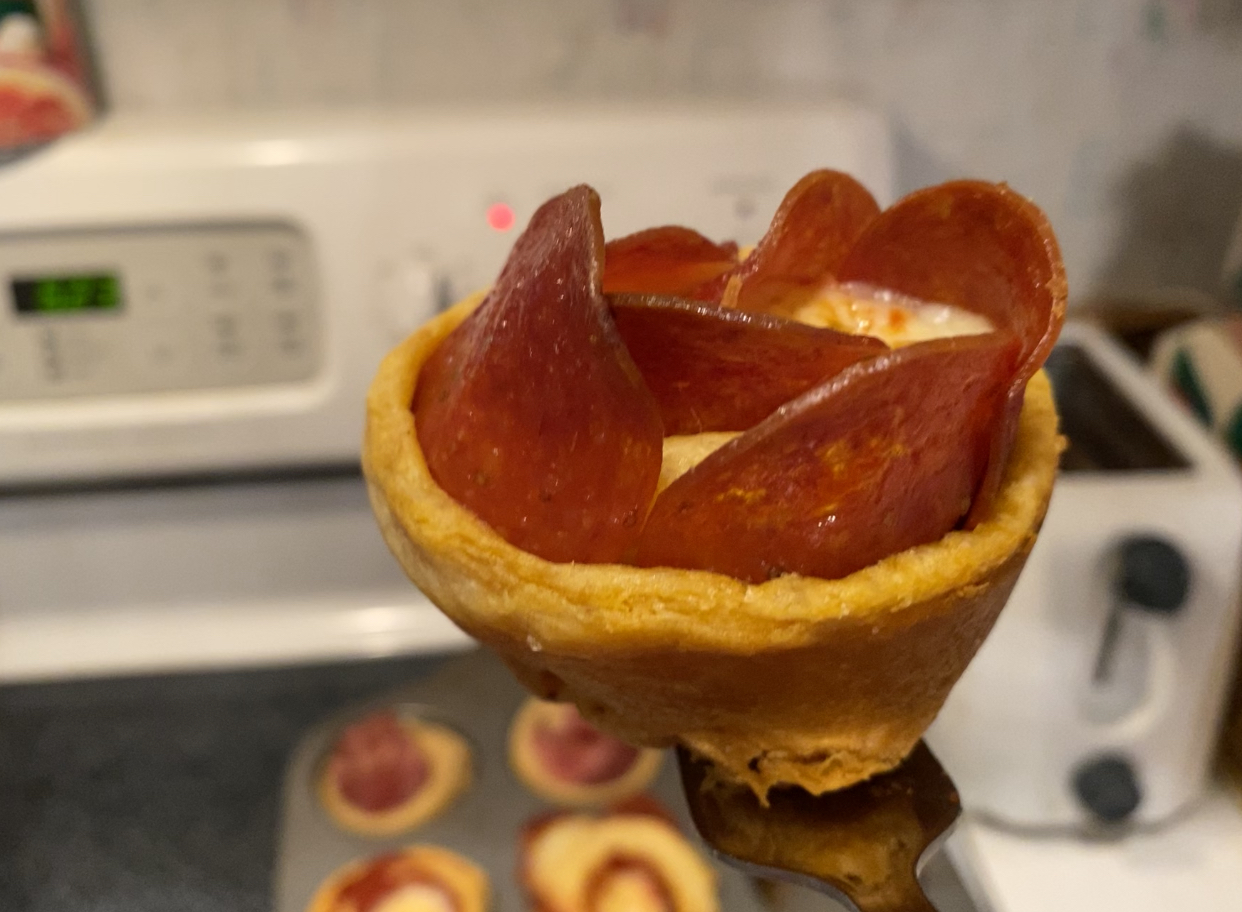
Pepperoni Pizza Flowers
Years ago, a bunch of my single friends and I had an anti-Valentines party. Everyone brought food and candy and candy to share. We played a lot of Mario Kart. Hoping to impress, I found this recipe and it was a hit. Four years later, I have my whole family with me and decided to try it again. Result? They liked it. Here's how you can make it too.
First, gather the ingredients.
However, the crescent rolls are perforated into triangles. For the flowers, you need to transform them into rectangles.
On each rectangle, add a little bit of sauce, some pepperoni slices, and a pinch of cheese. Make sure half of the pepperoni is on the dough, while the other half protrudes above it.
Next, fold the bottom of the dough up over the pepperoni so the cheese and sauce does not leak out.
Take the folded strip and roll it up. The pepperoni sticking out at the top become flower petals.
It should form a swirl of nothing but dough on the bottom.
And, because my daughters don't like pepperoni, I made a few flowers with sliced ham.
Place each roll inside a greased muffin pan.
The oven should be preheated according to the instruction on the crescent roll packaging. Stick the pans in the oven. You'll need them to bake a few minutes longer than the instruction suggest.
And then they're done! Pull them out when the dough turns golden brown. Use the extra sauce for dipping and serve with a veggie side dish.
Whether you're cooking for friends, family, or yourself, I hope you enjoy these as much as we did at our house.
YUM
2.12.2020
Playing Superman
In my pre-preschool days, my favorite pair of pajamas was this Superman outfit - complete with cape (the toy stethoscope and doctor’s glasses were not a part of the outfit, but somehow I managed to combine medical care with the world of superheroes). My cousin and I used to pretend that we were Superman and Lois Lane. Of course, at that age, we didn't understand that Lois was a romantic interest of Clark Kent. I just thought she was an accident prone girl who always needed rescue.
Ah, the lessons we learn as we grow up.
Shortly after graduating high school, I purchased Blindside's self-titled debut album. During some difficult times, I often found solace in this brutally crushing album. Even now, in a more stable place in my life, this is a record I can listen to over and over - one of those albums I can play at full volume through my car's stereo and scream along with it while not feeling remotely silly.
One song has become an anthem for me, a song titled “Superman.” Not because I have an unhealthy megalomaniacal self-image, but because the song touches that strange dichotomy between who I am and who I once was. The lyrics clearly recognize weaknesses in our humanity: "Just like you with my hands I can make mistakes. I wish that I could stop playing superman. I have decided to let the case drop. I'm not superman." The four year old version of me had high hopes, but today, I realize I'm not Superman.
It's strange how, as kids, we wanted nothing more than to be heroes. We want to save the world. Why is it as adults, we lose that dream? Is the real world too heavy a burden?
2.11.2020
Step One: Know Yourself
Five years ago, a social networking expert invited me to participate in her 365Awesome project - a series of blog posts about how to be awesome all year long. Below is my contribution. In the years since, she deactivated her blog and the post I wrote for her migrated into the void of 404 errors. Since my original post vanished from a website that no longer exists, I’m reclaiming it.
Step One: Know Yourself
When my phone receives a call from an unknown or blocked number, the default ring tone blares out a couple distorted power chords and a warbling synth riff, followed by a chorus familiar to anyone who watched CSI or listened to 70's era rock music. "Whooooo are you? Who Who? Who who? Who are you? ..." This gives me an automatic recognition that I don't know who is calling me. And I really want to know, who are you? Are you someone I want to talk to? Or should I let you go to voice mail?
Looking at the relationships in my life - family, friendships, colleagues - answering this question is essential. As a storyteller, I want to know who you are. I want to know your story. What excites you? What defines you? What makes you you?
Can you answer those questions? Who are you? One of the most fundamental elements to human existence is the desire to know and be known. Such knowledge is the foundation to intimacy. Who are you?
It is a simple query, yet complex enough to make it a challenging question to answer. It is easy to fall back on token answers, to rely on job titles or social status to define our identity. Or our hobbies, our finances, our romances. We tend to allow inconsequential tasks or labels determine who we think we are while our true selves are buried or forgotten.
That is the path I took. Afraid of criticism and ridicule, I stuffed my personality in a box and hid it in the attic of my mind to gather dust and cobwebs. The result was unpleasant. Not only was I chronically unhappy, I forgot how to experience true joy. The people that were most important to me suffered. Emotionally, spiritually, socially, I was a mess.
Thankfully, that was not a permanent affliction. I began to unpack my baggage and examine myself. Who am I? I sought to answer that question as thoroughly and honestly as possible. I didn't want to be miserable. I wanted to know myself. My desire was to discover someone awesome.
Along the way, I reclaimed my love for hiking and live music. I connected with an encouraging and vibrant community. I indulged in my geekiness. I took responsibility for my actions and choices.
I also learned a critical lesson. If you want to chase your dreams, if you want to be a leader, if you want to achieve your life goals, if you want to engage in any measure of personal growth or self-improvement, the question of your identity is one that must be answered. Who am I? Who are you? A complete answer to this question is the first step to bigger and greater things.
When you are interviewing for your dream job, launching an entrepreneurial venture, beginning a healthier lifestyle, or heading out for a first date. Knowing yourself makes the journey easier and more rewarding.
This is not a new concept. 18th century Scottish philosopher Adam Smith recognized this same truth. He said, "The first thing you have to know is yourself. A man who knows himself can step outside himself and watch his own reactions like an observer."
You need to know yourself first. Before anything else. This self examination gives you the ability to embrace the parts of you that you love and provides opportunity to fix the parts in need of repair. Your core identity grants you a baseline for self worth. It is the platform upon which you can accept healthy criticism or reject unwarranted discouragement.
To know your innermost self is power. Use it wisely. So, who are you?
Step One: Know Yourself
When my phone receives a call from an unknown or blocked number, the default ring tone blares out a couple distorted power chords and a warbling synth riff, followed by a chorus familiar to anyone who watched CSI or listened to 70's era rock music. "Whooooo are you? Who Who? Who who? Who are you? ..." This gives me an automatic recognition that I don't know who is calling me. And I really want to know, who are you? Are you someone I want to talk to? Or should I let you go to voice mail?
Looking at the relationships in my life - family, friendships, colleagues - answering this question is essential. As a storyteller, I want to know who you are. I want to know your story. What excites you? What defines you? What makes you you?
Can you answer those questions? Who are you? One of the most fundamental elements to human existence is the desire to know and be known. Such knowledge is the foundation to intimacy. Who are you?
It is a simple query, yet complex enough to make it a challenging question to answer. It is easy to fall back on token answers, to rely on job titles or social status to define our identity. Or our hobbies, our finances, our romances. We tend to allow inconsequential tasks or labels determine who we think we are while our true selves are buried or forgotten.
That is the path I took. Afraid of criticism and ridicule, I stuffed my personality in a box and hid it in the attic of my mind to gather dust and cobwebs. The result was unpleasant. Not only was I chronically unhappy, I forgot how to experience true joy. The people that were most important to me suffered. Emotionally, spiritually, socially, I was a mess.
Thankfully, that was not a permanent affliction. I began to unpack my baggage and examine myself. Who am I? I sought to answer that question as thoroughly and honestly as possible. I didn't want to be miserable. I wanted to know myself. My desire was to discover someone awesome.
Along the way, I reclaimed my love for hiking and live music. I connected with an encouraging and vibrant community. I indulged in my geekiness. I took responsibility for my actions and choices.
I also learned a critical lesson. If you want to chase your dreams, if you want to be a leader, if you want to achieve your life goals, if you want to engage in any measure of personal growth or self-improvement, the question of your identity is one that must be answered. Who am I? Who are you? A complete answer to this question is the first step to bigger and greater things.
When you are interviewing for your dream job, launching an entrepreneurial venture, beginning a healthier lifestyle, or heading out for a first date. Knowing yourself makes the journey easier and more rewarding.
This is not a new concept. 18th century Scottish philosopher Adam Smith recognized this same truth. He said, "The first thing you have to know is yourself. A man who knows himself can step outside himself and watch his own reactions like an observer."
You need to know yourself first. Before anything else. This self examination gives you the ability to embrace the parts of you that you love and provides opportunity to fix the parts in need of repair. Your core identity grants you a baseline for self worth. It is the platform upon which you can accept healthy criticism or reject unwarranted discouragement.
To know your innermost self is power. Use it wisely. So, who are you?
Labels:
advice,
blogging,
ethics,
health,
music,
nature,
observations,
quotes,
relationships,
writing
2.06.2020
The Diz-Files
Ever since Disney acquired Fox, rumors are swirling. Marvel fans have been speculating when the Fantastic Four and X-Men characters would be making their cinematic debuts under the official banner of Disney. Movie buffs are speculating which Hollywood stars will be portraying our favorite mutants. I even contributed my fan casting for a new Fantastic Four. The studio merger award a lot more to Disney than comic book heroes though. One of Disney's biggest gains was the original content Fox has produced over the years. With the launch of Disney Plus last fall, they heavily promoted one Fox property more than any other: The Simpsons.
It's cool. I can watch The Simpsons any time I want. Any episode from any season. All of the “Doh!” And “Eat my shorts” I can handle. To be honest though, I haven't watched The Simpsons in years. Despite seeing their thumbnail every time I open the Disney Plus app, I really haven't thought much about it.
Until this morning. For the first time since the deal between Fox and Disney was finalized, I pondered the marriage of the two companies. "If Disney owns Bart and Homer now, who else to they own?" I wondered. Fox created some amazing and groundbreaking shows over the last 30 years since The Simpsons debuted in 1989. What other incredible programming is available under the Disney umbrella?
I started thinking about some of my favorite shows from years passed. Does Disney own 24? Quick google check: yes they do. What about MadTV? Check google again ... nope. Fringe? Also no. The X-Files? Google says yes! Is The X-Files available on Disney Plus? It was one of my favorite shows when I was in high school. My parents didn't let me watch it so I'd have to sneak in episodes when they were busy or away from home. I'd love to introduce my oldest son to it - he'd probably dig the show.
Disney Plus, do you have The X-Files? Looks ... and ... no. Bummer.
Now that I realized the ownership of one of my all-time favorite shows belonged to Disney, my mind flooded with more questions.
Will The X-Files ever be available on Disney Plus?
How does Chris Carter feel about his creation changing ownership? It's like his career went full circle since he started his screenwriting career at Walt Disney Studios.
What if Disney hired Carter to write and direct for a Marvel film? He could do something cosmic like Nova. Or the sci-fi horror blend of Moon Knight would fit his style.
What does the future hold for The X-Files? Chris Carter has ideas about what is next but it's dependent on the participation of Gillian Anderson who has said she is permanently done with the show.
Reboot? Is that possible? What would a Disneyfied reboot of The X-Files be like?
What about crossover appeal? Between Marvel's shared universe and the Unified Pixar theory, Disney is big into interconnectedness. Just imagine what kind of synergy we could get from the FBI investigating the unsolved cases of Disney's paranormal phenomena. Could you see Mulder and Scully flying to Hawaii to search for a furry blue alien? I can.
Speaking of Mulder and Scully, are they Disney princesses now? Please tell me they're Disney Princesses.
Whatever Disney does with The X-Files, I'll be watching with no lights on. I hope the Smoking Man's in this one.
It's cool. I can watch The Simpsons any time I want. Any episode from any season. All of the “Doh!” And “Eat my shorts” I can handle. To be honest though, I haven't watched The Simpsons in years. Despite seeing their thumbnail every time I open the Disney Plus app, I really haven't thought much about it.
Until this morning. For the first time since the deal between Fox and Disney was finalized, I pondered the marriage of the two companies. "If Disney owns Bart and Homer now, who else to they own?" I wondered. Fox created some amazing and groundbreaking shows over the last 30 years since The Simpsons debuted in 1989. What other incredible programming is available under the Disney umbrella?
I started thinking about some of my favorite shows from years passed. Does Disney own 24? Quick google check: yes they do. What about MadTV? Check google again ... nope. Fringe? Also no. The X-Files? Google says yes! Is The X-Files available on Disney Plus? It was one of my favorite shows when I was in high school. My parents didn't let me watch it so I'd have to sneak in episodes when they were busy or away from home. I'd love to introduce my oldest son to it - he'd probably dig the show.
Disney Plus, do you have The X-Files? Looks ... and ... no. Bummer.
Now that I realized the ownership of one of my all-time favorite shows belonged to Disney, my mind flooded with more questions.
Will The X-Files ever be available on Disney Plus?
How does Chris Carter feel about his creation changing ownership? It's like his career went full circle since he started his screenwriting career at Walt Disney Studios.
What if Disney hired Carter to write and direct for a Marvel film? He could do something cosmic like Nova. Or the sci-fi horror blend of Moon Knight would fit his style.
What does the future hold for The X-Files? Chris Carter has ideas about what is next but it's dependent on the participation of Gillian Anderson who has said she is permanently done with the show.
Reboot? Is that possible? What would a Disneyfied reboot of The X-Files be like?
What about crossover appeal? Between Marvel's shared universe and the Unified Pixar theory, Disney is big into interconnectedness. Just imagine what kind of synergy we could get from the FBI investigating the unsolved cases of Disney's paranormal phenomena. Could you see Mulder and Scully flying to Hawaii to search for a furry blue alien? I can.
image courtesy of Discussing Movies
Whatever Disney does with The X-Files, I'll be watching with no lights on. I hope the Smoking Man's in this one.
Labels:
media,
movies,
nic's history,
random thoughts,
the kids,
TV
1.30.2020
What It’s Like to Be Me: In the Beginning Pt 2, Insecurity
For most people, their teen years were awkward. Even the cool kids go through a bumbling gangly phases at some point between the ages of 12 and 18. In my life, that phase started a little younger than most and lasted a lot longer.
Insecurity dominated much of my adolescent years. I was bullied throughout junior high. I was the shortest of the boys in my church youth group. My friends were all taller, cooler, and wealthier than me. They lived in nicer houses and dressed in trendier clothes. I could never compare - a fact of which I was painfully aware. My self esteem suffered and I developed kinship with other geeks and outcasts like me. Through the years, I found solace in music that reassured me I wasn’t alone.
Goo Goo Dolls: “Naked”
There are songs that you adore from the first moment you hear it. This was that kind of song for me. John Rzeznik’s lyrics spoke to awkward loneliness. “No one hears me, never been, never felt, never thought I'd say a word.” Whoa. I knew that feeling. His second verse repeated that sense of alienation. “They don't need me, don't want me, don't hear a word I say.”
King’s X: “Sometime”
Being a teen is confusing. You’re going through biological and chemical changes. You get contradictory instruction from parents and teachers. Everyone has different expectations of you. You’re trying to create a sense of autonomy separate from your parents. You’re unsure of who you are and what you want. You emotions swing from one extreme to the other. “Sometime” reminds me what it was like to experience this constant state of flux. It’s a vulnerable song with no resolution as Doug Pinnick sings of divergent desires. Sometimes, he wants to give. Sometimes, he wants to take. To run. To stay. To live. To die.
Collective Soul: “Goodnight, Good Guy”
Despite being a nerdy kid and socially awkward, I still wanted people to like me. Even on my worst days, I aspired to be a decent human being. Above all else, I wanted to be a good guy. I wanted other people to look at me and say, “yeah, he’s a good dude.” It’s a noble ideal, but it’s exhausting. It takes a lot of energy to always appear to be good. And more effort to actually be good. You hear this sense of weariness in the song. “But days are longer as my heart gets weaker and I can only stay so strong. Well I'll just sit here like a wounded soul who's finding it difficult to just let go.”
Blue October: “Weaknesses”
My insecurity always seemed entwined with an acute (and sometimes painful) self-awareness. I knew exactly who I was and what I was capable of doing. The inverse was also true: I knew who I wasn’t and what I was incapable of doing. Those were my inadequacies, failures, and weaknesses. It’s this self-depreciative view of the ego behind Justin Furstenfeld’s lyrics, “My weaknesses - With their ugly faces on a day to day basis.”
Switchfoot: “Let That Be Enough”
Switchfoot has always held space for communicating my deepest hopes and fears in ways I could never express on my own – and in ways more beautiful than I would have ever invented. In “Let That Be Enough,” Jon Foreman described loneliness as being a “plane in the sunset with nowhere to land.” While the words he sang seemed to meet me where I was at that moment in my life, the second verse seemed to be prophetic. “It's my birthday tomorrow, no one here could know I was born this Thursday 22 years ago.” I was 19 when this song came out, and I was still living with my folks. The following summer, I moved to a different state with some friends. A year later, one friend moved back home and the other moved in with his girlfriend. By the time I got to my 22nd birthday, no one around me knew it was my day. And it happened to be on a Thursday.
Insecurity dominated much of my adolescent years. I was bullied throughout junior high. I was the shortest of the boys in my church youth group. My friends were all taller, cooler, and wealthier than me. They lived in nicer houses and dressed in trendier clothes. I could never compare - a fact of which I was painfully aware. My self esteem suffered and I developed kinship with other geeks and outcasts like me. Through the years, I found solace in music that reassured me I wasn’t alone.
Goo Goo Dolls: “Naked”
There are songs that you adore from the first moment you hear it. This was that kind of song for me. John Rzeznik’s lyrics spoke to awkward loneliness. “No one hears me, never been, never felt, never thought I'd say a word.” Whoa. I knew that feeling. His second verse repeated that sense of alienation. “They don't need me, don't want me, don't hear a word I say.”
King’s X: “Sometime”
Being a teen is confusing. You’re going through biological and chemical changes. You get contradictory instruction from parents and teachers. Everyone has different expectations of you. You’re trying to create a sense of autonomy separate from your parents. You’re unsure of who you are and what you want. You emotions swing from one extreme to the other. “Sometime” reminds me what it was like to experience this constant state of flux. It’s a vulnerable song with no resolution as Doug Pinnick sings of divergent desires. Sometimes, he wants to give. Sometimes, he wants to take. To run. To stay. To live. To die.
Collective Soul: “Goodnight, Good Guy”
Despite being a nerdy kid and socially awkward, I still wanted people to like me. Even on my worst days, I aspired to be a decent human being. Above all else, I wanted to be a good guy. I wanted other people to look at me and say, “yeah, he’s a good dude.” It’s a noble ideal, but it’s exhausting. It takes a lot of energy to always appear to be good. And more effort to actually be good. You hear this sense of weariness in the song. “But days are longer as my heart gets weaker and I can only stay so strong. Well I'll just sit here like a wounded soul who's finding it difficult to just let go.”
Blue October: “Weaknesses”
My insecurity always seemed entwined with an acute (and sometimes painful) self-awareness. I knew exactly who I was and what I was capable of doing. The inverse was also true: I knew who I wasn’t and what I was incapable of doing. Those were my inadequacies, failures, and weaknesses. It’s this self-depreciative view of the ego behind Justin Furstenfeld’s lyrics, “My weaknesses - With their ugly faces on a day to day basis.”
Switchfoot: “Let That Be Enough”
Switchfoot has always held space for communicating my deepest hopes and fears in ways I could never express on my own – and in ways more beautiful than I would have ever invented. In “Let That Be Enough,” Jon Foreman described loneliness as being a “plane in the sunset with nowhere to land.” While the words he sang seemed to meet me where I was at that moment in my life, the second verse seemed to be prophetic. “It's my birthday tomorrow, no one here could know I was born this Thursday 22 years ago.” I was 19 when this song came out, and I was still living with my folks. The following summer, I moved to a different state with some friends. A year later, one friend moved back home and the other moved in with his girlfriend. By the time I got to my 22nd birthday, no one around me knew it was my day. And it happened to be on a Thursday.
1.23.2020
Protect Ya Neck: Sanity in the Age of Social Media
The internet is a weird place, both beautiful and ugly. It has given us the gift of social media, connecting distant relatives and old friends in ways we could have never predicted. That same gift is also a curse. The new possibilities that allowed people new methods to communicate gave other people freedom to communicate with the worst possible conduct. If you’re not careful, it would be easy to lose yourself as either a perpetrator or a victim in this wild west of online culture.
If you want to navigate the world of Social Media with your sanity intact, you need to follow the advice of the Wu Tang Clan: protect ya neck. Or as a decent therapist would tell you, set some boundaries.
These boundaries are a figurative fence around you, designed to protect your emotional state from those who would revel in provoking you. It looks different for everyone. What works for you might not be good for me, and what I do might sound absurd to others. Wil Wheaton deleted his twitter account to preserve his happiness – that was his boundary. Despite thousands of disappointed fans, he’s maintained this boundary because his well being is worth more than appeasing people who have zero vested interest in his personal life. I don’t need to employ those extremes, but I still need boundaries to prevent the ugliness of the online world from discouraging or demoralizing me.
To maintain my boundaries, I follow two rules. 1: I report spam, 2: I block trolls. That’s it. Pretty simple. These two rules help keep me healthy and happy.
Strangers send me ads or post suspicious links? I report them. An Instagram user tags me in a post letting me know how to get free followers? I report them. I’m followed by a Twitter user who is scandalously dressed in their profile picture? I report them. I get a Facebook friend request from someone I don’t know and all of their public posts promote their multilevel marketing business? I report them. I don’t have the time, patience, or energy to tolerate unsolicited shameless self-promotion.
Reporting people takes a little effort. Just a few mouse clicks and I feel like I’ve done my part to make social media a happier, healthier, and safer. Even if those goals are not achieved on the macro scale of society, it is accomplished in the micro scale of my soul. For my own personal sanity, all spam is reported.
As for trolls, it gets a little more complicated. I define trolling as a stranger making remarks or comments to someone they don’t know with the specific intention to provoke. It’s important to specify (for me) this is an act committed by strangers. Within the context of friendship, a little mutual teasing is expected and acceptable. I don’t object to friends or family making a harsh joke at my expense. A shared laugh is a great way to bond. However, if I don’t know you or understand your sense of humor, the space to joke around is more restrictive. The threshold between having fun and trolling is too easily crossed. When people abuse that line, I block. No questions asked. I do not have the time or energy to engage. If you’re the kind of person to make personal attacks against me without knowing me, then I don’t have any interest in what you have to say. Nor do I want you to have access to see what I post on social media.
When a friend recently posted praise of Kanye’s newest album, I replied to share my perspective – that the album really isn’t that good. Rhyming patterns, lyrical complexity, production values, all of it in my opinion is a lower quality that what Kanye is capable of creating. The only reason anyone is excited about it is because of Kanye’s professed conversion to Christianity. If it wasn’t a gospel album, none of these people would compliment it. One of the claims I made in that long thread was how I don’t believe Christians should have to tolerate bad art just because the art was made by other Christians. Apparently, my statement was unpopular. About a half hour later, a stranger to me (but a friend of my friend) replied back to me with an accusation and a link. He doubted my claim to dislike bad music and linked to one of my public Facebook posts which contained a video of John Mayer performance. In essence, he was saying I didn’t have the right to call Kanye’s album trash if I liked a song from Mayer.
Consider this. Some random dude on the internet was so offended by my opinion about Kanye West that he dug through eight months of my public posts searching for anything I might have said to use against me in some sort of gotcha-styled straw man argument. This is a perfect match for the definition of trolling as described by the University of Nebraska-Lincoln: “creating discord on the Internet by starting quarrels or upsetting people by posting inflammatory or off-topic messages in an online community. … someone who purposely says something controversial in order to get a rise out of other users.” He didn’t like what said so he sought to create discord. Start a fight. Get a rise out of me. Why should I reward him by defending myself or retaliating? It’s far more responsible to bock the troll.
These are the boundaries I’ve set for myself to protect my mental health. I don’t expect anyone else to follow the same rules, but I would hope everyone has their own boundaries. It’s good for us. As my friend Jen frequently says, “I have healthy boundaries for my benefit and yours.”
Be prepared though, once you create guidelines for how you maintain your boundaries, not everyone will understand or appreciate them. In fact, some people will be offended. I could return to the kerfuffle over Kanye as an example. I had a private chat with the trolling stranger’s mutual friend later that evening when he asked about our interaction.
I have a different opinion. If you’re so angry at someone else’s opinion is that you have to dig through nearly a full years worth of random post to find something that you think contradicts their claim? That’s childish. You don't have to agree, but I'm gonna protect my neck.
If you want to navigate the world of Social Media with your sanity intact, you need to follow the advice of the Wu Tang Clan: protect ya neck. Or as a decent therapist would tell you, set some boundaries.
These boundaries are a figurative fence around you, designed to protect your emotional state from those who would revel in provoking you. It looks different for everyone. What works for you might not be good for me, and what I do might sound absurd to others. Wil Wheaton deleted his twitter account to preserve his happiness – that was his boundary. Despite thousands of disappointed fans, he’s maintained this boundary because his well being is worth more than appeasing people who have zero vested interest in his personal life. I don’t need to employ those extremes, but I still need boundaries to prevent the ugliness of the online world from discouraging or demoralizing me.
To maintain my boundaries, I follow two rules. 1: I report spam, 2: I block trolls. That’s it. Pretty simple. These two rules help keep me healthy and happy.
Strangers send me ads or post suspicious links? I report them. An Instagram user tags me in a post letting me know how to get free followers? I report them. I’m followed by a Twitter user who is scandalously dressed in their profile picture? I report them. I get a Facebook friend request from someone I don’t know and all of their public posts promote their multilevel marketing business? I report them. I don’t have the time, patience, or energy to tolerate unsolicited shameless self-promotion.
Reporting people takes a little effort. Just a few mouse clicks and I feel like I’ve done my part to make social media a happier, healthier, and safer. Even if those goals are not achieved on the macro scale of society, it is accomplished in the micro scale of my soul. For my own personal sanity, all spam is reported.
As for trolls, it gets a little more complicated. I define trolling as a stranger making remarks or comments to someone they don’t know with the specific intention to provoke. It’s important to specify (for me) this is an act committed by strangers. Within the context of friendship, a little mutual teasing is expected and acceptable. I don’t object to friends or family making a harsh joke at my expense. A shared laugh is a great way to bond. However, if I don’t know you or understand your sense of humor, the space to joke around is more restrictive. The threshold between having fun and trolling is too easily crossed. When people abuse that line, I block. No questions asked. I do not have the time or energy to engage. If you’re the kind of person to make personal attacks against me without knowing me, then I don’t have any interest in what you have to say. Nor do I want you to have access to see what I post on social media.
When a friend recently posted praise of Kanye’s newest album, I replied to share my perspective – that the album really isn’t that good. Rhyming patterns, lyrical complexity, production values, all of it in my opinion is a lower quality that what Kanye is capable of creating. The only reason anyone is excited about it is because of Kanye’s professed conversion to Christianity. If it wasn’t a gospel album, none of these people would compliment it. One of the claims I made in that long thread was how I don’t believe Christians should have to tolerate bad art just because the art was made by other Christians. Apparently, my statement was unpopular. About a half hour later, a stranger to me (but a friend of my friend) replied back to me with an accusation and a link. He doubted my claim to dislike bad music and linked to one of my public Facebook posts which contained a video of John Mayer performance. In essence, he was saying I didn’t have the right to call Kanye’s album trash if I liked a song from Mayer.
Consider this. Some random dude on the internet was so offended by my opinion about Kanye West that he dug through eight months of my public posts searching for anything I might have said to use against me in some sort of gotcha-styled straw man argument. This is a perfect match for the definition of trolling as described by the University of Nebraska-Lincoln: “creating discord on the Internet by starting quarrels or upsetting people by posting inflammatory or off-topic messages in an online community. … someone who purposely says something controversial in order to get a rise out of other users.” He didn’t like what said so he sought to create discord. Start a fight. Get a rise out of me. Why should I reward him by defending myself or retaliating? It’s far more responsible to bock the troll.
These are the boundaries I’ve set for myself to protect my mental health. I don’t expect anyone else to follow the same rules, but I would hope everyone has their own boundaries. It’s good for us. As my friend Jen frequently says, “I have healthy boundaries for my benefit and yours.”
Be prepared though, once you create guidelines for how you maintain your boundaries, not everyone will understand or appreciate them. In fact, some people will be offended. I could return to the kerfuffle over Kanye as an example. I had a private chat with the trolling stranger’s mutual friend later that evening when he asked about our interaction.
I have a different opinion. If you’re so angry at someone else’s opinion is that you have to dig through nearly a full years worth of random post to find something that you think contradicts their claim? That’s childish. You don't have to agree, but I'm gonna protect my neck.
1.18.2020
What It’s Like to Be Me: In the Beginning Pt 1, The Things That I Could Be
‘In the Beginning’ is the first section of the soundtrack to my life. These songs are my beginning, either reminding me what it was like to be a kid or representing in some way my life from adolescence through young adulthood. Those years are weird and magical, uncomfortable and awkward, carefree and careless. For most kids, this is the time of their life when anything is possible and everything is new. These are the years you begin to identify who are as a person and what you want to be when you grow up.
When I thought about the things that I could be, my biggest dream was to become an architect. But by the time I graduated high school, I wanted to be a DJ with my own morning radio show. The dreams of youth are fickle and complicated. This first group of songs from my ‘What It’s Like to Be Me’ playlist look at those dreams I had as a kid, the things I hoped for and longed to become true.
Skee-Lo: "I Wish"
My dad used to joke about how all he ever wanted to be when he grew up was six foot tall. He never got his wish. Neither did I. However, I did receive a theme song in 1995 when Skee-Lo released his biggest hit "I Wish." If I was a pro-wrestler, this would have been my walk-in music. This song is a short dude’s anthem – we all know the chorus but his verses spoke to my soul: “Her boyfriend's tall and he plays ball so how am I gonna compete with that? 'Cause when it comes to playing basketball, I'm always last to be picked and in some cases never picked at all.” It’s like he knew me.
Steve Taylor: "Hero"
What kid doesn’t want to be a hero? I loved to read, from comic books and horror novels to the bible and history books, I was the kind of kid Stave sand about in this song. “In a storybook land I could dream what I read. When it went to my head I'd see. I want to be a hero.” Yet heroes aren’t perfect and I grew up in an era where our heroes kept killing themselves, Kurt Cobain, Bradley Nowell, Shannon Hoon. Taylor addressed this fallibility of heroes: “Growing older you'll find that illusions are brought and the idol you thought you'd be was just another zero.” It made me want to save our heroes.
Elvis Presley: "If I Can Dream"
I’m not a big Elvis Presley fan. His music was far before my time. But I love this song. Even as a kid, I could recognize something was off in this world. While I didn’t always know what that something was, I knew it could be better. This is the longing you hear in Elvis’ voice as he sings this song. “There must be lights burning brighter somewhere. Got to be birds flying higher in a sky more blue. If I can dream of a better land where all my brothers walk hand in hand, tell me why can't my dream come true?” Elvis gave me a hope for a solution to this dream: “As long as a man has the strength to dream, he can redeem his soul and fly.”
Wideawake: "Misunderstood"
My brother went to school with a kid named Scott. They played basketball together and became friends. That's when I got to know him. After they graduated, Scott joined a band called Common Thread. I went to a lot of their concerts, even ran sound for them a few times. They eventually changed their name to Wideawake and put out a couple albums. One of their most popular songs sang of a common thread among teenagers – especially kids like me who didn’t always feel like they fit in. “I wish I could read your mind, be one of your kind. I missed you in my time, misunderstood. I wish I could somehow be all that you want from me.” I was a misunderstood kid. All I really wanted is what every other kid wanted: to belong.
Coldplay: "Fix You"
My brother and I grew up with two different dads. Technically, it was the same person, but Dad changed after a massive injury he sustained while I was in fifth grade. He was strong, sporty, and confident while my brother was in junior high. By the time I reached that age, his strength and confidence had vanished and his athletic ability was confined to being a fan. My brother grew up with a social butterfly; I grew up with a wallflower. I was 26 when this song came out but it transported me back to when I was still in school and every dream I ever wished on behalf of my father. “Lights will guide you home and ignite your bones. And I will try to fix you.” All I wanted was the impossible. I just wanted to fix my dad.
When I thought about the things that I could be, my biggest dream was to become an architect. But by the time I graduated high school, I wanted to be a DJ with my own morning radio show. The dreams of youth are fickle and complicated. This first group of songs from my ‘What It’s Like to Be Me’ playlist look at those dreams I had as a kid, the things I hoped for and longed to become true.
Skee-Lo: "I Wish"
My dad used to joke about how all he ever wanted to be when he grew up was six foot tall. He never got his wish. Neither did I. However, I did receive a theme song in 1995 when Skee-Lo released his biggest hit "I Wish." If I was a pro-wrestler, this would have been my walk-in music. This song is a short dude’s anthem – we all know the chorus but his verses spoke to my soul: “Her boyfriend's tall and he plays ball so how am I gonna compete with that? 'Cause when it comes to playing basketball, I'm always last to be picked and in some cases never picked at all.” It’s like he knew me.
Steve Taylor: "Hero"
What kid doesn’t want to be a hero? I loved to read, from comic books and horror novels to the bible and history books, I was the kind of kid Stave sand about in this song. “In a storybook land I could dream what I read. When it went to my head I'd see. I want to be a hero.” Yet heroes aren’t perfect and I grew up in an era where our heroes kept killing themselves, Kurt Cobain, Bradley Nowell, Shannon Hoon. Taylor addressed this fallibility of heroes: “Growing older you'll find that illusions are brought and the idol you thought you'd be was just another zero.” It made me want to save our heroes.
Elvis Presley: "If I Can Dream"
I’m not a big Elvis Presley fan. His music was far before my time. But I love this song. Even as a kid, I could recognize something was off in this world. While I didn’t always know what that something was, I knew it could be better. This is the longing you hear in Elvis’ voice as he sings this song. “There must be lights burning brighter somewhere. Got to be birds flying higher in a sky more blue. If I can dream of a better land where all my brothers walk hand in hand, tell me why can't my dream come true?” Elvis gave me a hope for a solution to this dream: “As long as a man has the strength to dream, he can redeem his soul and fly.”
Wideawake: "Misunderstood"
My brother went to school with a kid named Scott. They played basketball together and became friends. That's when I got to know him. After they graduated, Scott joined a band called Common Thread. I went to a lot of their concerts, even ran sound for them a few times. They eventually changed their name to Wideawake and put out a couple albums. One of their most popular songs sang of a common thread among teenagers – especially kids like me who didn’t always feel like they fit in. “I wish I could read your mind, be one of your kind. I missed you in my time, misunderstood. I wish I could somehow be all that you want from me.” I was a misunderstood kid. All I really wanted is what every other kid wanted: to belong.
Coldplay: "Fix You"
My brother and I grew up with two different dads. Technically, it was the same person, but Dad changed after a massive injury he sustained while I was in fifth grade. He was strong, sporty, and confident while my brother was in junior high. By the time I reached that age, his strength and confidence had vanished and his athletic ability was confined to being a fan. My brother grew up with a social butterfly; I grew up with a wallflower. I was 26 when this song came out but it transported me back to when I was still in school and every dream I ever wished on behalf of my father. “Lights will guide you home and ignite your bones. And I will try to fix you.” All I wanted was the impossible. I just wanted to fix my dad.
1.15.2020
A Soundtrack for My Life
If your life was a movie, what songs would be on the soundtrack?
That was a challenge given to me by a therapist several years ago. At the time, my marriage was falling apart and I was working for a tyrannical micromanaging boss. All I wanted to do was hide in my home office with the lights out and watch Netflix. Recognizing my need for help and that the help I needed was beyond what I could provide for myself, I took the scary step into a counseling facility and signed up for weekly therapy sessions.
As I returned week after week, two things became apparent. First, my depression wasn’t a chemical imbalance or biological condition. She diagnosed me with situational depression, which meant if my situation changed my depression would lessen and possibly vanish. The other obvious thing was how my emotional vocabulary was prohibitively stunted. I knew the main emotions: happy, sad, mad – basically, the main characters from Inside Out. But the finer feelings, the nuanced variants were harder to comprehend. I couldn’t express the difference between frustrated and confused or the escalation from eager to thrilled. Afraid to show that which I couldn’t describe, I’d often bury my emotions. Anything I couldn’t hide spewed out in over-dramatic fashion.
Knowing I wasn’t able to change my circumstances, my therapist instead sought to expand my emotional vocabulary. She had me list every emotion I could think to label and sort them according to those I felt capable of expressing versus those that challenged me. Then she asked me about my soundtrack.
“What songs would be on your soundtrack?” She asked.
I was excited. As an audiophile and music junkie, this was the type of question I’d been preparing my whole life to answer. Even in the depths of depression, I found refuge in the songs that spoke to my soul.
“Well,” I said, “There’s a lot.”
“Define a lot.” She said.
“I have a playlist in iTunes titled Soundtrack to My Life
She chuckled then asked, “How many songs are in that playlist?”
“Over 600.”
“How about you whittle it down?”
I stared at her without replying. The task seemed too daunting to contemplate.
She continued, “Think it through, if someone wanted to know who you were, what it was like inside your head, and you could only play them a song, what song would you play for them?”
“I don’t know if I could only play a single song.” I said.
“Maybe narrow it down to five.”
She gave me homework. Over the week, she wanted me to sort through my list of more than 600 songs and pick out the five I felt represented me the most. The five songs that best explained who I was, how I felt about myself, and the story of my life. She wanted me to bring the list with me into the next session. The following Tuesday, I gathered my results, scribbled onto a sheet of lined notebook paper. Only, I couldn’t break it down to five. The closest I could get was 25.
Over the next few weeks, she asked me to play one song from that list. Then we would discuss why I selected that song and how it made me feel. We did the same thing the next week and the week after. Slowly, I discovered new ways to express my emotions. I found verbiage previously foreign to me. Months passed and circumstances changed. Those situations causing my depression were altered and I slowly worked my way back to better state of mind.
Even after my therapist gave me a clean bill of mental health and graduated me out of counseling, I kept that handwritten list of 25 songs. I never stopped thinking about the assignment she gave me.
Music is therapeutic. It has always been my safe place. Songs written by other people have always helped me understand myself. When I couldn’t find a way to express myself, a talented lyricist gave me words I couldn’t invent on my own. Time and time again, I’d hear a song for the first time and think to myself, “Yes, that’s it. That is what I’ve been struggling to say all this time. That perfectly describes how I’m feeling.”
In the years since compiling the 25 songs representing me, I’ve intentionally deliberated the content of the original 600 track playlist. Using my list from therapy as a foundation, I curated a new playlist. I culled songs from the big playlist and added new songs to reflect my current phase in life. Then I sorted them thematically to help me make sense of this expanded list. Finally, I gave it a title: What It’s Like to Be Me.
This is the true soundtrack to my life. If anyone really wants to know who I am, they could listen to these songs and know more about me than I could ever tell them in conversation alone.
Throughout the next twelve months, I’m going to share this list in small increments. Little by little, I’ll take you on a musical journey through my life from childhood through today. The songs themselves will not follow a chronological order as their release dates don’t always align with the era of my life it describes. But in the end, I hope it all makes sense.
That was a challenge given to me by a therapist several years ago. At the time, my marriage was falling apart and I was working for a tyrannical micromanaging boss. All I wanted to do was hide in my home office with the lights out and watch Netflix. Recognizing my need for help and that the help I needed was beyond what I could provide for myself, I took the scary step into a counseling facility and signed up for weekly therapy sessions.
As I returned week after week, two things became apparent. First, my depression wasn’t a chemical imbalance or biological condition. She diagnosed me with situational depression, which meant if my situation changed my depression would lessen and possibly vanish. The other obvious thing was how my emotional vocabulary was prohibitively stunted. I knew the main emotions: happy, sad, mad – basically, the main characters from Inside Out. But the finer feelings, the nuanced variants were harder to comprehend. I couldn’t express the difference between frustrated and confused or the escalation from eager to thrilled. Afraid to show that which I couldn’t describe, I’d often bury my emotions. Anything I couldn’t hide spewed out in over-dramatic fashion.
Knowing I wasn’t able to change my circumstances, my therapist instead sought to expand my emotional vocabulary. She had me list every emotion I could think to label and sort them according to those I felt capable of expressing versus those that challenged me. Then she asked me about my soundtrack.
“What songs would be on your soundtrack?” She asked.
I was excited. As an audiophile and music junkie, this was the type of question I’d been preparing my whole life to answer. Even in the depths of depression, I found refuge in the songs that spoke to my soul.
“Well,” I said, “There’s a lot.”
“Define a lot.” She said.
“I have a playlist in iTunes titled Soundtrack to My Life
She chuckled then asked, “How many songs are in that playlist?”
“Over 600.”
“How about you whittle it down?”
I stared at her without replying. The task seemed too daunting to contemplate.
She continued, “Think it through, if someone wanted to know who you were, what it was like inside your head, and you could only play them a song, what song would you play for them?”
“I don’t know if I could only play a single song.” I said.
“Maybe narrow it down to five.”
She gave me homework. Over the week, she wanted me to sort through my list of more than 600 songs and pick out the five I felt represented me the most. The five songs that best explained who I was, how I felt about myself, and the story of my life. She wanted me to bring the list with me into the next session. The following Tuesday, I gathered my results, scribbled onto a sheet of lined notebook paper. Only, I couldn’t break it down to five. The closest I could get was 25.
Over the next few weeks, she asked me to play one song from that list. Then we would discuss why I selected that song and how it made me feel. We did the same thing the next week and the week after. Slowly, I discovered new ways to express my emotions. I found verbiage previously foreign to me. Months passed and circumstances changed. Those situations causing my depression were altered and I slowly worked my way back to better state of mind.
Even after my therapist gave me a clean bill of mental health and graduated me out of counseling, I kept that handwritten list of 25 songs. I never stopped thinking about the assignment she gave me.
Music is therapeutic. It has always been my safe place. Songs written by other people have always helped me understand myself. When I couldn’t find a way to express myself, a talented lyricist gave me words I couldn’t invent on my own. Time and time again, I’d hear a song for the first time and think to myself, “Yes, that’s it. That is what I’ve been struggling to say all this time. That perfectly describes how I’m feeling.”
In the years since compiling the 25 songs representing me, I’ve intentionally deliberated the content of the original 600 track playlist. Using my list from therapy as a foundation, I curated a new playlist. I culled songs from the big playlist and added new songs to reflect my current phase in life. Then I sorted them thematically to help me make sense of this expanded list. Finally, I gave it a title: What It’s Like to Be Me.
This is the true soundtrack to my life. If anyone really wants to know who I am, they could listen to these songs and know more about me than I could ever tell them in conversation alone.
Throughout the next twelve months, I’m going to share this list in small increments. Little by little, I’ll take you on a musical journey through my life from childhood through today. The songs themselves will not follow a chronological order as their release dates don’t always align with the era of my life it describes. But in the end, I hope it all makes sense.
1.13.2020
Narcissism Speeding
Highway 195 connects Spokane to Pullman as a two lane roadway for most of the distance between the two cities. Northbound and southbound lanes of traffic occasionally diverge, and in some uphill stretches one lane splits into two to allow faster cars to pass slower traffic. With good weather, clear road conditions, and other drivers maintaining the speed limit, a student at WSU could walk out of a classroom and make it to the downtown Spokane in an hour and a half.
People also tend to speed on this highway. The scenery isn’t the most interesting vista in the world, just gentle rolling hills covered with farmlands. From one small town until the next, it feels like driving through emptiness where you’re more likely to see tumbleweed than speed traps. However, the speed traps do exist and the road is often patrolled by Washington State Patrol and sheriffs from both Spokane and Whitman counties. We were able to witness both the speeder and the cop on a recent road trip.
An impatient driver attempted to pass me in one of those uphill sections. I had cruise control set at the speed limit but still moved into the right hand lane for slow pokes because it is the courteous thing to do. A white SUV came up fast behind me but not fast enough. The two lanes merged into one while I was still out front. I remained set at the speed limit so I didn’t feel any shame or guilt making him slow his roll. He tailgated me for a few miles until the road split again, the last of the two lanes for southbound traffic before Rosalia. He started merging into the slow lane prior to its actual existence and passed me before I had a chance to move out of his way.
OK, fine, whatever. At least he wasn’t tailgating me anymore. By the time I drove past the Rosalia exit, the white SUV was out of site, but it wouldn’t be the last time I saw him. Up another hill and around the bend, I saw some flashing red and blue lights. Someone got pulled over. As I got closer, that unknown someone became someone I recognized: the white SUV. I laughed. He was pulled over for speeding, obviously. If I had to guess, I’d wager the officer clocked him at least ten miles an hour over the limit. This occasion would not be the last time I saw that white SUV.
Driving on, the twinkling lights disappeared from my rearview mirror. Out of site, out of mind. Annie and I continued our conversation and our trip to the Pullman area. I didn’t think much of the speeding/tailgating driver exchanging his license and registration with the WSP officer – none of my business. Or at least I temporarily gave up my thoughts of him.
Less than ten minutes later, he provided reason to ponder his presence again. I glanced in the rearview and noticed a white vehicle coming up behind me at a high rate of speed. Another couple seconds and his identity became clear – the white SUV again. I was still using cruise control. Still set at the speed limit. I moved into the slow lane as soon as one became available and the white SUV immediately zipped by me. I couldn’t help but hope for another speed trap in the miles ahead of us.
I understand that roads have speed limits and speeding is an infraction of which law enforcement has the right (duty?) to pull over and fine offending drivers. I also realize speeding is the most common traffic violation. People speed. It happens. They get pulled over and receive tickets. Sometimes they show up in court to dispute the charges. This is all normal.
However, returning to the same offence immediately after being penalized for it isn’t normal. A normal person would think “Oops, I got caught; I should check myself before I wreck myself.” Or something like that. Most people would recognize the error of their ways and correct their behavior, even if temporarily. Normal behavior would be learning from the mistake of speeding, and drive within reasonable speeds with hopes to avoid another ticket.
Narcissism doesn’t operate with this logic. One of the most common signs of pathological narcissism is a failure to learn from your mistakes. Instead, they would think it is their right to speed and the real problem is the police officer. Or they might think there was nothing wrong with the way they were driving. “It’s not my fault,” they say, “it’s not a big deal.”
In that brief interaction and observation of the lead-footed captain of a white SUV on the way to Pullman, I recognized the real problem in America: pathological narcissism. It infects every corner of American society. From schools to office buildings, from churches to marketplaces, and at every level of elected position from municipal councils to the President of the United States of America. We, the people are a little too self-absorbed. We feel entitled, like we deserve everything we want and our desires are insatiable. We overestimate our talents and embellish our achievements. We are obsessed with wealth and power, filled with greed and envy. We belittle people we don’t like, attack those who disagree with us, and fear those who are different. We are arrogant and demanding, expecting more from others than we are willing to give.
Welcome to America, what can you do for me?
Or maybe, just possibly, I’m reading too much into one lone speeder along highway 195. It is conceivable that I’m projecting my frustrations with the current state of our nation onto this one excessive driver.
People also tend to speed on this highway. The scenery isn’t the most interesting vista in the world, just gentle rolling hills covered with farmlands. From one small town until the next, it feels like driving through emptiness where you’re more likely to see tumbleweed than speed traps. However, the speed traps do exist and the road is often patrolled by Washington State Patrol and sheriffs from both Spokane and Whitman counties. We were able to witness both the speeder and the cop on a recent road trip.
An impatient driver attempted to pass me in one of those uphill sections. I had cruise control set at the speed limit but still moved into the right hand lane for slow pokes because it is the courteous thing to do. A white SUV came up fast behind me but not fast enough. The two lanes merged into one while I was still out front. I remained set at the speed limit so I didn’t feel any shame or guilt making him slow his roll. He tailgated me for a few miles until the road split again, the last of the two lanes for southbound traffic before Rosalia. He started merging into the slow lane prior to its actual existence and passed me before I had a chance to move out of his way.
OK, fine, whatever. At least he wasn’t tailgating me anymore. By the time I drove past the Rosalia exit, the white SUV was out of site, but it wouldn’t be the last time I saw him. Up another hill and around the bend, I saw some flashing red and blue lights. Someone got pulled over. As I got closer, that unknown someone became someone I recognized: the white SUV. I laughed. He was pulled over for speeding, obviously. If I had to guess, I’d wager the officer clocked him at least ten miles an hour over the limit. This occasion would not be the last time I saw that white SUV.
Driving on, the twinkling lights disappeared from my rearview mirror. Out of site, out of mind. Annie and I continued our conversation and our trip to the Pullman area. I didn’t think much of the speeding/tailgating driver exchanging his license and registration with the WSP officer – none of my business. Or at least I temporarily gave up my thoughts of him.
image courtesy of Inlander
I understand that roads have speed limits and speeding is an infraction of which law enforcement has the right (duty?) to pull over and fine offending drivers. I also realize speeding is the most common traffic violation. People speed. It happens. They get pulled over and receive tickets. Sometimes they show up in court to dispute the charges. This is all normal.
However, returning to the same offence immediately after being penalized for it isn’t normal. A normal person would think “Oops, I got caught; I should check myself before I wreck myself.” Or something like that. Most people would recognize the error of their ways and correct their behavior, even if temporarily. Normal behavior would be learning from the mistake of speeding, and drive within reasonable speeds with hopes to avoid another ticket.
Narcissism doesn’t operate with this logic. One of the most common signs of pathological narcissism is a failure to learn from your mistakes. Instead, they would think it is their right to speed and the real problem is the police officer. Or they might think there was nothing wrong with the way they were driving. “It’s not my fault,” they say, “it’s not a big deal.”
In that brief interaction and observation of the lead-footed captain of a white SUV on the way to Pullman, I recognized the real problem in America: pathological narcissism. It infects every corner of American society. From schools to office buildings, from churches to marketplaces, and at every level of elected position from municipal councils to the President of the United States of America. We, the people are a little too self-absorbed. We feel entitled, like we deserve everything we want and our desires are insatiable. We overestimate our talents and embellish our achievements. We are obsessed with wealth and power, filled with greed and envy. We belittle people we don’t like, attack those who disagree with us, and fear those who are different. We are arrogant and demanding, expecting more from others than we are willing to give.
Welcome to America, what can you do for me?
Or maybe, just possibly, I’m reading too much into one lone speeder along highway 195. It is conceivable that I’m projecting my frustrations with the current state of our nation onto this one excessive driver.
Labels:
cars,
ethics,
family,
life,
observations,
random thoughts,
rants
1.01.2020
Holiday Tidbits
Weird
I’ve been told I have eclectic tastes in music. I know this. It isn’t a surprise to me. So when Annie told me my Christmas playlist was filled with weird songs, I agreed. It includes tracks from albums like Punk Goes Christmas, Let It Snow Baby … Let It Reindeer, and Family Force 5’s Christmas Pageant. I listen to holiday tunes from MxPx, Sufjan Stevens, Barenaked Ladies, and Chance the Rapper. Annie’s claim is more statement of fact than it is an opinion. I have some weird music in my Christmas collection.
She wasn’t the only one to let me know this year. One by one, each of the kids told me the same thing: “Dad, your Christmas music is weird.” However, JJ had the best way to reveal this non-revelatory statement. He paired the accusation with a request.
“Dad,” he said, “you listen to some really weird Christmas songs. Can you play The Night Santa Went Crazy again? I like that one a lot.”
Common
We celebrate Christmas Eve with Annie’s side of the family every year. Their tradition is a white elephant exchange with an expectation of everyone bringing something of $50 value to contribute. Inevitably, a theme emerges every year. No one plans it yet it seems like we coordinated our gift plans prior to the party.
Last year, the theme was pots and pans. Not every gift could be used for cooking and baking, but several were sets of pots, pans, fancy skillets, or stoneware. This year, the theme was blankets and knives. At least five people included a blanket in their gift. Several, including Annie, brought knife sets in a kitchen block or hunting knives. Considering booze is a recurring gift every year, I told Annie and her sister that we all had the same plan: to get drunk, murder someone, and stay warm while doing it.
Winning
Giving gifts to others generates the feelings of glad tidings and joy. It might also reward you with a sense of deep satisfaction. My parents flew out to visit this year – that alone is the best Christmas present I could have received. Seeing them open the gifts we gave them was so much greater with them here than if we had seen pictures through social media after the fact. Dad immediately put his hat on and wore it for the next three hours. Mom squealed at the sight of her sweatshirt. She even declared it to be “the best present ever.” Clearly, we won Christmas.
Planning
2020 has arrived. New Year’s Day comes with New Year’s resolutions. I generally eschew resolutions as they tend to be unreasonable or abandoned within the first few weeks of January. This year is different. I’ve determined this is the year I finish my book. Actually, a complete (and rough) first draft. This is a goal requiring significant time and focus. It also needs planning and breaking the end result down into tiny achievable steps to get me there. So excuse me while I step away from the internet for a while and work on my manuscript.
I’ve been told I have eclectic tastes in music. I know this. It isn’t a surprise to me. So when Annie told me my Christmas playlist was filled with weird songs, I agreed. It includes tracks from albums like Punk Goes Christmas, Let It Snow Baby … Let It Reindeer, and Family Force 5’s Christmas Pageant. I listen to holiday tunes from MxPx, Sufjan Stevens, Barenaked Ladies, and Chance the Rapper. Annie’s claim is more statement of fact than it is an opinion. I have some weird music in my Christmas collection.
She wasn’t the only one to let me know this year. One by one, each of the kids told me the same thing: “Dad, your Christmas music is weird.” However, JJ had the best way to reveal this non-revelatory statement. He paired the accusation with a request.
“Dad,” he said, “you listen to some really weird Christmas songs. Can you play The Night Santa Went Crazy again? I like that one a lot.”
Common
We celebrate Christmas Eve with Annie’s side of the family every year. Their tradition is a white elephant exchange with an expectation of everyone bringing something of $50 value to contribute. Inevitably, a theme emerges every year. No one plans it yet it seems like we coordinated our gift plans prior to the party.
Last year, the theme was pots and pans. Not every gift could be used for cooking and baking, but several were sets of pots, pans, fancy skillets, or stoneware. This year, the theme was blankets and knives. At least five people included a blanket in their gift. Several, including Annie, brought knife sets in a kitchen block or hunting knives. Considering booze is a recurring gift every year, I told Annie and her sister that we all had the same plan: to get drunk, murder someone, and stay warm while doing it.
Winning
Giving gifts to others generates the feelings of glad tidings and joy. It might also reward you with a sense of deep satisfaction. My parents flew out to visit this year – that alone is the best Christmas present I could have received. Seeing them open the gifts we gave them was so much greater with them here than if we had seen pictures through social media after the fact. Dad immediately put his hat on and wore it for the next three hours. Mom squealed at the sight of her sweatshirt. She even declared it to be “the best present ever.” Clearly, we won Christmas.
Planning
2020 has arrived. New Year’s Day comes with New Year’s resolutions. I generally eschew resolutions as they tend to be unreasonable or abandoned within the first few weeks of January. This year is different. I’ve determined this is the year I finish my book. Actually, a complete (and rough) first draft. This is a goal requiring significant time and focus. It also needs planning and breaking the end result down into tiny achievable steps to get me there. So excuse me while I step away from the internet for a while and work on my manuscript.
12.13.2019
Insulting Mr. Grinch
During the autumn of 1957, Dr. Seuss introduced a new character into the pantheon of Christmas icons: the Grinch. Despite his gruff and grumpy personality, this furry green recluse quickly became one of the most recognizable and beloved figures of the holiday season, a third place finisher behind baby Jesus and Santa Clause. His popularity skyrocketed thanks in part to CBS's animated TV special released nine years after the book's first publication.
Rather than granting MGM animation full control, Dr. Seuss went back to work revising his original tale, adapting it to a screenplay. With the script penned by the creative mind who gave life the Whoville universe, CBS hired horror movie legend, Boris Karloff to voice the green monster. The rest is television history.
In addition to the screenplay, Dr. Seuss wrote a song for the TV special. It included lyrics not contained in the original book. The tune, You're a Mean One, Mr. Grinch went to great lengths to describe the depravity of the Grinch's demeanor and personality. This song has resonated with audiences for more than 50 years, ever since Thurl Ravenscroft provided his deep bass voice to the cartoon soundtrack. It has been rerecorded by a variety of artists like Cee-Lo Green and Sixpence None the Richer. And Christmas just isn't Christmas in America if I don't hear that song at least once in December.
There's a reason we love that song. The Seussian lyrics employ a series of similes and metaphors so wildly inventive and diabolically clever, the listener is compelled to ponder the meaning of each individual insult. One after another, the next put-down sounding more twisted than the prior. Yet it maintained an innocent wholesomeness throughout. These are the kind of personal digs that makes a person think "I wish I had thought of that." It begins by letting the villain know, "you're a mean one," and it goes downhill from there, a relentless onslaught of jabs and digs somehow both demeaning and delightful.
As a bullied kid, I always wished I had the courage to speak such insults to my bullies - beat them down with the power of the English language and my superior intellect. Now I just smile at the beautiful syntax and listen in awe of the unmatched wit and genius who entered these invectives into our lexicon.
Most of these taunting phrases are easy to understand. After all, these words were written for a television broadcast aimed at an elementary aged demographic. Cuddly as a cactus? Ouch. Those things are pokey; no one wants to cuddle with a cactus. Charming as an eel? Those things are fugly and possibly the least charming of all sea creatures. A bad banana with a greasy black peel? Bananas like that are better suited for the compost pile than for human consumption. We get these slights. We feel them in our bones. They allude to experiences we all share. We don't just hear these insults, we can see them, smell them, taste them, and touch them. You're a Mean One, Mr. Grinch is a song that speaks to all five of our senses.
We know people who we would describe as having an empty hole for a heart and a soul full of gunk. There are individuals in our lives who remind us of an appalling dump-heap overflowing with the most disgraceful assortment of deplorable rubbish imaginable, mangled up in tangled up knots. We often describe many of our elected officials with the three words that best describe the Grinch: stink, stank, and stunk. From start to finish, we revel in the abasement of the nasty wasty skunk and the king of sinful sots.
While we would love to see some of these words applied to our least favorite people, we also hope to be better than the Grinch. I wouldn't want anyone to prefer a sea-sick crocodile over my company. Don't tell me my heart is full of unwashed socks, I do my kids' laundry and I know how badly my teenager's unwashed socks reek. I would hate it if my heart was called a dead and moldy tomato, I loathe tomatoes. And I never want to be thought of as the human embodiment of a three decker sauerkraut and toadstool sandwich with arsenic sauce.
However, there is one insult in the entire song that doesn't quite fit. Every time I hear the song, I think to myself, "actually, that sounds kind of appealing." After telling the Grinch his brain is full of spiders, (which is indisputably creepy, gross, and awful) the singer continues to state "You've got garlic in your soul."
Wait, that's it? Garlic in your soul? How is that a bad thing? Garlic is the most essential ingredient in the kitchen. It's used in so many dishes – everything from Italian cuisine to Chinese food. It's found in homesteaders' pantries and five star restaurants. It enhances meats and veggies, cheeses and breads. I worry about people who don't like garlic. I love its flavor and the smell is divine. There is a Mediterranean eatery in Post Falls that uses garlic in abundance and the scent wafts out from their building into the surrounding streets. I smell it every time I drive by and it makes my heart melt in hunger and sweet desire.
My dad once claimed he put too much garlic in a meal he was preparing. I told him his argument was invalid - there's no such thing as too much garlic.
A person with garlic in their soul is a good chef. They are the master of their kitchen and culinary artists. They bring joy to their families and their patrons. I would be honored if someone told me there was garlic in my soul.
Perhaps the garlic in the Grinch's soul was the one sliver of goodness he possessed that allowed his heart to grow three sizes. After all, no one can be pure evil, even someone vile with a termite smile like the Grinch.
image courtesy of MGM Television
Rather than granting MGM animation full control, Dr. Seuss went back to work revising his original tale, adapting it to a screenplay. With the script penned by the creative mind who gave life the Whoville universe, CBS hired horror movie legend, Boris Karloff to voice the green monster. The rest is television history.
In addition to the screenplay, Dr. Seuss wrote a song for the TV special. It included lyrics not contained in the original book. The tune, You're a Mean One, Mr. Grinch went to great lengths to describe the depravity of the Grinch's demeanor and personality. This song has resonated with audiences for more than 50 years, ever since Thurl Ravenscroft provided his deep bass voice to the cartoon soundtrack. It has been rerecorded by a variety of artists like Cee-Lo Green and Sixpence None the Richer. And Christmas just isn't Christmas in America if I don't hear that song at least once in December.
There's a reason we love that song. The Seussian lyrics employ a series of similes and metaphors so wildly inventive and diabolically clever, the listener is compelled to ponder the meaning of each individual insult. One after another, the next put-down sounding more twisted than the prior. Yet it maintained an innocent wholesomeness throughout. These are the kind of personal digs that makes a person think "I wish I had thought of that." It begins by letting the villain know, "you're a mean one," and it goes downhill from there, a relentless onslaught of jabs and digs somehow both demeaning and delightful.
As a bullied kid, I always wished I had the courage to speak such insults to my bullies - beat them down with the power of the English language and my superior intellect. Now I just smile at the beautiful syntax and listen in awe of the unmatched wit and genius who entered these invectives into our lexicon.
Most of these taunting phrases are easy to understand. After all, these words were written for a television broadcast aimed at an elementary aged demographic. Cuddly as a cactus? Ouch. Those things are pokey; no one wants to cuddle with a cactus. Charming as an eel? Those things are fugly and possibly the least charming of all sea creatures. A bad banana with a greasy black peel? Bananas like that are better suited for the compost pile than for human consumption. We get these slights. We feel them in our bones. They allude to experiences we all share. We don't just hear these insults, we can see them, smell them, taste them, and touch them. You're a Mean One, Mr. Grinch is a song that speaks to all five of our senses.
We know people who we would describe as having an empty hole for a heart and a soul full of gunk. There are individuals in our lives who remind us of an appalling dump-heap overflowing with the most disgraceful assortment of deplorable rubbish imaginable, mangled up in tangled up knots. We often describe many of our elected officials with the three words that best describe the Grinch: stink, stank, and stunk. From start to finish, we revel in the abasement of the nasty wasty skunk and the king of sinful sots.
While we would love to see some of these words applied to our least favorite people, we also hope to be better than the Grinch. I wouldn't want anyone to prefer a sea-sick crocodile over my company. Don't tell me my heart is full of unwashed socks, I do my kids' laundry and I know how badly my teenager's unwashed socks reek. I would hate it if my heart was called a dead and moldy tomato, I loathe tomatoes. And I never want to be thought of as the human embodiment of a three decker sauerkraut and toadstool sandwich with arsenic sauce.
image courtesy of MGM Television
However, there is one insult in the entire song that doesn't quite fit. Every time I hear the song, I think to myself, "actually, that sounds kind of appealing." After telling the Grinch his brain is full of spiders, (which is indisputably creepy, gross, and awful) the singer continues to state "You've got garlic in your soul."
Wait, that's it? Garlic in your soul? How is that a bad thing? Garlic is the most essential ingredient in the kitchen. It's used in so many dishes – everything from Italian cuisine to Chinese food. It's found in homesteaders' pantries and five star restaurants. It enhances meats and veggies, cheeses and breads. I worry about people who don't like garlic. I love its flavor and the smell is divine. There is a Mediterranean eatery in Post Falls that uses garlic in abundance and the scent wafts out from their building into the surrounding streets. I smell it every time I drive by and it makes my heart melt in hunger and sweet desire.
My dad once claimed he put too much garlic in a meal he was preparing. I told him his argument was invalid - there's no such thing as too much garlic.
A person with garlic in their soul is a good chef. They are the master of their kitchen and culinary artists. They bring joy to their families and their patrons. I would be honored if someone told me there was garlic in my soul.
Perhaps the garlic in the Grinch's soul was the one sliver of goodness he possessed that allowed his heart to grow three sizes. After all, no one can be pure evil, even someone vile with a termite smile like the Grinch.
image courtesy of MGM Television
12.06.2019
On the line between Good & Evil
Fiction authors have a daunting task when telling a believable story. They want their readers to feel connected to their world as if they are observers inside the novel. Actions must adhere to a consistent set of rules either bound by the laws of physics or stretched beyond science in ways obedient to the world the writer created. Motivations need explainable reasons complimenting the plot points and characters’ personalities.
Then there are the characters. Protagonists can’t be too good and antagonists can’t be too evil. A talented scribe finds the delicate balance between these opposed forces of right and wrong which tug at the characters and influences their lives in a way the same forces affect us in the real world. When done correctly, these mixed characters become some of our favorite figures in books and movies: the flawed hero and the sympathetic villain. We love them because we can relate.
We fail to understand the hero who is pure goodness because we do not know any people that saintly in real life. We are unimpressed by pure evil villains because we have never seen someone that wicked in our personal interactions.
The best stories have heroes who make mistakes. They have fatal flaws. Their history is littered with choices they regret. They do not save the day because of their inherent goodness, they do so reluctantly. They become heroes because they made a decision to be better than their past selves.
The best stories have villains whose treachery is born from the nature of their environment, not the depths of their soul. We recognize their behavior is wrong but we empathize with them because we know we might do something similar if thrust into the same predicament. We understand our own potential for selfishness and deceit and how easy it would be to commit to misconduct under less fortunate circumstances.
We know flawed heroes and sympathetic villains in real life. We are friends with people who have inflicted great harm with good intentions. We commend people who demonstrate heroics by being in the right place at the right time. We work with people who do their best to live righteously yet fail, disappointing the people they love the most. And we have family members who followed a destructive path only to find redemption and use their pain to help others going through similar struggles. If heroes and villains exist in real life, they are our parents and siblings, our kids and partners, our colleagues and neighbors.
If we search our hearts, we can find the same qualities inside ourselves. We see our good deeds along with the bad. We are both the hero and the villain in our own stories, sympathetic to our past and flawed in our future. This fragile existence between holy and profane is what makes us human. It gives us great stories to tell at parties and pass along to our grandchildren. It allows us to relate to others and find healing in the two most powerful words in the English language: me too.
Then there are the characters. Protagonists can’t be too good and antagonists can’t be too evil. A talented scribe finds the delicate balance between these opposed forces of right and wrong which tug at the characters and influences their lives in a way the same forces affect us in the real world. When done correctly, these mixed characters become some of our favorite figures in books and movies: the flawed hero and the sympathetic villain. We love them because we can relate.
We fail to understand the hero who is pure goodness because we do not know any people that saintly in real life. We are unimpressed by pure evil villains because we have never seen someone that wicked in our personal interactions.
The best stories have heroes who make mistakes. They have fatal flaws. Their history is littered with choices they regret. They do not save the day because of their inherent goodness, they do so reluctantly. They become heroes because they made a decision to be better than their past selves.
The best stories have villains whose treachery is born from the nature of their environment, not the depths of their soul. We recognize their behavior is wrong but we empathize with them because we know we might do something similar if thrust into the same predicament. We understand our own potential for selfishness and deceit and how easy it would be to commit to misconduct under less fortunate circumstances.
We know flawed heroes and sympathetic villains in real life. We are friends with people who have inflicted great harm with good intentions. We commend people who demonstrate heroics by being in the right place at the right time. We work with people who do their best to live righteously yet fail, disappointing the people they love the most. And we have family members who followed a destructive path only to find redemption and use their pain to help others going through similar struggles. If heroes and villains exist in real life, they are our parents and siblings, our kids and partners, our colleagues and neighbors.
If we search our hearts, we can find the same qualities inside ourselves. We see our good deeds along with the bad. We are both the hero and the villain in our own stories, sympathetic to our past and flawed in our future. This fragile existence between holy and profane is what makes us human. It gives us great stories to tell at parties and pass along to our grandchildren. It allows us to relate to others and find healing in the two most powerful words in the English language: me too.
Labels:
books,
ethics,
life,
movies,
observations,
random thoughts,
writing
Subscribe to:
Posts (Atom)